
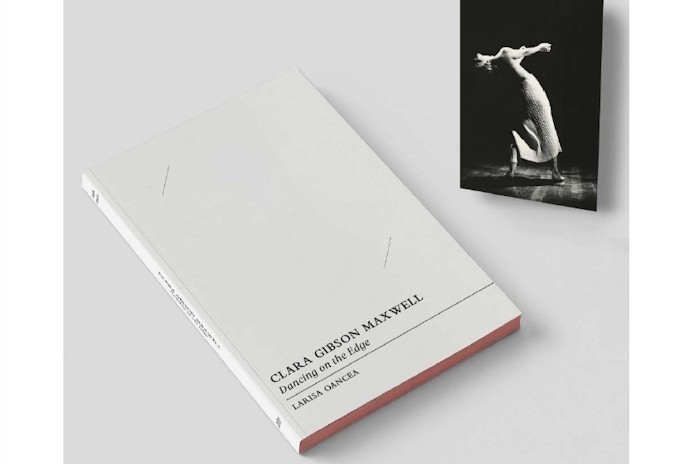
Despite being connected closely to dance over many decades, studying, performing, choreographing, writing, I had never previously come across the Paris-based American choreographer Clara Gibson Maxwell. It’s fair to say that she is not a household name. But not too many choreographers get books published about their work, so when Clara Gibson Maxwell: Dancing on the Edge by art historian and researcher, Larisa Oancea, came onto my radar, the interest was piqued.
Oancea’s monograph is based on extensive conversations she had with Maxwell and her partner, David Ames Curtis, as well as on her vast archive of personal notebooks and diaries, photographs, videos, reviews, interviews, news-paper clippings, statements, correspondence and other ephemera. Fortunately for dance historians, Maxwell had a habit of journaling and recording everything.
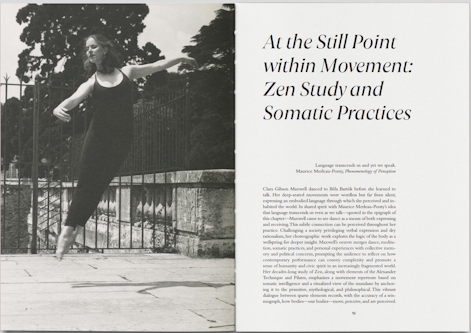
Photo left: Clara Gibson Maxwell rehearsing outdoors in 1987
Photo Clara Gibson Maxwell Archives, courtesy The Film Studio
A little research reveals that the book’s subtitle is very appropriate. While Maxwell’s career spans several decades, and her live and screendance work has been presented internationally, she is a choreographer who has largely avoided the mainstream.
Although rooted in American modern dance traditions, her work shifted away from its form and style, inspired as it was by myriad influences including experimental film, avant-garde music, architecture, philosophy, literature, Zen meditation and somatics. But in many ways, that all combines to make her rather interesting.
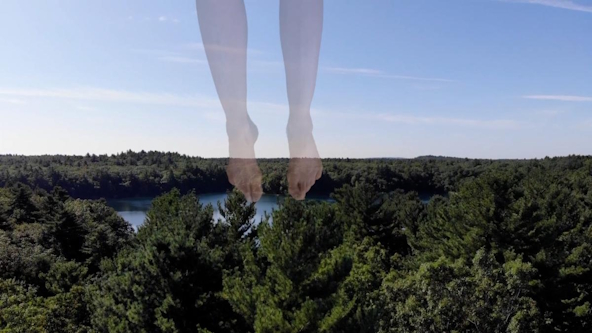
Photo Clara Gibson Maxwell Archive, courtesy The Film Gallery
In a ‘Statement of Purpose’ in 1987, Maxwell wrote that, “Dance is an expression of the social, political, moral, economic, and artistic climate of its time.” That is undoubtedly true. But to that should be added place and choreographer, both of which come through very clearly in the book, which references many of her works, although it is naturally her more emblematic inspirations and pieces that are to the fore.
Published by The Film Gallery, Clara Gibson Maxwell: Dancing on the Edge is not a linear biography or chronology. Rather, each chapter looks at aspects of her practice. In turn, they deal with Zen study and somatics, choreographing philosophy and literature, responding to site and architecture, and exploring movement through American composer Ornette Coleman’s notion of harmolodics, of which more anon.
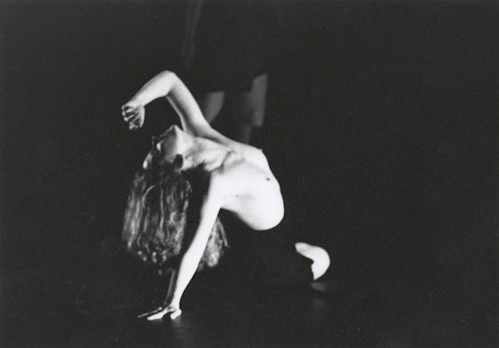
Photo Juan Hernansez, courtesy The Film Gallery
Moving onto choreographing philosophy and literature, Oancea tells how Ophélie Song (1989), Maxwell’s first major success, marked a significant moment in her career. She explains how, in a feminist reinterpretation of Shakespeare’s character from Hamlet, the work revolves around a central question that arose in pre-performance conversations with philosopher Cornelius Castoriadis: ‘What is it that Ophelia knows that no-one wants to hear?’ Oancea notes how the character is painted not as a passive victim, but rather a visionary figure, her madness “an expression of unpalatable lucidity.”
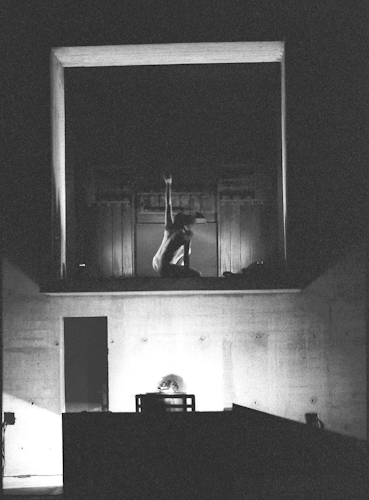
at Convent of Sainte Marie de La Tourette, 1998
Photo Pablo Perazlo, courtesy The Film Gallery
The reader learns of Maxwell’s reflections on the possibility of a unity of body, mind, and soul that came to a head in her trilogy of Cartesian Studies (1994), then La Cartésienne (1995) and Cartesian Women (1996), based on correspondence between Princess Elisabeth of Bohemia and the philosopher René Descartes. Oancea notes how, in her dialogue with literature and philosophy, their influence often goes beyond literal adaptation. “A quiet dissonance arises between bodily motion and the drift of thought, often veering towards geometrization and abstraction.”
Further connections of dance to philosophy come with Corps Eros (to Hesiod, 1997), a solo that typical of Maxwell was followed by a lengthy discussion with a anthropologists, artists, art critics, art historians, novelists, sociologists, and philosophers. Twenty years later, the choreographic/musical/video-projection/spoken-word creation, Thoreau’s Henhawk Visits Mexico (to Thoreau, 2017), demonstrated Maxwell’s increasing use of technology.
Moving on to Maxwell’s site-responsive choreography, the book includes discussions of Corpus (1998) at the Convent of Sainte Marie de La Tourette in Eveux-sur-Arbresle near Lyon and Banquet (2001) at Taliesin West, headquarters of the Frank Lloyd Wright Foundation, where she was resident artist and teacher for The Taliesin Fellowship.
Over many pages, Oancea traces Maxwell’s collaborations with pioneering jazz composer Ornette Coleman, who she first met in 1990. Their friendship led to her extension of his musical philosophy of harmolodics to her choreography, notably in Choros (1991-1995), which she rehearsed with Coleman in his Harlem studio.
According to quotation by Coleman in the book, harmolodics is “The use of the physical and mental of one’s own logic made into an expression of sound to bring about the musical sensation of unison executed by a single person or within a group. Harmony, melody, speed, rhythm, time and phrases all have equal position in the results that come from the spacing and placing of ideas.” I’m a long way from being sure I understand what that means in practice, though. In 2016, music writer Richard Williams commented that, “You knew it when you heard it: it was what made his music sound the way it did.” He did add, however, “But whenever interviewers asked him to explain it… the answer was so gnomic and cryptic as to be beyond normal comprehension.”
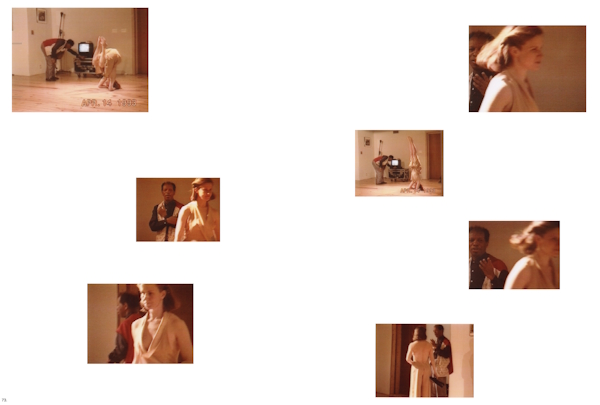
rehearsing Choros with Ornette Coleman, 1993
Photo Clara Gibson Maxwell Archives, courtesy The Film Gallery
So, like Maxwell’s creations, Oancea’s book interrogates multiple influences. Also like her work, it does succeed in encouraging a direct reaction from its audience, in this case, its readership. In the spirit of post-performance discussions, you do find yourself asking questions, even if you do not always discover the answers.
Clara Gibson Maxwell: Dancing on the Edge is liberally illustrated with 90 photos, many from her works, but also including a set of plates juxtaposing images from Maxwell’s own projects with associated illustrations from Western and non-Western art. Even so, and while the author examines each aspect of the choreographer’s work in depth with copious references to her creations, their background and inspirations, the book never really paints pictures of the pieces themselves. One gets very little idea of the movement, what it actually looked like, what it actually felt like. That’s hardly unknown in writing about dance, of course, but it feels especially acute here; something to do with knowing that Maxwell positioned herself away from the mainstream, I’m sure.
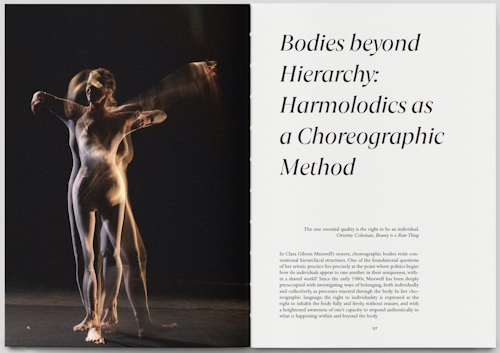
Photo left: Wei Gao Burgeoning Dancescape [Clara Gibson Maxwell], 2026
Photo Wei Gao, courtesy The Film Studio
Even the photos don’t help that much. And the book is liberally illustrated. Many of the photos are from Maxwell’s works, but they also include a set of plates juxtaposing images from her projects with associated illustrations from Western and non-Western art. But then it is only one of two pillars of the project to explore, document, and showcase the choreographer, the other being an exhibition at The Film Gallery in Paris, an important part of which was a multiscreen video installation of eight small-format monitors arranged according to an associative logic. To get a truly complete picture, I suspect seeing both is really needed.
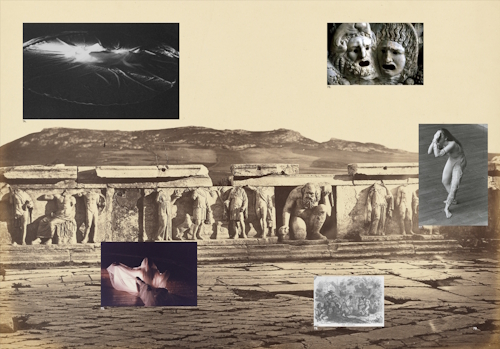
Photo courtesy The Film Gallery
The text is a challenging read. Ait comes close to the feel and academic tone of a doctoral thesis. Its natural home appears to be with university libraries or researchers rather than the coffee tables of most dance lovers. But perseverance pays off and there is something about the writing that makes you want to go on. Certainly, the deeper in one gets, the more one starts to understand Maxwell’s work, and indeed, the choreographer herself.
Away from her choreography, the book sent me scurrying away to learn more about Maxwell. In some ways, it’s a shame it doesn’t contain more of her life story, because there is most certainly a story to tell. Born in 1958, that her work is so transdisciplinary is perhaps no surprise given that she initially studied philosophy, dance, and film at Harvard from 1976 to 1979. Inspired by a masterclass given by Anna Sokolow, she left to pursue a dance career, a move that included her obtaining an MFA from the Juilliard School in 1984.
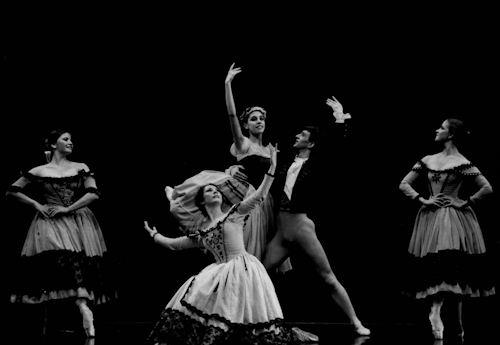
in Anthony Tudor’s Soirée Musicale, 1981
Photo Peter Schaaf, courtesy The Film Gallery
It has been noted elsewhere that she felt sidelined at Juilliard because she was seen as an intellectual. But even at Juilliard, she wanted to experiment. There is a story about her locking herself in her room with teacher Hanya Holm so that Holm, only allowed to teach theory so that the students didn’t pick up any of her more provocative movement ideas, could demonstrate her ideas.
It’s a massive generalisation, and the gap is not as wide as it once was, but American modern dance has always tended to be more overtly about technique, shape and form that has contemporary dance in Europe; especially at the conservatoires and vocational schools. So, it comes as no great surprise to find that France was where Maxwell found a home. She travelled, had various jobs, auditioned for companies including for Pina Bausch, who apparently rejected her for being too cheerful. Returning to Paris, she worked as a travelling circus clown and kick-line chorus girl, but also choreographed in smaller Paris dance venues. The city, the venue for the first success that was Ophélie Song, would become her permanent residence, her base from which all her subsequent creations grew.
Now to go and hunt out some more video.
For more on Clara Gibson Maxwell and her work, visit www.kaloskaisophos.org.
Clara Gibson Maxwell: Dancing on the Edge
by Larisa Oancea
Published by The Film Gallery, Paris
ISBN: 979-10-984405-0-2
Softback
176 pages
23 x 16.5 cm
€30