

Bayerische Staatsoper, Munich
March 8, 2026
When Bayerisches Staatsballet dancer Heinz Bosl died of leukaemia in 1975, aged just 28, German ballet lost a dancer of tremendous technique and sensitivity to roles. His standing at the time is demonstrated by Margot Fonteyn asking him to partner her on her 1973 and 1974 tours. Over fifty years later, his influence continues to live on through the Heinz Bosl-Stiftung (Foundation), which funds the Bayerisches Junior Ballet München (BJBM) and that helps recent graduates transition into successful professional careers.
The Heinz-Bosl-Stiftung matinées in Munich are very popular. They take place in spring and autumn, each season bringing two performances, presenting the BJBM and students from the Ballett-Akademie der Hochschule für Musik und Theater München. March 8 was one of the first warm days of Spring, the sort of day when people usually prefer outdoor activities, but the matinée filled the 2,101-seat opera house to the brim.
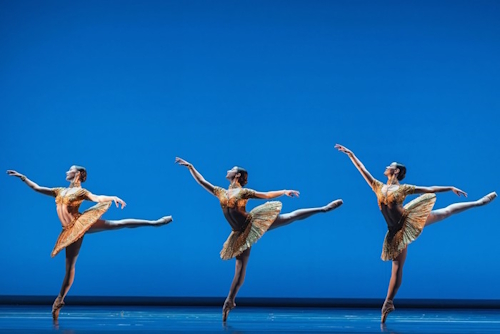
Photo Nicholas MacKay
The 2026 Spring programme opened with two pieces, each for three women from the BJBM. It was, as Ivan Liška, director of the company, said in an introductory speech, to honour International Women’s Day. But it was just as much a glimpse into the history of dance, preceding the four contemporary pieces that followed.
The first was an excerpt, Drei Odalisken (Three Odalisques) from Le Corsaire. The ballet premiered in Paris 1856 with choreography by Joseph Mazilier. Marius Petipa followed with his version in 1858. Based on the latter, Liška reconstructed the ballet for the Bayerisches Staatsballett in 2007. Olja Aleksić, Michaela Berinde and Vera Cortell danced the three odalisques or harem girls, who enchant the pasha. To Adolphe Adam’s music they showed off intricate footwork, fast battements and many small jumps.
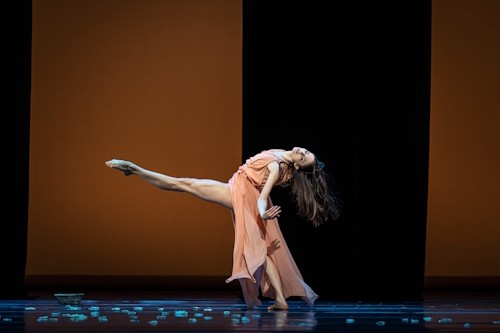
Photo Nicholas MacKay
They were followed by an homage to Isadora Duncan (1877-1927), one of the trailblazers of modern dance, noted for her performing barefoot and replacing the rigid corset with light, flowing Greek-like dresses. In 1902 she performed in Munich, causing a sensation and a scandal.
Danielle Beskur, Appoline Hartz and Rose Perrot appeared in Liška’s 3 Isadoras from 2021. Created in collaboration with the late Colleen Scott, Liška’s three short solos are based on choreographic material from Isadora Duncan and Frederick Ashton’s Five Brahms Waltzes in the Manner of Isadora Duncan from 1976. The three women swept over the stage in Duncan’s characteristic movements, running with high knee-up skips and swinging arms. The last solo is the famous one, in which the dancer spreads handfuls of petals on the floor.
in Waltzing Through Ballet by Lida Doumouliaka
Photo Nicholas MacKay
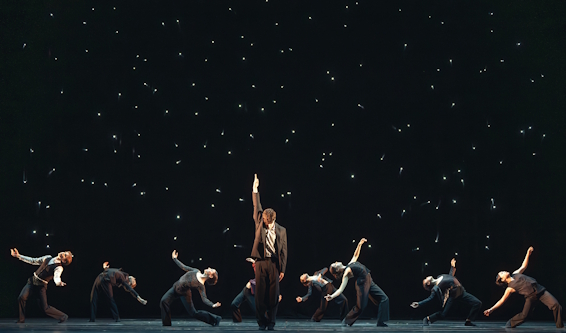
The Ballett-Akademie usually presents all their students aged 8-18, but at this matinée only the eldest were dancing. The first piece was a premiere, Waltzing Through,for twenty-three dancers to Ravel’s La Valse by Greek choreographer Lida Doumouliaka. It shifts between showing the perfect surface in a society and revealing the underlying conflicts.
Right from the beginning you feel ill at ease. Stars blink in a black sky, but are somehow too bright. They could also be drones surveilling the people below. The dancers, all clad in black pants and tops, walk in and start to waltz, first as individual couples, then in a circle as if dancing in a big ballroom, where everyone knows the rules. To me it brought associations to the grand balls that still take place in Vienna. But in between the very pleasing waltzing, couples pull and push each other. One man trips up another, who falls. A hand is raised as if firing a gun and some drop dead, only to rise again. It ends with the feeling of the dancers being in a close-knit community dissolved. They dance closely watching the screens of their iPhones, a cluster of single individuals.
in Framed Freedomby Craig Davidson
Photo Nicholas MacKay
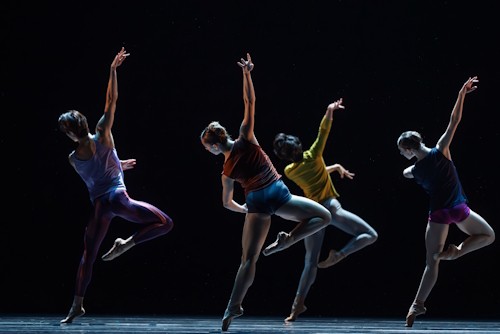
The following piece Framed Freedom by Australian choreographer Craig Davidson, premiered in February at the 10. Biennale Tanzausbildung (10th Dance Education Biennale) in Berlin, where twelve vocational dance schools from Germany and abroad each showed a work, attended workshops and exchanged ideas. In Framed Freedom, ten dancers form a group from which other groups evolve. The movements are based on ballet but with a different flow and dynamic.
The evening ended with the BJBM performing Marco Goecke’s Devil’s Kitchen, which he created for the company in 2025. To Pink Floyd songs, all sixteen dancers seem to be caught in a world of sex and drugs. There’s a lot of touching the genitals and scratching as if in need of shot. The jerky movements and the constant tension in their bodies, made them look like people hooked-up to an electrical current that was pulsing through them, and which they cannot escape. Neither in the light downstage nor when disappearing into a cloudy mist upstage. When Joe Bratko-Dickson stands alone at the end screaming silently, it felt like watching an elegy to loneliness and indescribable pain.
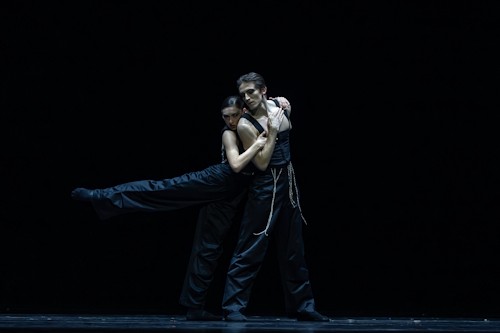
in Marco Goecke’s Devil’s Kitchen
Photo Nicholas MacKay
In Munich, dance is becoming increasingly popular and the level of proficiency has risen tremendously over the past years. When the Bayerisches Staatsballet performs at the opera house it is on average 98 percent sold out. Marco Goecke received part of his education at the Heinz-Bosl-Stiftung, and Violetta Keller, now principal with the Bayerisches Staatsballett, received her education at the Ballett-Akademie. This evening showed that the present crop of students at both the Ballett-Akademie and the BJBM are very strong dancers too, particularly in the modern repertoire.
To learn more about the Heinz Bosl-Stiftung and its work, click here.