
Sadler’s Wells East, London
April 27, 2026
There are performers whose biographies arrive before they do. Louise Lecavalier’s certainly does. La La La Human Steps. Édouard Lock. David Bowie. Frank Zappa. The Bolshoi. A body once described as having ‘legs of fire’.
Then she appears at Sadler’s Wells East in a long black coat, hoodie, metallic top and silver shoes. She runs a lap of the stage, turns her back to us, and sends the silver shoes flying with a cheeky backward kick.
The legend, it turns out, has excellent comic timing.
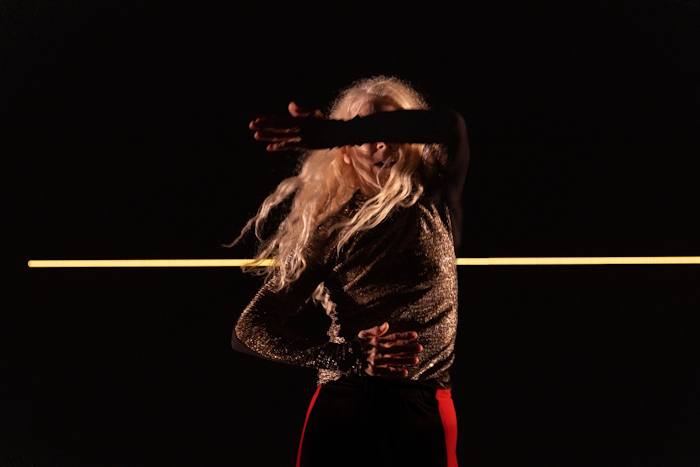
The radical past is there, and the body in front of us is busy making trouble in the present. At 67, Lecavalier gives us little chance to admire endurance from a respectful distance. She is closer to a live wire: playful, wiry, restless and disarmingly alive.
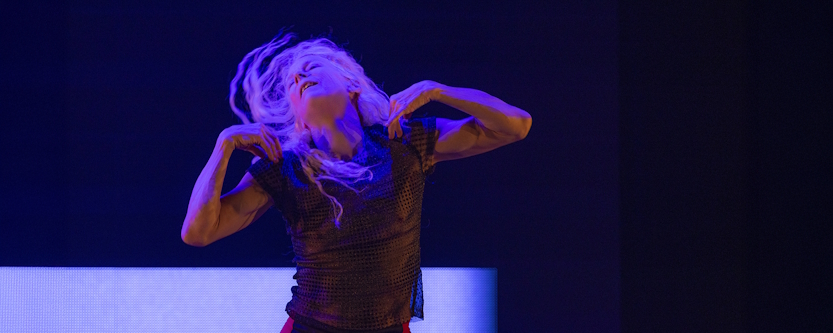
Photo André Cornellier
danses vagabondes, receiving its UK premiere as part of Sadler’s Wells’ Elixir Festival, takes its title and initial spark from Carlo Rovelli’s Écrits Vagabonds, a collection of essays in which he ponders the world around us, the passing of time and some of the great philosophical questions. In the post-show talk, Lecavalier says the book gave her a push rather than a programme. That feels important. The piece feels like wandering in motion: impulsive, rhythmic, restless, hard to pin down.
At the back of the stage is a square screen, pixelated and unstable. It begins in black and white, like the static of an old television with no signal, then shifts through colour, darkness, vibrating orange-red forms and insect-like patterns. Around Lecavalier, the lighting repeatedly draws lines, rectangles and borders. She seems to have wandered into an old television game, bouncing off the edges of a boxed electronic world, caught and released by the stage’s geometry. The frame becomes part of the game: something to hit, cross, disturb and bounce from.
Her movement is fast, compact and often upper-body driven, with quick footwork and turns keeping the energy constantly in motion. Arms cut and flicker; the torso pulses; small jolts travel through her as if sound is entering the nervous system directly. At times the piece has the atmosphere of a rave or late-night festival set, except the person commanding the room carries decades of dance history and still seems impatient with sitting politely inside any of it.
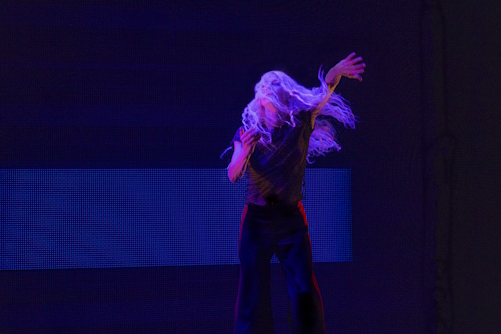
Photo André Cornellier
The surprise comes later: Lecavalier says the piece is 99 per cent choreographed. Ninety-nine. So, the rave has a map, and the twitch has a score. The woman who appears to be riding impulse is also following something exact enough to let her play. Even the pauses are chosen. She says she puts them in to absorb what has just happened and feel where she is going next. With a flash of pride, she adds that catching her breath is not the point.
Still, at 65 minutes, the solo sometimes stretches beyond its charge. The repetition of pulse, flicker and rebound occasionally keeps the party going after the idea has already made its entrance. The structure does not always find a new gear. Lecavalier remains compelling, even when the material circles longer than it quite needs.
She also keeps taking things off. The long black coat goes, then the hoodie, then the metallic top, until the body seems lighter and sharper. Transformation is available as a reading, of course. My first thought is simpler: this is what dancers do in class. You arrive wrapped in layers, get warm, then peel them away as the body starts to work.
That practicality is part of her charm. Lecavalier is never precious about herself. She can look mythic one moment and faintly mischievous the next. Her long blonde hair, lean frame and translucent upper layer could easily become an icon, yet she keeps puncturing any drift towards solemnity. This is a working body: muscular, rhythmic, funny, stubborn, alert.
Age is there, of course. The festival places it there, and a 67-year-old body doing a 65-minute solo is hardly a footnote. Lecavalier, though, has a nice way of dodging the heavy halo around it. In youth, she overtrained and over-rehearsed, as if one body could be bullied into more brilliance. Now she does less of that. She trusts more. The fire is still there; she has simply stopped throwing extra furniture into it.
By the end, I am unsure whether I have ‘understood’ danses vagabondes in any tidy sense. The piece seems uninterested in that kind of understanding. Its logic is closer to current than argument, closer to pulse than statement. Lecavalier does not explain the vagabond. She activates her.
What I do understand is the voltage. Watching her move through grids, beats, screens and borders, interpretation gives way to a far less sensible urge: to follow this woman somewhere louder, darker and more alive, preferably somewhere in Soho after midnight.