The Place, London
April 24, 2026
There is something wonderfully slippery about The Great Chevalier. Presented by the Ballet National Folklorique du Luxembourg, it arrives dressed in the language of heritage, institutional prestige and artistic grandeur. Yet, almost from the start, it becomes clear that the work is less concerned with confirming those structures than with gently, and often hilariously, pulling them apart.
Part of the pleasure lies in realising that the Ballet National Folklorique du Luxembourg itself is part of the fiction. The company, its history and its ceremonial weight are all presented with such confidence that they feel almost plausible. That plausibility matters. The work is not simply making fun of folklore or institutional language; it understands how such languages operate, how quickly a title, a biography, an archive or a ‘classic’ can begin to sound authoritative.
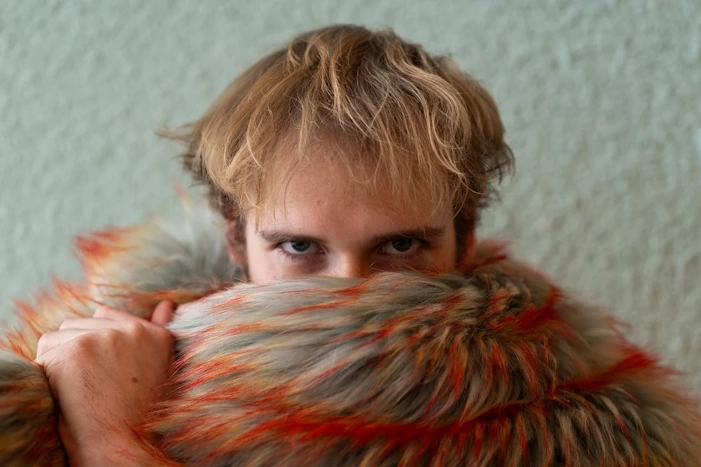
At its centre is Monsieur Chevalier, the flamboyant artistic director of the company, performed with delicious comic authority by Louis Chevalier. He is introduced as a figure of authority: an expert, a visionary, a guardian of tradition. But the more he speaks, poses and dances, the more that authority begins to wobble. The joke is clear enough: Chevalier is grand, theatrical, and determined to turn every tiny gesture into evidence of genius. But the longer the performance goes on, the more pointed the joke becomes, because such figures are not unfamiliar in the dance world.
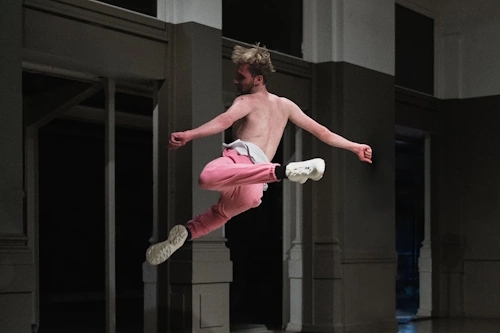
Photo Lara Andreolli
The premise is knowingly absurd, but the absurdity is shaped with real precision. Chevalier’s stage presence depends on a fine balance between control and collapse. He knows how to hold a room. A turn of the head, a pause before speaking, the exact angle of a hand: all are delivered with the seriousness of a grand maître presenting a sacred tradition. Yet the seriousness is constantly undercut by his own excess. His relationship with the audience hovers somewhere between seduction, provocation and comic play.
The work is driven as much by speech as by dance. Chevalier talks, explains, lectures and mythologises, drawing the audience into the scale of his own importance before allowing that mythology to fray. Dance enters almost as evidence: proof of tradition, proof of genius, proof of the authority he is so determined to perform. The famous ‘Pigeon Dance’, presented as one of the company’s emblematic classics, becomes a particularly effective example of this. What begins as a display of heritage gradually tips into something stranger, as folk dance, ballet and parody start to trip over one another. Every step seems to arrive with quotation marks around it.
The audience participation sharpens the satire further. At first, the invitation to join in appears generous, even inclusive. But it soon begins to feel like a comic exercise in collective agreement, with Chevalier turning communal dance into another demonstration of his authority. That is what makes the sequence so funny, and so recognisable. Anyone who has spent time in dance training or rehearsal culture will know the tone: the grand language of tradition, discipline and artistic necessity, delivered with such conviction that questioning it can feel almost improper.
That is also why the joke lands. It is not only laughing at one exaggerated persona, but at the structures that make such a persona possible. Chevalier is wildly exaggerated, but recognisable enough to make the satire bite: the charismatic director, the self-mythologising auteur, the institutional representative who speaks of legacy while carefully curating his own mythology.
Simone Mousset’s presence sharpens this further. Positioned mostly downstage right, she remains on stage as executive director, host and indispensable assistant, quietly keeping Chevalier’s world in motion. She welcomes the audience and introduces him, but as the evening unfolds, she also becomes the person who manages his excesses and helps sustain the performance of authority around him. Her performance is funny because it is so credible: part loyal supporter, part facilitator, part silent witness to the system’s absurdity.
The scenography by Mélanie Planchard, in collaboration with Mousset and Lewys Holt, keeps the focus firmly on performance as construction. Nothing feels overburdened. The space allows Chevalier’s body, voice and persona to do the necessary work. Maurizio Spiridigliozzi’s historical music adds to the sense of invented ceremony, evoking the weight of tradition while also making us question how easily that weight can be staged.
Even when the piece lingers over a joke, Chevalier’s timing keeps the humour alive. Repetition becomes part of the game: each return to the same inflated gesture or ceremonial phrase adds another layer to the performance’s comic authority. His ability to stretch a moment just to the edge of awkwardness, then puncture it with a shift of tone or physical detail, keeps the evening alive.
What makes the evening work is that it does not ask us to choose between thinking and laughing. The Great Chevalier is funny, but never careless. It is theatrical, but not empty. Beneath its flamboyance lies a thoughtful critique of cultural performance: of how nations, companies and artists package themselves for consumption; of how folklore can be both cherished and invented; of how charisma can become a form of choreography in itself.
In the end, The Great Chevalier is less a tribute to tradition than a mischievous examination of how tradition is staged. It invites us to laugh, but also to notice what we are laughing at. Behind the sunglasses, the poses and the grandiloquent speeches, there is a sharp little piece about how easily artistic authority can be performed into existence.
The Great Chevalier can be seen from August 6-29 at the 2026 Edinburgh Festival Fringe, when it is on at Summerhall.