
Theaterhaus, Stuttgart
March 5, 2026
With their latest program, Radical Classical, Gauthier Dance Juniors took the audience on a rollercoaster of sheer fun, erotic display and a quiet moment of reflection in a programme of seven short pieces by seven contemporary choreographers all set to classical music.
And the evening was as much about the music as the dance. Each piece was introduced with a short film in which musicians and a violin maker talked about the music. The reason for this, Eric Gauthier explained in another short film, is that young people do not listen to classical music unless they are brought up with it, which is a shame because it is so expressive and full of emotions. That was the reason, why he let music 100 years and older be brought to life by the ensemble’s eight talented and fabulous dancers, aged 22 to 23.
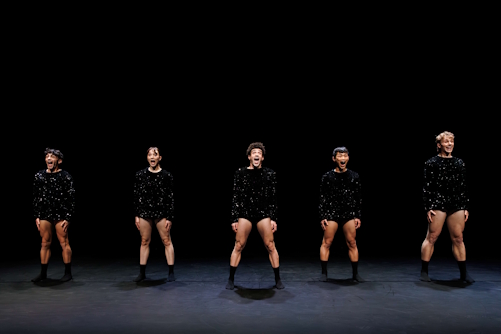
Photo Jeanette Bak
The evening opened and closed with two humorous pieces, starting with German choreographer Andreas Heise’s Frühlingsstimmen (2025) to Johann Strauss II’s score of the same title from 1883. Seven dancers, clad in black shorts and long-sleeved T-shirts full of glittering sparkles, at times undulated with bird-like movements, did funny body rolls or turned as if moved by an external force. They looked like big, black, happy birds having fun.
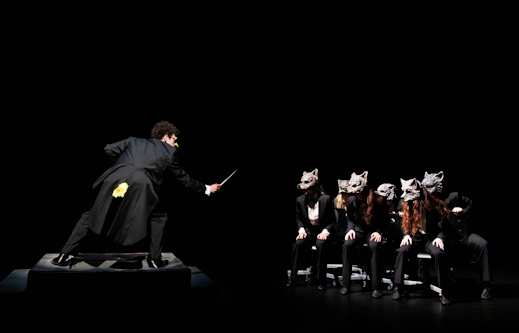
Photo Jeanette Bak
The last piece was company director Eric Gauthier’s hilarious Orchestra of the Wolves (2009) to Ludwig van Beethoven’s Fifth Symphony (1804). Giuseppe Iodice, dressed in tail-coat and wearing a duck’s mask and tail, conducted six dancers in wolf masks, the ‘musicians.’ At the beginning it is very amicable, but slowly the wolf-pack becomes more aggressive, circling in on the conductor. For a while he manages to keep them at bay with authority and his baton, but eventually the pack devours him, yellow feathers flying.
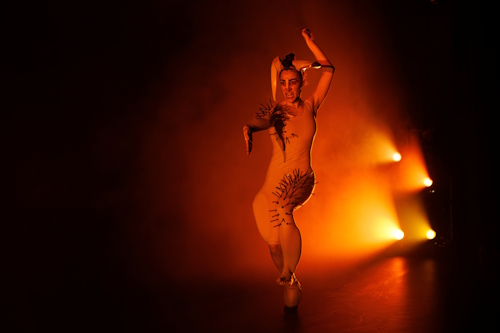
Photo Jeanette Bak
Two of the pieces had strong sexual connotations. Marie Chouinard’s Prélude à l’après-midi d’un faune (1994) to Claude Debussy’s music from 1894, references Vaslav Nijinsky’s famous ballet from 1912 in the movement. But Chouinard takes the ballet several steps further. In a misty glade, a Carolina Fernandes enters clad in a nude-coloured unitard, horns on her head. But there is nothing romantic about her. One thigh is swollen. From the other thigh, and from her opposite shoulder and upper arm, protrude what look like ten-centimentre long nails, which touched other parts of her body every time she squatted. It looked quite scary. At one point she takes off her horns, attaching one to her crotch like an erected penis. She copulates a row of square light columns, before finally relieving herself on the floor. At the end, the audience was quiet for quite a few moments before their applause broke loose.
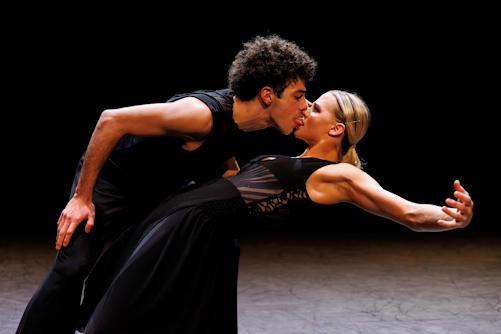
Photo Jeanette Bak
The second was a duet from Aszure Barton’s Lascilo Perdere (2005) to Antonio Vivaldi’s Cum dederit from 1704. Giuseppe Iodice sits on a chair at the side of the stage. Ashton Benn enters. She walks towards him. He stretches out his tongue. They engage in a French kiss, that lasts for their almost five minutes long duet. When they finally part, they are still connected by a thin thread of saliva glittering in the light.
Two pieces were new-ish versions of iconic ballets. Ohad Naharin’s B/olero, (2008), to Maurice Ravel’s score from 1928 arranged by Isao Tomitas, is a duet. At some of the repetitive beats, Ashton Benn and Naia Dobrota just circle their lower arm, then take off in jumps and run across the stage, Dobrota following Benn, who has a strong stage presence making her appearance and movements look much larger than they are. The piece surprisingly, ends quietly, the original crescendo replaced by a diminuendo.
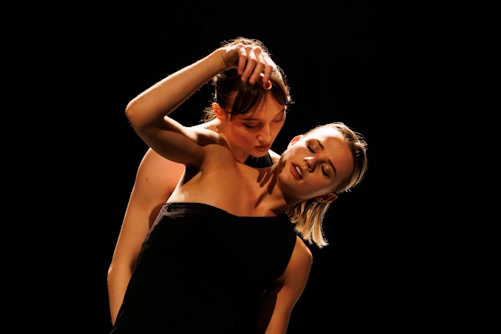
Photo Jeanette Bak
Italian choreographer, Mauro de Candia’s La morte del Cigno (2009) to Camille Saint-Saëns’ Le Cygne 1886, was danced by Rong Chang. Apart from the title, it has nothing to do with Pavlova’s Dying Swan. In nude-coloured shorts and looking completely naked, Chang writhed on the floor in a spotlight. At times, you could count his ribs. Impressive was the way he was fully into himself, although the movement only occasionally resembled the beat of a swan’s wings.
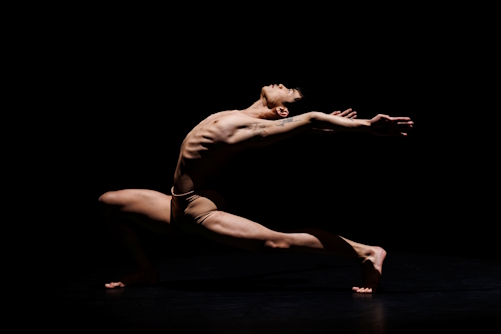
Photo Jeanette Bak
Completing the line-up, long-time choreographer-in-residence, Marco Goecke, created a new piece for the programme. FURIA (für Gudrun) is a homage to Gudrun Schretzmeier, co-founder of Theaterhaus Stuttgart, Gauthier Dance’s home theatre, and costume designer, who died in 2025. A duet to Marin Marais and Arcangelo Corelli’s Folia Variations from 1700, it was danced by Mathilde Roberge and Atticus Dobbie. It’s full of the familiar jerky and angular Goecke movement but, at the same time, is intimate and tender. Roberge and Dobbie looked at and caressed each other, parting only to reunite in another affectionate gesture. The piece ends with Dobbie alone, his partner having disappeared.
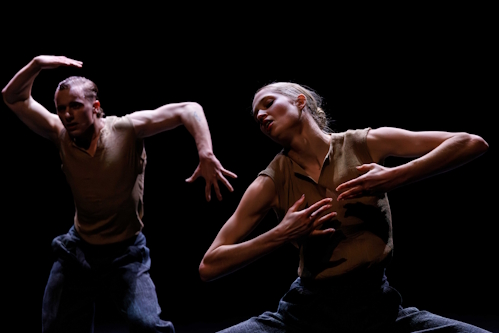
Photo Jeanette Bak
Radical Classical was a superb evening. Even though some of the works were old, they still felt surprisingly new and provoking, due in no small part to the eight gorgeous dancers of Gauthier Juniors, who mastered all the different styles with ease. Each piece was quite rightly received with roaring applause.