Metropolitan Hall, Taipei
April 5, 2026
This year’s annual performance by the Dance Department of the University of Taipei (臺北市立大學舞蹈學系), Body: Following the Light (身‧循光), featured choreographies by faculty members, plus a guest appearance by dancers from Sungkyunkwan University in Seoul. It closed with a tribute to Tsai Li-hua (蔡麗華), who passed away in January this year, and a restaging of an excerpt from her Dream World (菩提), made in 2000.
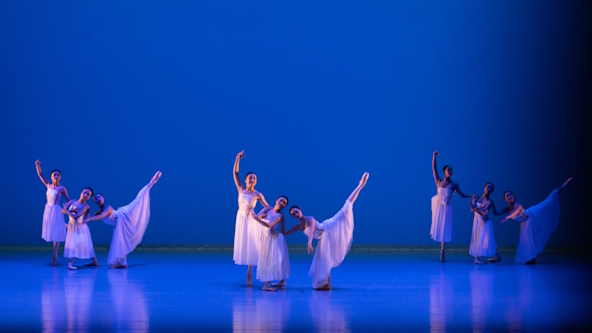
Photo Chen Yu-han
University performances in Taiwan invariably seem to begin with classical ballet and Ode (詠歌) by Lin Wei-hua (林惟華), danced to Mozart’s Clarinet Concerto in A Major, got things off to a fine start. Lin’s choreography is gently elegant and well-structured with ever-changing groupings. It all fits the music like a glove. With the dancers in white against a classic blue backdrop, it looked a picture too. There were a few uncertain moments individually, but it’s a very pleasing creation and made a fine start.
The Evolvement of Qi (炁衍) by Lai Tzu-yi (賴姿伊) gets off to a mystical start, a feeling helped by the haunting sound of [instrument] in the music. An exploration of the interplay yin and yang, it’s a beguiling dance, the highlight being a male-female duet featured some excellent partnering, the many lifts all flowing very naturally.
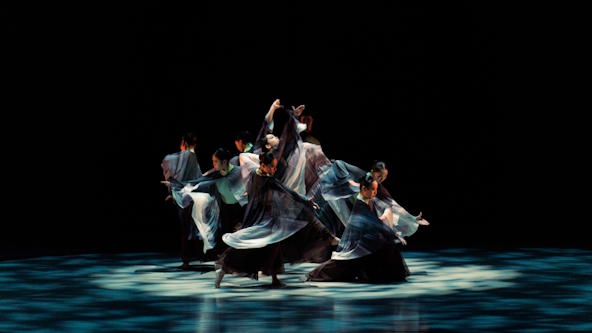
Photo Chen Yu-han
Rhythms of the World, Written in the Body (世界的節奏,書寫於身體之中) was co-created by Kim Na-ye, Tung I-fen (董怡芬) and the dancers of Sungkyunkwan University. A presentation of the ChoreoLab Project, which is grounded in international exchange and emphasises cross-cultural dialogue, it views culture as a living, breathing thing rather than something identifiable by external symbols. As the dancers bring their diverse training backgrounds and life experiences to the stage, they collide (quite literally) and interweave as they meet, before generating new relationship.
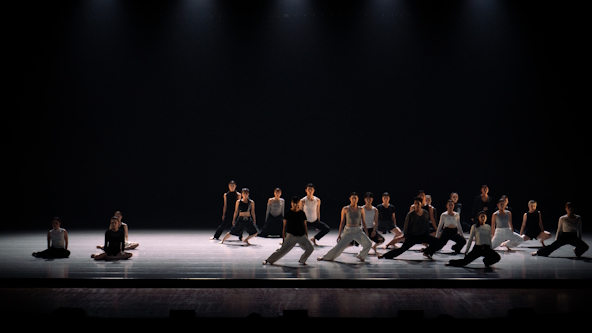
by Kim Na-ye, Tung I-fen and dancers of Sungkyunkwan University.
Photo Chen Yu-han
The opening immediately gives off a very urban vibe. There’s very much an air of the street. A lot happens simultaneously with many numerous direct encounters, small group and duet moments. Dancers eye each other tentatively, sometimes seeking to avoid one another. When they do meet head on, usually deliberately it feels, there’s lots of pushing and aggression. Evidence of support for each other does come in a falling and catching section, however. It comes even more together towards the end, a sign of hope that coexistence is possible in spite of difference.
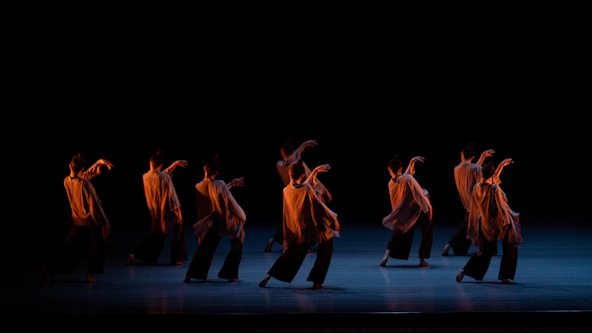
Photo Chen Yu-han
Wei Xun II (唯醺II) by Hsiao Chun-ling (蕭君玲) features the cast in playful mood. The rather appealing choreography makes the dancers look almost tipsy. Bodies are incredibly fluid, often moving as if their owners have lost control over them. But while the form-breaking movement may have looked loose, it was very smartly controlled, as evidenced by the wonderful synchronicity in the unison moments.
Hsiao explains that the work has its roots in the context of the Chin Dynasty, when political corruption left upright scholars with little opportunity to contribute to society. Many chose to withdraw from official life, retreating to the mountains where they drank, wrote poetry, and engaged in philosophical debate. The meaning has evolved over time however, it now representing the courage to be different from the mainstream and to remain true to oneself; a sentiment that resonates across both ancient and contemporary contexts.
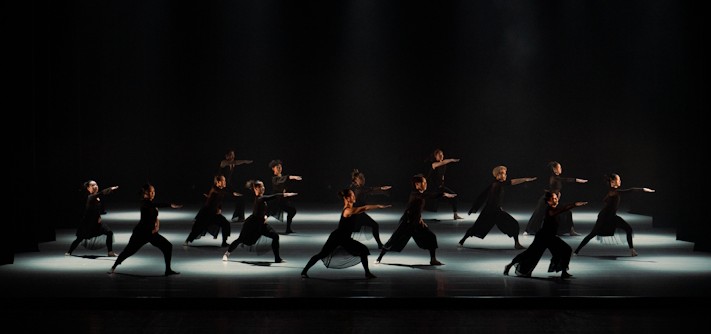
Photo Chen Yu-han
Flow of Energy (能量流) by Ruping Wang (王如萍) weaves a dance of dynamism in which many moments are fleeting and ephemeral but that, as a whole, come together very coherently. While clearly being repeatedly sparked into life by spoken instructions or counts, the dancers equally seem driven by some sort of metaphysical energy.
It all matches the minimalist, rigorous electronica of two tracks from Ryoji Ikeda’s dataplex album surprisingly well, and that comes in after a snatch of Bach’s Goldberg Variations. Indeed, it’s remarkable how the art-techno concoction of bleeps, scratches and percussive effects come together to make a very effective accompaniment for dance, especially the second ‘Data.Reflex’ track that almost seems to have a rhythmic pattern through it. The dance too increasingly takes on a sort of order as lines and circles of performers appear out of what could easily be mistaken for chaos.
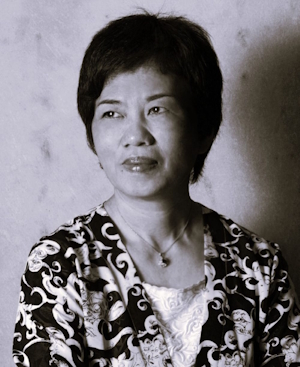
So, to the much-loved Tsai Li-hua, who served as Head of the Department of Dance at Taipei University from 2002 to 2008, although she continued to support and encourage talented students for some time after stepping down. Indeed, she devoted her entire life to nurturing Taiwanese dance talent, being formally recognised for that in 2025 when awarded the Lifetime Achievement Award for Contributions to Arts Education by the Ministry of Education.
She will also be particularly remembered for her study of Taiwanese folk dance and folk art groups. She made a point of visiting troupes in person, learning their dance and culture, and inviting them pass their knowledge on to students and the next generation of dancers. In doing so, she helped ensure that dance is a living, breathing art form that connects land, culture and people across generations.
In 1988, Tsai founded the Taipei Folk Dance Troupe (台北民族舞蹈團), Taiwan’s first professional folk dance ensemble, her choreography establishing what has been called a ‘new folk dance style.’ She also established Taiwan’s first professional dance publication, Taiwan Dance Magazine, which sadly ceased publication some time ago.
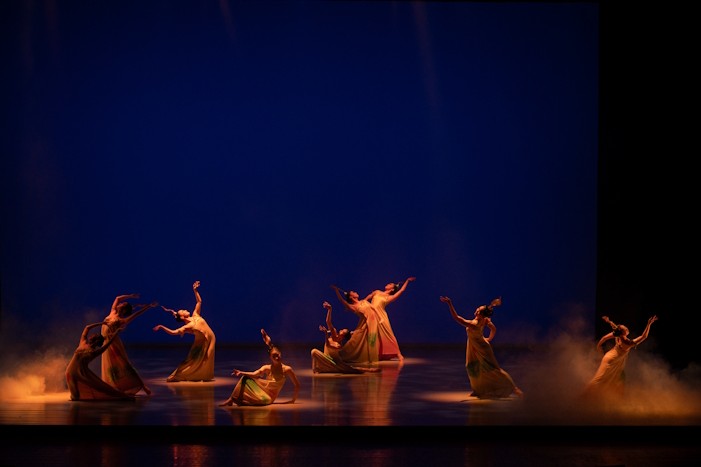
Staged with the assistance of dancers from the Taipei Folk Dance Troupe, and set to music by Gerald Shih (史擷詠), a prolific composer for film, dance and theatre, now also deceased, the Lotus Dance from her Dream World provided a calming end to the evening.
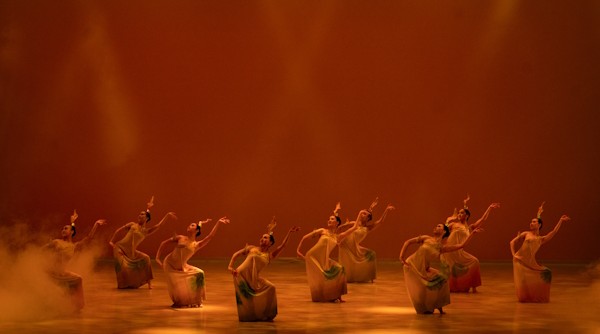
Photo Chen Yu-han
The choreography is serene and graceful. In their gorgeous long white dresses, each adorned with a large pink lotus flower and leaves, the nine dancers appeared to float effortlessly around the stage. They looked like a heavenly vision, there being something almost spiritual about it all.