

Sadler’s Wells, London
April 23, 2026
Carlos Acosta’s Don Quixote is a riot of colour and sound from the first step to the last. Birmingham Royal Ballet’s production exudes sumptuous gaiety, romance and a great deal of fun, offering an evening of high-spirited entertainment driven by technical brilliance, comic charm and a score that seems to laugh from the pit.
There have been so many variations on Cervantes’ story that it is sometimes difficult to remember where the original literary figure ends and the ballet tradition begins. Acosta’s version focuses less on Don Quixote himself and more on the love affair between Kitri and Basilio. The plot follows the young lovers as they try to persuade Kitri’s father, Lorenzo, to allow them to marry, despite his determination to see his daughter wed to the wealthy nobleman Gamache. After three acts of schemes, disguises, interventions and romantic persistence, Basilio’s trick finally wins Lorenzo over. By the time the deception is revealed, it is too late: the lovers have his blessing, and the ballet concludes in a celebratory wedding feast.

Photo Tristram Kenton
Don Quixote himself plays a curiously minor role. At times, one can almost forget that it is meant to be his story. The scene is set in the prologue, the quixotic elderly Spanish nobleman, imagining himself a knight errant riding out to right wrongs in pursuit of his idealised Dulcinea. He is present throughout the ballet, but as a very minor presence, his function largely dramatic rather than choreographic. With effectively no dancing of his own, he is inevitably sidelined. He becomes less the centre of the evening than a wandering observer who happens upon the events surrounding Kitri and Basilio, involving himself here and there, and gently helping to steer Kitri’s father towards accepting their love.
If there is a weakness in the production, that imbalance is it. Acosta’s choreography is a splendid mixture of virtuosity, theatrical comedy and romantic warmth, but the title character does feel a bit like an adjunct to the action rather than its driving force. He’s far from alone in taking that approach although, personally, I would have liked the ballet to be more meaningfully about Don Quixote, rather than using him as a framing figure for the far more vivid adventures of Kitri and Basilio.
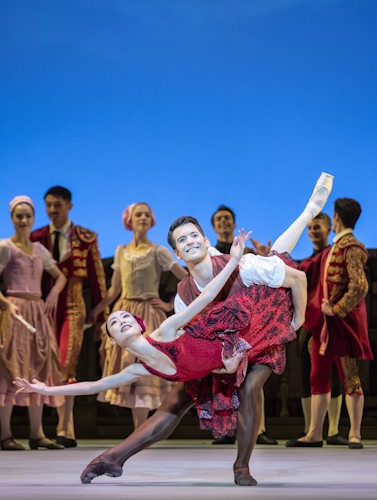
in Carlos Acosta’s Don Quixote
Photo Johan Persson
But what adventures they are.
As Kitri, Momoko Hirata is magnificent. It is a challenging, energetic and feisty role, and Hirata does it justice and more. She is wonderfully virtuosic, spinning, jumping and holding the stage with complete authority. Yet this is not merely a display of technique. She brings dramatic force, wit and brightness to the role, making Kitri both a ballerina showcase and a living, breathing comic heroine. Her dancing has brilliance, but also personality.
Mathias Dingman’s Basilio does not quite match Hirata’s command at every moment, but his performance is nevertheless one of real excellence. There were one or two slight wobbles, swiftly recovered, but his dancing remained engaging, technically impressive and dramatically alive. He gives Basilio charm, athleticism and warmth, and the partnership with Hirata carries the romantic heart of the evening.
Tzu-Chao Chou deserves particular commendation as Amour. Light-footed, buoyant and full of playful character, he seems to soar into the air, landing with remarkable softness. His performance appears effortless, and he embellishes the role with a cheeky sense of fun that lifts the stage whenever he appears.
There is an interesting quality to the way the principal dancers and first artists perform in this production. Many of the dances have the feel of brilliant standalone vignettes: technically excellent, full of flair and verve, and often thrilling in themselves. Yet they can also seem only loosely connected to the wider context of Don Quixote’s own journey. The performers are vivid; the choreography dazzles; but the dramatic relationship between the ballet’s title and its action does not always fully cohere.

in Birmingham Royal Ballet’s Don Quixote
Photo Johan Persson
The ensemble dance with spirit and purpose, giving Acosta’s choreography the sense of fun it demands. At times, complete unity of rhythm and timing went a little astray. This did not seriously diminish the pleasure of the evening, but in a production so dependent on momentum, crowd energy and Spanish-flavoured exuberance, such moments of looseness are noticeable.
The music is one of the evening’s great pleasures. Ludwig Minkus’s original score, arranged for this production by Hans Vercauteren, draws the audience in from the first note. It is full of gaiety, laughter, warmth and sheer theatrical musicality. The Royal Ballet Sinfonia, conducted by Paul Murphy, gives it a wonderfully lively performance, richly deserving the ovation it received at the end of the evening.
Visually, the production is sumptuous. Tim Hatley’s costumes and sets create a world of warmth, brightness and colour, while Peter Mumford’s lighting perfectly matches the mood of the ballet. The stage seems filled with Spanish sunshine: light, golden, romantic, and full of long days turning into lazy, love-filled evenings.

Photo Tristram Kenton
Acosta first created a version of Don Quixote for The Royal Ballet in 2013, while still dancing with the company. In 2022, two years into his tenure as director of Birmingham Royal Ballet, he created this new production for BRB. Designed specifically for touring, it works a treat. Acosta has described Don Quixote as a ballet for virtuosos, the kind of ballet dancers aspire to perform in order to prove themselves at the very pinnacle of the art. Watching this production, it is easy to see why. It demands flair, stamina, character and technical ability of the highest order.
It is a long ballet. With a prologue and three acts, including two scenes in both Acts II and III, the performance runs to around two hours and forty-five minutes including intervals. While it remains enjoyable from start to finish, some scenes, notably the Dryads sequence, could have been significantly shortened without harming the production. For an evening of this length, a 7pm start would also be welcome.
Still, these reservations do not overshadow the achievement. Carlos Acosta, Birmingham Royal Ballet and the Royal Ballet Sinfonia have created an exciting, engaging, romantic and fun-filled evening of virtuoso dancing. The choreography is inventive, the music is performed with real life and lyricism, the principal performances are deeply engaging, and the production as a whole radiates colour, warmth and pleasure.
Don Quixote himself might not be quite the heart of Don Quixote, but as an evening of ballet, spectacle and joyous entertainment, it is not to be missed.