

Coronet Theatre, London
March 14, 2026
Taiwanese company Hung Dance (翃舞製作) brought Push and Pull (推拉), choreographed by artistic director Lai Hung-chung (賴翃中), to the Coronet Theatre. With its slightly eccentric and slightly worn atmosphere, the venue feels oddly suited to a work about one of humanity’s most persistent fascinations: relationships.
A particular kind of relationship stands at the centre of the work. Over forty-five minutes the stage repeatedly presents a pattern in which a man observes, handles and directs a woman’s body.
The performance opens with an unsettling image. A box-like structure stands centre stage, somewhere between a piece of furniture and a coffin. Inside it a woman moves, the structure rocking and producing dull sounds. A man approaches and begins knocking on the box. The sound grows louder and louder. Very quickly it becomes unpleasant. The rhythm carries a sense of insistence, as if something inside must be forced to reveal itself. Eventually he dismantles the structure layer by layer, exposing the woman from its innermost compartment. The moment has the faint atmosphere of a horror film, difficult not to read as the release of some strange creature.
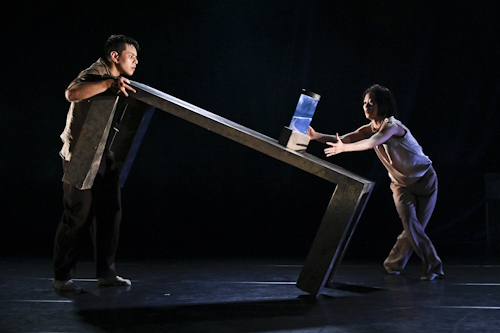
Photo Liu Ren-haur
The woman retreats under a table like a frightened cat, clutching one of its legs. The man pushes the table and drags her and the furniture across the stage. From this moment the physical grammar of the work becomes clear. Much of what follows consists of technically intricate partnering sequences: pulling, rotating, lifting, dragging, rolling. The woman’s body is repeatedly picked up, repositioned and set down, almost as if it were an object to be examined or tested. At times she resembles a doll being manipulated.
Sitting in the audience, the ethical structure presented on stage becomes increasingly uncomfortable. I find myself asking a simple question: Are we like this? Have we become so used to this structure that we have begun to accept it as normal?
There is no denying the extraordinary technique of the performers, Lu Ying-chieh (盧瀅潔) and Lee Kuan-ling (李冠霖), or the ingenuity of Lai Hung-chung’s partnering. Yet the thoughts that arise while watching are not always about beauty. One wonders how shoulders and elbows withstand the repeated pulling and twisting, whether the spine and neck remain safe through the constant turning and dragging. The female body carries the choreography and absorbs a violence that arrives dressed as partnership. The energy accumulating on stage carries a restless quality, tinged with control and a certain male self-absorption.

Photo Franco Wang
Only two days earlier, at Sadler’s Wells, Tiler Peck and Roman Mejia offered a very different image of partnership. Their duet moved through weight sharing and musical sensitivity, the two dancers seeming to breathe together. In Push and Pull, the duets feel closer to a repeated handling of a female body. Dragging, swinging, leg rotations and rolling movements appear again and again. At times the woman is flung outward and slides repeatedly across the floor, creating the odd impression that the stage has turned into an ice rink. Particularly striking are the moments when the man grips her hand, stands as the centre of a circle and sends her body outward in a low arc close to the ground. The image inevitably recalls the death spiral in ice dance. The elegant harmony associated with that move disappears here, leaving the mechanics of control fully visible.
At one moment the woman’s arm trembles against the floor like a fish taken out of water. The image is brief but piercing, a body struggling to recover its breath.
Another sequence shows the woman repeatedly pushing the man aside as if he were a door. Sound and shifting light suggest an attempt to find an exit, a possible way out. When she pushes this “door” open again, the lighting suddenly floods the auditorium and she turns towards the audience. Unfortunately, she only looks in our direction. She does not actually see us.
Later sections allow the woman brief moments of initiative. She pulls the man, pushes him, attempts to redirect the movement. These moments remain short lived. The choreography quickly returns to its cycle of pushing, pulling, lifting and dragging, placing the woman once again in the position of being handled and observed.
In the final image the woman leaves the stage. The man remains and extinguishes the light. The gesture feels appropriate and leaves behind a faint chill.
Push and Pull speaks of the push and pull within relationships, of giving and receiving. What remains visible on stage, however, is a long and unmistakable imbalance.