Shulin Arts Center, Taiwan
April 24, 2026
The Play with Ballet Showcase (玩芭蕾 Showcase) staged by Taipei Capital Ballet (台北首督芭蕾舞團) provides a platform for choreographers to experiment with style and vocabulary. As they do so, the hope is that new possibilities for ballet in Taiwan and new choreographers might emerge. The event is also a time for dialogue and exchange, between artists and with audiences.
The eight pieces that made up the 2026 programme comprised four by emerging choreographers selected from the many submissions received in this year’s open call for entries, and four by more experienced dance creators. While some works were more successful than others, the result was an evening full of interest and variety. Also very pleasing was that six of the ballets had the women on pointe. So often in evenings like this, sightings of pointe shoes can be very rare indeed.
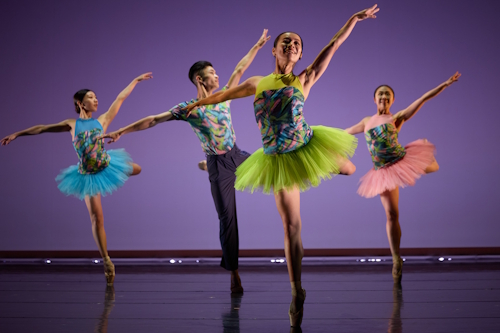
(l-r: Weng Pei-shan, Tseng Kuan-wei, Chen Ting-yu, Jian Hui-ling
Photo Oraku Hiko
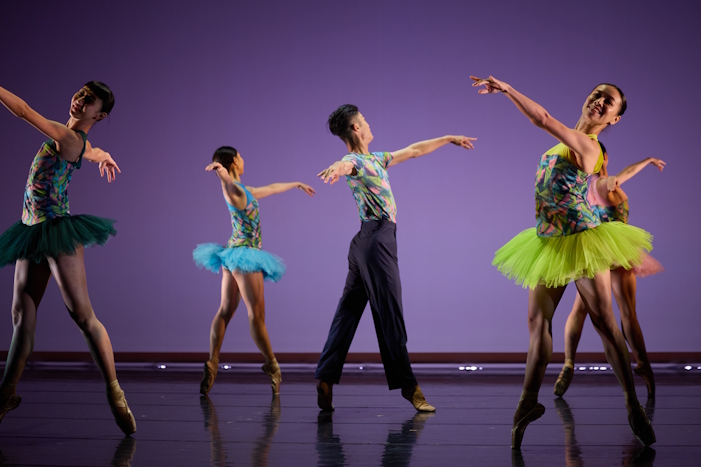
Without doubt, the most accomplished work was Unseen, which closed the evening. Created by Etienne Ferrère, a Hong Kong-based French national and former principal dancer with the Singapore Ballet, the title comes from the idea that a lot of the things we value the most are the things that we cannot see: emotions, feelings, memories and the like. All that is brought out through extremely pleasing choreography that, while classical through and through, is as full of tone and colour as the Michael Torke music to which it is performed.
While the music has a lot of repetitive rhythms and harmonies, the dance constantly paints new and interesting pictures. Performed by members of Taipei Capital Ballet, even the opening seconds, four dancers in short tutus standing in shadows, has impact. Thereafter there is a fine floaty solo by Weng Pei-shan (翁佩珊) in blue. A duet for two of the other women, Zhang Zi-yu (張滋育) in dark green and Jian Hui-ling (簡惠聆) in pink is full of energy.
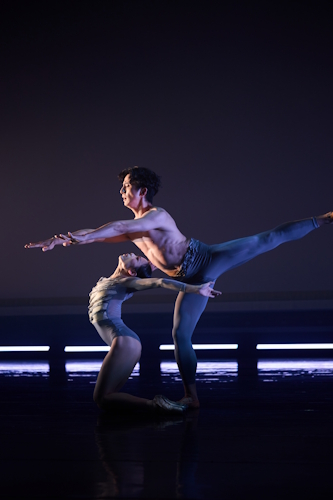
Photo Oraku Hiko
There’s a fine solo for Tseng Kuan-wei (曾冠偉) that includes numerous leaps and turns, all performed with lightness and precision, and while making eye contact with the audience. That connection is so important. Tseng later dances a subtle pas de deux with Chien Hsiang-ting (簡湘庭) in light green. Also excellent was Chen Ting-yu (陳亭妤) in yellow. It was all very well danced and very neatly structured indeed.
For Hold the Void (永別之間, literally ‘Between Farewells’), former principal dancer with the Béjart Ballet Lausanne, Sun Jia-yong (孫佳勇), took inspiration from the tale of Orpheus and Eurydice. We meet the couple as they make their way out of Hades. Sun’s twist is that it was her who made him look back as she realised what he truly couldn’t bear wasn’t losing her again.
The slow, beautiful opening walk, Jian Xiang-ting (簡湘庭) following Sun himself as Orpheus, is followed by duet that is a dance of letting go. Both dancers packed it with feeling as their characters found themselves at a final farewell.
Scarlet Rose by Lu Hsin-yi (呂馨怡), formerly a dancer with MiR Dance Company in Gelsenkirchen, Germany, is a four-part work about relationships.
The first, to Tempus Fugit by Francesco D’Andrea, projects the image of Tseng Kuan-wei seduced by the allure of four female figures, and includes a fine solo by him. The second, to a reworking of Prokofiev’s Dance of the Knights from Romeo and Juliet sees him partner three women. There is a lot of coming and going, the choreography never quite reaching the heights of the score. Section three, to Zymphonica’s ‘Shout Down’ sees two women dance with red fans as Lu tries to show the relationship between them, before the final scene, to Garbriel Saban’s ‘A Different Theory’ attempts to bring it all together.
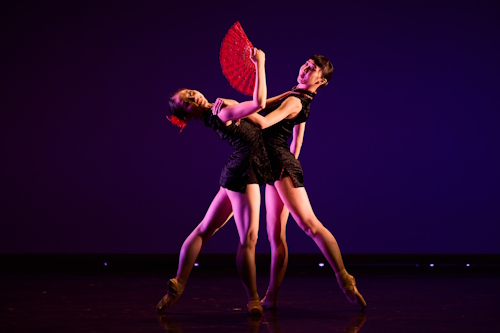
Photo Oraku Hiko
Four dances, four musical styles. Too much? Maybe, especially in such a short space of time. Certainly, both musically and choreographically, the ballet’s disparate parts struggled to gel.
Evan Chan (詹翔宇) showed so much choreographic potential during previous editions of Play with Ballet that this year he was invited to return. His Object Tale (物語) alludes to the fact we all wear masks to some extent in real life. Taking them off allows things to be revealed, including inner emotions. A dance of many metaphors, Object Tale asks what is one’s real face.
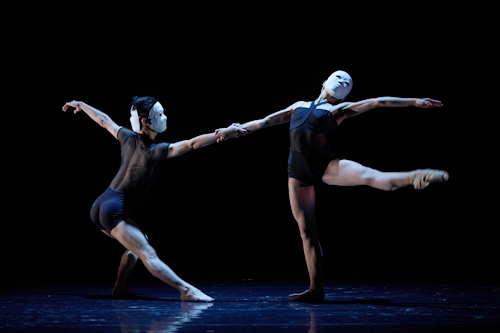
Photo Oraku Hiko
The dancers all appear wearing masks at some point, sometimes front and back. One body, two faces, thus hiding the real self even more. The choreography is appealing and it’s a topic that clearly has mileage, but it just isn’t quite there yet.
Standing out among the open call works, Floating by Su Yin-sheng (蘇胤勝) may be little more than a sketch, but what a delicious one it is. Created in collaboration with the two dancers, it opens in a shadowy spotlight, Cao Xiao-pei (曹曉沛) already lifted by Zheng Yi-hao (鄭一㠙). And off the ground is pretty much where Cao stays throughout, Zheng the fulcrum around which she moves as she spends almost the entire dance on his shoulders, in his arms or otherwise wrapped around his body. The partnering was exemplary, the choreography hugely appealing.
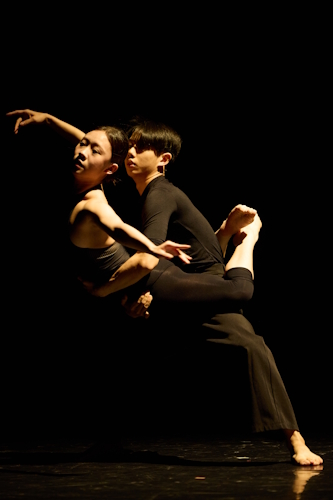
in Floating by Su Yin-sheng
Photo Oraku Hiko
Of all the dances, Floating has most scope for development, I suspect. It is easy to see how it could become a major feature in a longer piece. My only issue is that ballet flats for him, pointe shoes for her, would be more aesthetically pleasing than bare feet.
I was also rather taken by Tuning (調律) by Yang Zong-yu (楊宗諭), still only a second-year student of dance at the National Taiwan University of Arts.
The youngest of this year’s selected artists, Yang also seeks to explore the subtle nuances of contemporary human relationships, seeking freedom within the framework of classical ballet. And he and his five dancers do find it. Performed to Zoë Keating’s ‘Flying and Flocking’, the contemporary-classical choreography packs a lot in. It’s quite complex in structure, featuring a lot of individual movement out of which short unison duets appear. Indeed, the dancers even seemed to have a detached air, even when close by. Perhaps a reflection of modern society. Whatever, it was all rather appealing.
In Crack, choreographer Aska Huang (黃政諺) muses on the fact that, while some cracks are easily smoothed over, some remain very deep underneath. That’s seen in classical choreography that is indeed interrupted by cracks, often depicted as falling. The dancing by Chen Bo-yu (陳柏羽), Lin Yi-ting (林佁庭) and Ku Sano (桑野空) was fine but the miming and acting failed to convince.
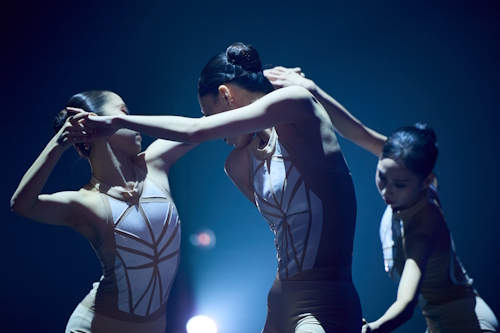
Photo Oraku Hiko
Completing the line-up, My Own Liberation by Jean-Paul Weaver attempts to interweave Haitian vodou, ballroom and ballet as it seeks to depict the “existential realities of a contemporary, post-apocalyptic queer community.” The programme note also lists a 1791 slave rebellion in Haiti and the 1967 disqualification of drag queen Crystal Labeja from a New York City pageant for the colour of her skin, as being amongst the work’s roots.
That’s a lot, so perhaps it’s not surprising that the work falls down on several counts, notably any narrative, meaning or intent being unclear. Listed characters include Papa Dambala (Berto Gold (Vase Mizrahi)), the benevolent spirit of Haitian Voudu responsible for creating the cosmos and shaping the earth, and his wife, Ayida Wedo (Veronique Bailey). But both largely stand at the back, neither exuding presence. Most of the dancing is done by three ballet dancers as three Marrassa, whose balletic choreography is charmingly sweet in a childlike sort of way.
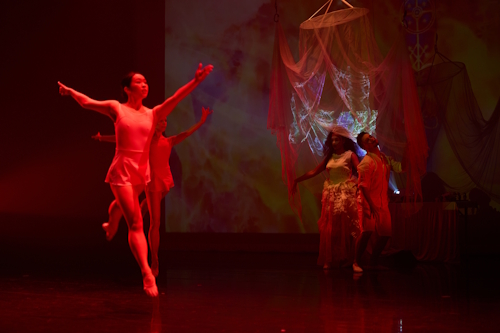
Photo Oraku Hiko
But, on the whole, Play with Ballet proved an enjoyable, certainly an interesting evening; one that showed there are young choreographers out there who are willing to work with the classical vocabulary, to experiment with it in contemporary ways. Well done Taipei Capital Ballet for giving them the chance.