

As Scottish Dance Theatre celebrates its 40th anniversary, David Mead talks with artistic director Joan Clévillé about the company’s continued success and plans for the year.
Forty years. It’s a milestone everyone connected with Scottish Dance Theatre is rightly proud of and celebrating with a year of dance that brings together past, present and future, culminating in a special party weekend at its home Dundee Rep Theatre at the end of October.
Scottish Dance Theatre is a Dundee success story. From its beginnings in 1986 as Dundee Rep Dance Company, led by Royston Maldoom and with just three professional dancers, it quickly grew, establishing a reputation for a company unafraid to push the limits of what dance can be and what dance can do, in the theatre and in the community.
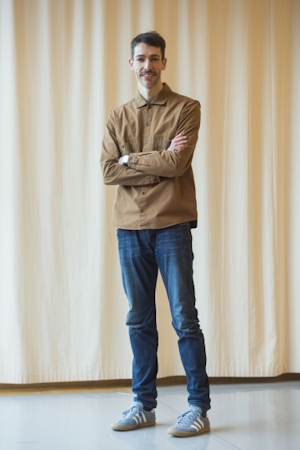
Joan Clévillé
Photo Alan Richardson
Subsequently led in turn by Tamara McLorg, Neville Campbell, Janet Smith, and Fleur Darkin, the company established a name for presenting work in truly diverse range of choreographic styles including by Sharon Eyal and Gai Behar, Liv Lorent, Didy Veldman, Emanuel Gat and Damien Jalet. That programming philosophy continues under present artistic director, Joan Clevillé, who has been at the helm since 2019.
But what is the secret of the company’s longevity and success?
“I think it’s twofold,” he says. “There’s an artistic integrity in the way work is approached, made and taken care of that I think it’s quite extraordinary. Everyone is so deeply invested in what is produced. There’s a sense of giving oneself fully, while also embracing your vulnerability or strengths of course. I think that’s incredibly satisfying. And it’s something I think audiences feel when they encounter this amazing company and these artists on stage.”
The second thing is the company’s strong connection with its home audience, Clévillé believes. “Because the company started more as a community project, as a grassroots initiative, it’s always been in dialogue with people and place. That, resonates with people. You can feel it, whatever the proposition is: mainstream or more fringe, experimental, adventurous, more or less challenging.”
Location plays a role too. That Scottish Dance Theatre is based in Dundee, a smaller city, away from the brighter spotlights a little, has really shaped the company, he agrees.
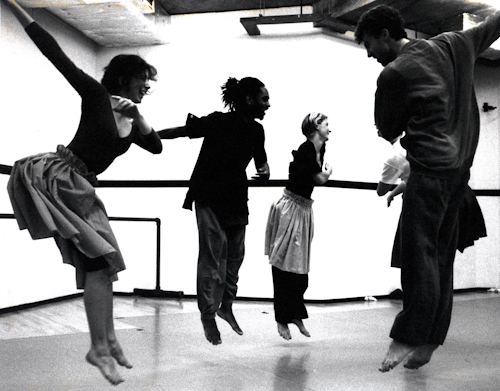
Photo Alan Richardson
“It is a blessing being in a small city. You have a sense that you can just get on with what you’re doing. There’s not much sort of self-consciousness about the work you’re making. You can commit, I think, quite generously, to whatever the proposition is without second guessing too much yourself. Is this in? Is this not? Is this cool? Is this not? I think it’s easier to give yourself to a process and to the work, and to focus.”
The city being relatively small means you feel the impact of what you do quite clearly, he continues. “That’s encouraging and rewarding. There’s a community of artists, a community of people, and you meet them quickly and easily. There’s a kind of ‘let’s do it attitude.’ And if you’re working with a community, it’s very immediate. I think that all grounds the work and grounds you as an artist.”
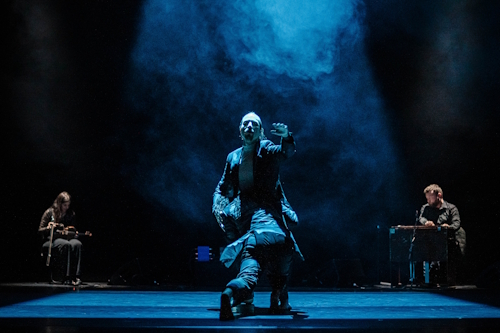
Photo Brian Hartley
On the other hand, he concedes, “It can sometimes feel isolated, remote and on the periphery in not a helpful way. You have to work hard at making sure you connect with what’s happening in other parts of the UK, in bigger cities where there’s more of a community of contemporary dance audiences, artists, dancers. And we are even further away from what happens elsewhere in Europe. That’s certainly a challenge.”
The schedule for the company’s anniversary year is jam-packed. “There’s always a lot going on, but this year there is really a lot, like with capital letters!” says Clévillé. “We’ve tried to think about it holistically though. It’s a season that very much represents the different aspects of the company, because the company is many things.”
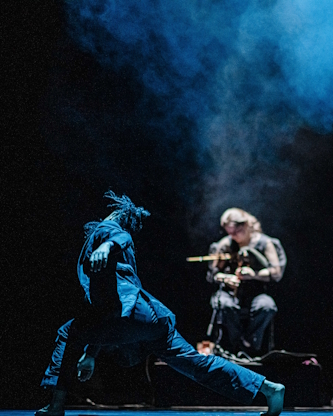
Photo Brian Hartley
The company’s relationship with Scotland is celebrated in the Scottish Roots programme, a sort of dialogue between tradition and innovation in Scottish culture that opens on March 12, not at the Dundee Rep, but at Canvas, a creative, community-focused hub in the city. “The beautiful thing is that we are then taking it to smaller scale theatres and community spaces; places like the Isle of Skye, where we have two shows, and the community hall in Ardrishaig, also on the West Coast, in Argyll.”
Scottish Roots includes two pieces directly inspired by Scottish folk music that were originally developed in collaboration with the Celtic Connections Festival in Glasgow. Clévillé’s own O Chiadain An Lo (which translates as ‘The recollection of that day’) is inspired by the music of Skye piper Brìghde Chaimbeul. And then there’s the return of Sofia Nappi’s hit production, Moving Cloud.
Sandwiched between them is a premiere by Edinburgh choreographer, Tess Lethem. “I think she sort of subverts the stereotypical image that one might have about Scottish identity and culture. She’s a relatively young maker, really interested in improvisation practices, but also her aesthetic is fragmented. It’s real, very playful, quite ironic. It feels super, super fresh and bold in its proposition.
“Scotland has a very strong identity and I think it’s really exciting to have that sort of kaleidoscope of different facets of what that identity is, and have a dialogue with it as a contemporary dance company.”

(pictured l-r: Kieran Brown, Kai Tomioka, Glenda Gheller,
Orla Hardie, Pauline Torzuoli)
Photo Brian Hartley
A 40th Anniversary Double Bill of two new works by French-American choreographer Emilie LaRiche and Édouard Hue from Switzerland celebrates Scottish Dance Theatre’s history of innovation.
“Emilie’s choreography is very crafted, almost lyrical, I would say. It’s very poetic ensemble work. Édouard’s work has a kind of like raw, groovy, more urban sort of quality, very fiery. I’m looking forward to the combination of the two.”
Clévillé goes on to say how, “This program celebrates bringing the world to Scotland, putting Scottish and UK audiences in touch with what’s happening elsewhere. It’s also about what happens when we bring artists in to work with those based in Dundee, when choreographers meet this environment, these artists including local designers. It’s about collaboration and dialogue, and being sort of part of the bigger picture of where contemporary dance is going today, which is really exciting.”
The 40th Anniversary Double Bill opens at the Dundee Rep on June 19, before touring to London, Manchester, Leeds and Inverness in the autumn.
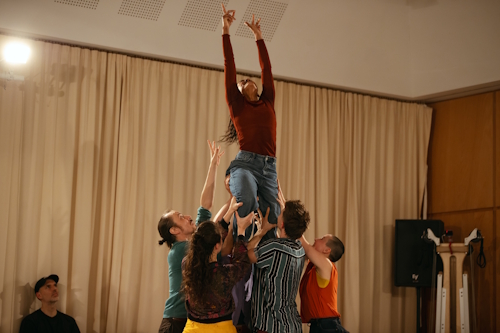
Photo Genevieve Reeves
The double-bill also features in what promises to be a very special weekend at the end of October that also includes a gala on October 31, what Clévillé calls “our sort of celebration moment.” Apart from performing excerpts of works, he says, “We want to invite some of our previous company members, collaborators and so on. It’s about the artists that have given themselves to the company over the years but also a celebration of audiences and communities and bringing everyone together.”
As part of that, Bridie Gain is creating RECollect, a work inspired by the company’s archive company made with and performed by the local dance community. Although it will premiere in June, Clévillé also promises some of it will appear in the gala.
The year’s programming is completed by the return of Meytal Blanaru’s Ray, a chance to watch the dancers close-up in what is very much a shared experience, and its spin-off, Little Ray, a playful piece for children aged 3 to 5, although their grown-ups are welcome too!

Photo Genevieve Reeves
Restaging existing works highlights the fact that Scottish Dance Theatre is one of the few full-time, repertory, contemporary dance companies left in the UK. “To sustain what it takes to be a repertory dance company, just from a kind of practical and resource point of view, is becoming increasingly difficult. There’s an investment in longevity and commitment. You are committing to do works again. But I’m passionate about it because I think it requires an openness from the artists involved, an openness to the fact dance can be many different things. Dance can be this and it can be that but we can hold both even though they’re sometimes contradictory. To be able to hold that complexity and that richness, really excites me.”
The future is not going to be easy. Clévillé notes how cultural institutions generally have become eroded and underfunded. “Funding is really is a quite dynamic landscape. We were very fortunate that we got an increase in our funding from Creative Scotland last year, which we’re obviously very grateful for. But, right now, we’re waiting on a decision about our funding from Dundee City Council after a public consultation. It’s clear that, whatever happens with that, resources are diminishing.
“But I think Scottish Dance Theatre has done a really good job over these forty years of being responsive and adaptive. I think it’s a company that doesn’t stay too locked into ‘this is how things are and so we’ll just continue to do that.’

in a gala weekend at the end of October
Photo Camilla Greenwell
“It’s hard to know what will happen over the next ten years. What I hope won’t change is that core of connection with the community and of being in a relationship with the community; being outward looking and having a long-term investment in dancers because we still have an ensemble and that’s also becoming rare in contemporary dance.
“Will the model look very different in the way we produce the work, in the way we share it? I don’t know, but if it looks exactly as it looks now, then I think I will be saying, ‘OK, that’s great, but is it still fit for purpose?’ And that’s an important question to keep asking yourself.”
For more on Scottish Dance Theatre’s season including dates and venues, visit dundeerep.co.uk.