Experimental Theater, National Theater, Taipei
April 3, 2026
Right from its inaugural edition in 2021, the Wan Sha Performing Arts Center (涴莎藝術展演中心) in Tainan has made a point of encouraging curiosity and freedom among the dance makers selected for its annual Wan Sha Dance Platform for Choreographers (涴莎舞蹈創作平台). After premiering their creations in Tainan in October 2025, five young, emerging choreographers brought their works to Taipei. It proved an evening of great variety, the works, each around fifteen minutes in length, all leaving an imprint on the memory in a good way.
While hip hop is popular in Taiwan, it is rarely presented on stage by theatres. So, a big ‘hurrah!’ for Apache Line by Cheng Tzu-chien (鄭子謙). With technique, mostly breakin’, and relationships very much to the fore, the choreography work takes the form of a duet between Cheng Wen-shuo (鄭文碩) and Wu Meng-zhe (吳孟哲).
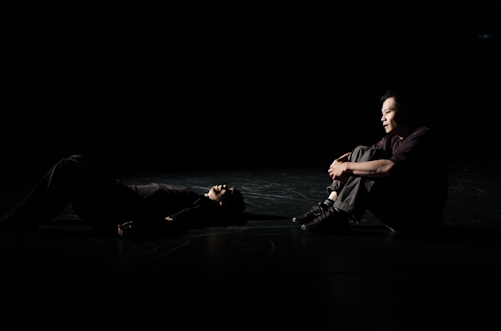
Photo Fang Yu-ting
The pacing is particularly impressive. While a subtle physical distance is maintained between the dancers, that there is a bond between them is very clear, the back-and-forth dance feeling much like a conversation. While their steps are similar, Cheng’s choreography leaves enough space for personal style to emerge. He and the performers play beautifully with movement speed, also throwing in occasional pauses for the viewers, and the dancers, to catch their breath.
The performances were excellent, some of the fast but so accurate footwork particularly noteworthy. Also excellent was the way the pair constantly related to each other. The simple act of looking with one’s eyes can say a great deal. Wu was especially impressive here, also making contact with the audience on several occasions.
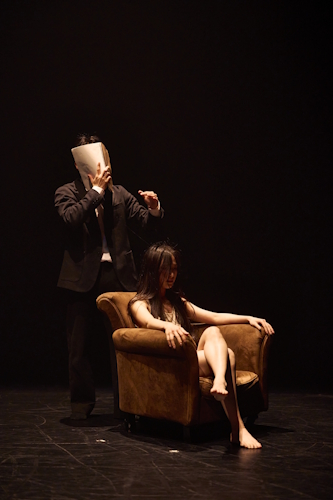
Photo Chen Wei-sheng
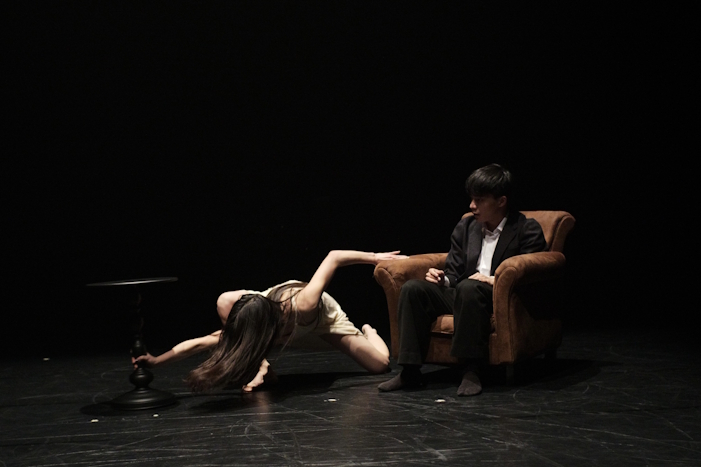
Half (半) by Xia Zhen-wei (夏震緯) work depicts the relationship between three characters in a series of scenes that are familiar and authentic, yet presented in a way that borders on the surreal, and in which things get decidedly complex.
Two old armchairs, two reading tables, two women, Lai Yi-ting (賴羿婷), dressed in white, and Chao Chen-yu (趙晨羽), in black. But lit separately, suggesting two different locations. One senses Lai is waiting. She’s edgy, twitchy, restless in the extreme; feelings all displayed to the full in her terrific opening solo that makes full use of the chair, as indeed does all the dance in the work.
Things get even better when Xia arrives in a dark suit, as if returning from a day at the office. Their relationship immediately starts to be revealed in a fast -paced and brilliantly timed duet. Hidden undercurrents quickly come to the surface. There’s tension, frustration, even anger, but also moments of joy and tenderness, all very evenly divided and working both ways.
Then it gets complicated! Xia finds himself with Chao. It’s possible to read what follows in multiple ways. Another woman? Or does a moment of unison indicate she’s another side of the same woman? And the two do come together at the end. Whatever, the feeling seems more tense. Things get even more confused when all three appear together, Lai exchanging her slip of a dress for Xia’s suit and vice-versa. Cue more fast-paced action before it closes with the two women, Xia on the floor.
So, narrative but far from straightforward. And the briefest of programme notes was not giving anything away. But also, quite enthralling from start to finish, and probably the one work in the evening that has more to offer. You certainly never knew what was going to happen next. And the performances by all three were quite excellent.
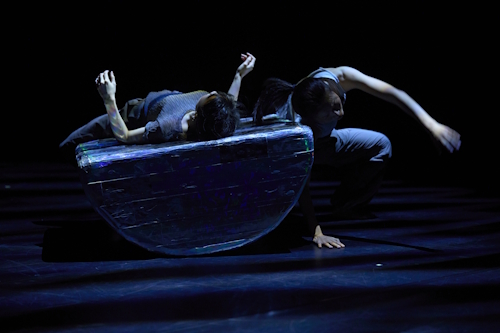
Photo Chen Wei-sheng
The programme opened with The Wheel (輪) by Chen En-tong (陳恩彤), whose experimental creations straddle public spaces, circus, objects and bodies. Danced by herself and Cai Yi-gen (蔡貽亘), it takes the form of a duet on and around an unstable crescent-shaped cylindrical object. The idea behind the piece stems from questioning how, in a world that is unsecure, we find a new balance among our constantly shifting surroundings.
The pair start apart, one exploring the object in a visibly animalistic manner with a lot of what looks like crawling, perching, and probing. The other relates to the object in a more obviously human way. When they come together, around and then on the object, the relationship between them sometimes felt awkward, some of the actions feeling not quite coming as naturally out of the movement as might be. With both finally standing on the object, there is a sense that, with effort, that elusive balance might be achievable.
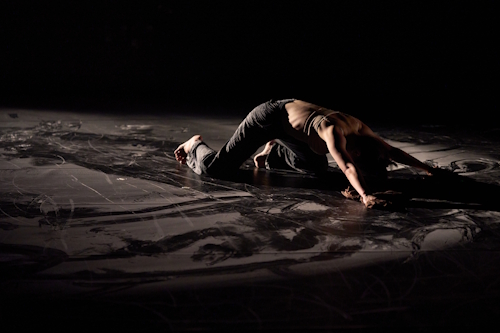
Photo Chen Wei-sheng
Steamed Buns (饅頭) by Shih Min-wen (施旻雯) took us to the more experimental, conceptual end of the spectrum. It opens with her carrying a bucket of water, gurgling more water in her mouth. A long-sleeved top is folded carefully, then unexpectedly used to clean the floor. Later, there’s some writhing as if possessed. While a difficult work to get a handle on, there were times when it drew you in, helped greatly by the way Shih was completely immersed in her performance.
Completing the line-up, Viscous Rain, Transparent Flowers (黏稠的雨透明的花) by Zeng Zi-yin (曾子音) sees the choreographer-performer makes great use of her flexibility. Initially in particular, there’s a lot of broken movement, like joints giving way. She brings to mind images of a creature awakening, learning to use its limbs, or perhaps emerging from a pupa, a picture provoked by fabric and cut of her trousers. As Zeng constantly flows and changes form, a lot of effort goes into the struggle that’s often quiet yet intense and powerful at times.
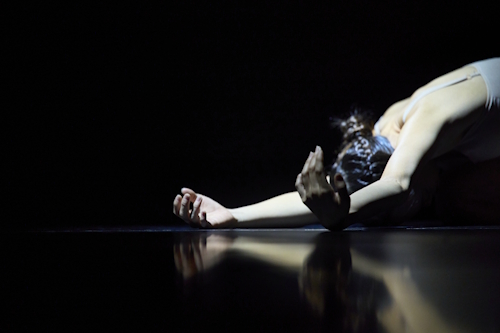
Photo Chen Wei-sheng
A mixed evening for sure but platforms like this are important. It’s essential that emerging dancemakers get opportunities. It’s how they learn. And it’s good too that they get to show their creations to a Taipei audience. Well done Wan Sha! And if I’m around for next year’s edition, I’ll certainly be along.
Note: English translations of titles are by the author and unofficial.