
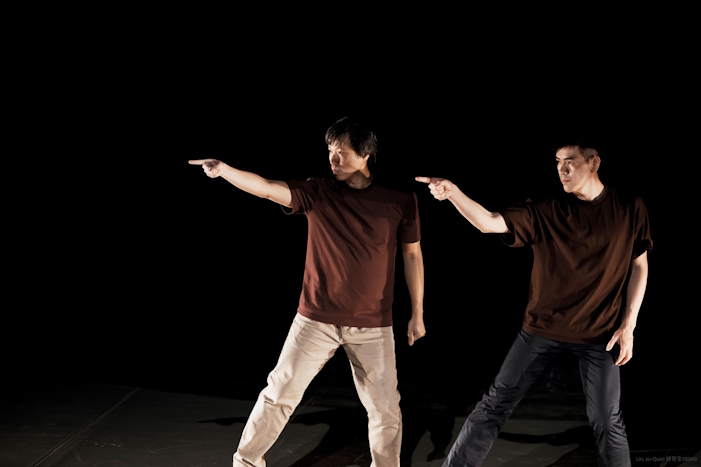
Shuiyuan Theater, Taipei
April 4, 2026
Almost the first thing that happens is Taiwanese performer Chou Shu-yi (周書毅) telling us, via a pad and a marker pen, that he won’t be talking on stage during the show because, “It’s too difficult to talk about this.” Over the 75 minutes that follow, he and fellow performer Lee Mun Wai (李文偉) from Singapore but now resident in Berlin, who we do hear, deliver their message very clearly indeed, however.
Directed by Taiwan-born, Dresden-based Lo Fang-yun (羅芳芸) and co-created with Chou and Lee, The Seas Between Us (當水落下) by Polymer DMT (聚合舞), a cross-disciplinary creative collective based in both Germany and Taiwan, is the culmination of a three-year project co-produced by HELLERAU – European Centre for the Arts and PACT Zollverein in Essen.
The starting point for the work is Taiwan’s relationship with China. But The Seas Between Us goes beyond that. It delves deeply into personal identity, considering and demonstrating very effectively how who we are, our thoughts, actions, beliefs, are all shaped by politics, social systems and cultural influences. Deeply thoughtful, and made all the more potent by being very personal, it exposes many confusions and contradictions.
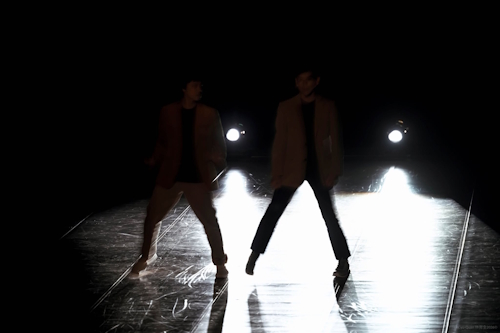
Photo Lin Yu-quan
There’s a distinct sense of uncertainty right from the off as the pair walk slowly towards the audience to a menacing soundscape. They appear to be treading carefully, but working out precisely how one should read it is tricky.
Chou and Lee reflect on their respective dance training and life experiences, both using their bodies as a living, moving store of memories. We hear how Chou first went to a dance studio aged 10 and found himself learning Chinese folk dance, then Chinese classical dance, both beautifully illustrated. He shows grace and gentleness, sometimes exaggeratedly so, as his recollections reveal themselves in dance.
Their backgrounds are different but their explorations reveal similarities and common frictions. Lee talks of how he learned the styles of all the Western modern dance pioneers: Mary Wigman, Kurt Jooss, Merce Cunningham, Trisha Brown, Martha Graham. Spot the obvious. No Asian names. He moves much more freely, expansively, confidently. He shows a similar refined ease to Chou. But he makes the point he learned from ‘them.’ He learned what ‘they’ wanted him to learn. Dances that didn’t really belong to him. Only later did he realise, when in Europe asked to show something from his own culture, what was missing from his life.
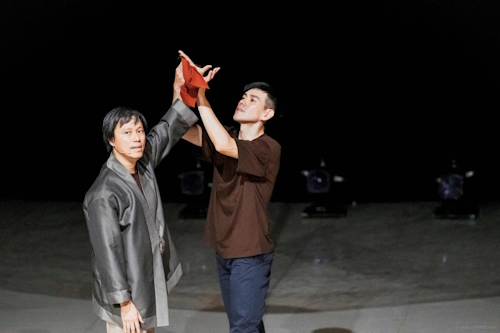
Photo Lin Yu-quan
The personal nature of the piece continually draws you in. The pair are honest and up front. Chou tells us how he first went to China aged 32, and just how emotional the experience was at times. Reflecting on a visit to some grottoes, “I knew this place, but did this place know me?” he asks.
The Cross-strait issue comes to the fore. There are references to the warning that, “Taiwan independence is a dead end.” We hear the threat of military force. Soon, the pair are answering questions, asked by a disembodied voice, both now using their pads. What do they like about China? What do they dislike? What do they want to say to China? What do they worry about? The answers reveal plenty of contradictions.
There’s an old Chinese saying, that says the last creature to discover water would be the fish. Another take on it explains that a fish can’t see the water it is in, unless it jumps out of its fish bowl. In other words, it’s only by moving away from our own environment that we can truly understand it. Here, Lee muses on what it was like being Chinese in Germany, finding himself part of a minority for the first time. Only then, he says, away from his homeland, did he realise what it meant to be Chinese. He questions why he only then cared about his Chinese-ness in a way he did not in Singapore. Guilt spews forth. Because he neglected it when younger, he wonders. An apology to his younger self, perhaps?
by Polymer DMT
Photo Lin Yu-quan
I found The Seas Between Us very powerful. I’m sure it helps that I’ve spent much time in Taiwan over the years. And, of course, the issues raised are very well-known to the audience. They may well experience the same conflicts as Chou in particular. But while presenting the piece in Europe and elsewhere may bring challenges given the remoteness and likelihood of less understanding of the political issues, it’s not difficult to see how audiences might relate to the general themes, how they might consider how identity and culture is so often spoken of in very simple terms and how nationalism, as in the past, has a habit of embracing and using tradition to its own end.
But I keep coming back to the human frame the work sits in. That’s the main reason it works so well. Lo and the performers draw the viewer in. They make it very clear that the issues affect real people in real ways, they are not simply something political or national or cultural or ethnic or whatever. A second big plus is that nothing is rushed, nothing is forced. The Seas Between Us takes its time, allowing the viewer time to think.
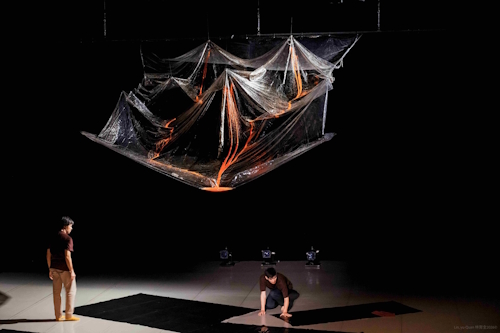
At the end, blood flows as streaks of red on the sculptural canopy that the work takes place under. The soundscape hints at military marching. A warning of where failure to coexist might lead at the very least.