U mkt and Tanbu Sugar Refinery Cultural Park, Taipei
April 19, 2026
There’s a lot of planning involved in working out what to see at the Want to Dance Festival (艋舺國際舞蹈節) Open Call Program (公開徵選單元). Most performances are short, twenty minutes at the most, but with them taking place across multiple venues simultaneously through the afternoon, it’s not only a question of what do you want to see, but whether you can get from A to B in time you have.
On a sunny day with the temperature in the low 30s, the small mezzanine of the air-conditioned U-mkt made for a pleasant place to watch. Formally Xinfu Market, the U-shaped building has been renovated and is now a base for studies of traditional market culture and a place for events that invite public participation and thus help the rebirth of this very old part of the city.
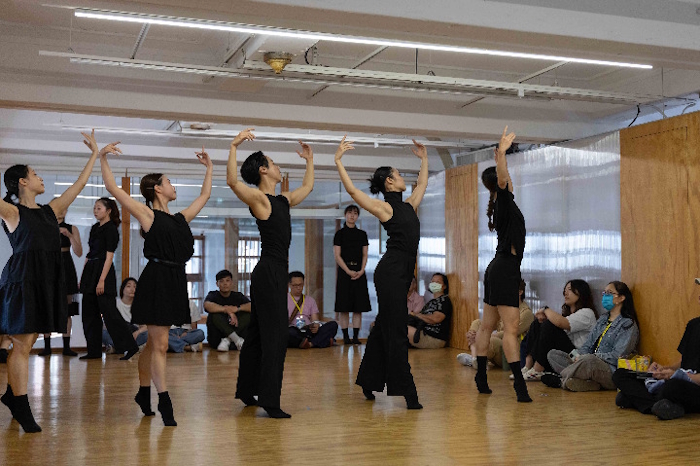
The space is tight to say the least: around 5 metres x 12 metres, and that has to accommodate the audience too! So, top marks for Chuang Chia-jie (莊嘉杰), an undergraduate student at National Taiwan University of Arts (NTUA), for managing to restage his RE-trace (波返) there, albeit with slightly fewer dancers and one or two choreographic changes, the low ceiling especially causing a problem with lifts.
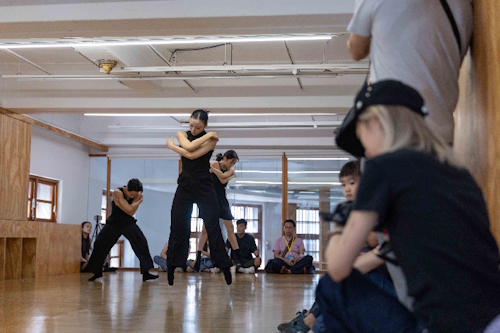
Photo Terry Lin
Any choreographer who tackles Ravel’s Bolero is brave. Many have tried but few have come close to matching the power of the score. Having previously seen Re-trace on regular theatre stage and outdoors, the confined space and close-up viewing brought new perspectives. It certainly intensified the choreography, which reflects the cyclical, repetitive nature of the music. Similar movement reappears but staggered, overlapped, and offset across different bodies. The texture and volume of the dance do not quite build to the same extent, however. Still, a fine start to the day.
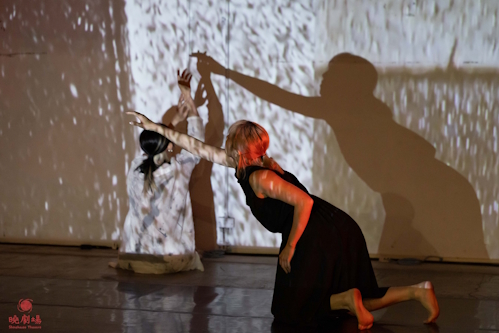
In the same space at U-mkt, What Remains After That Day (那天之後__(What Remains After)) by Liu Hsin-tzu (劉芯慈), MFA candidate at NTUA, got off to an intriguing start. Chao Chen-yu (趙晨羽), in white, moved among the audience, drawing squares on the floor with her finger, adding a number inside each one. Meaning is revealed when she then mimes the use of an old push-button telephone. Incredibly, or maybe not, all this passed most in the audience by, even when happening inches in front of them, so engrossed were they in their own devices.
in What Remains After That Day
Photo Terry Lin
The work seeks to reflect the unpredictability of fate and the fluctuations of life. That’s certainly more than hinted at in what follows. Elsewhere in the space, Kao Lin Chun-chieh (高林君潔), in black, kneels by an umbrella. Chao holds her arm out as if checking whether it’s raining. That the umbrella is red feels important. It certainly adds a dramatic splash of colour to the scene.
The choreography that follows is extremely pleasing, the partnering and connection between the couple excellent. It ends unusually too, the pair blowing up two small balloons, one white, one black. The white one is released, the air hissing loudly as it escapes. The black one is then popped. Ah, fate.
Another well-constructed and performed piece, What Remains After That Day clearly has mileage to be taken further. The only disappointment on the day was the accompanying video designs by Liu got somewhat lost, the space far to light for them to have impact.
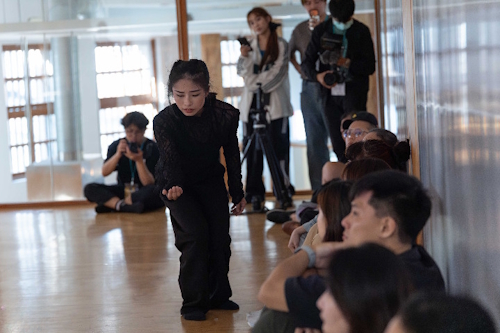
Photo Terry Lin
A third piece at the venue, Breathing Time (呼吸時), created and performed by Tsai Dong-hao (Tyrek, 蔡東皓) and Cheng Ya-ting (Tilly, 鄭雅庭) of In Parallel, a movement research team centred on the fusion of partner acrobatics and dance, brought dance with no narrative or emotion. Rather, the piece is quite simply an exploration of breath and how it is an integral part of every weight shift, balance, and transition.
And breath does dominate. Even as the pair walk, but especially as they rise and fall, you hear it, even above the music, which in turn helps you see its relationship with the movement. The choreography is largely slow and thoughtful, although as the dynamic increases, arms and bodies pump almost mechanically. Later lifts and juggling were excellent, although the low ceiling again did the work few favours.
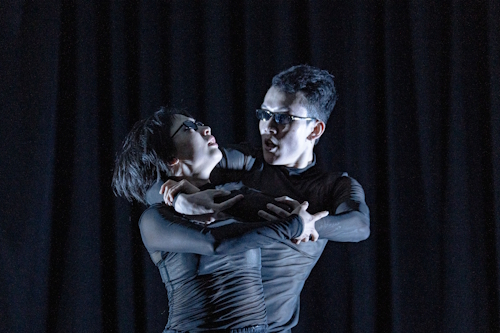
Photo Terry Lin
Moving to the Tanbu Sugar Refinery Cultural Park and the space that is Warehouse A, If I could, I couldn’t by Liao Chien-yao (廖健堯) and Lai Wei-chun (賴韋蒓) features much entanglement of bodies. Dressed in black tops and shorts, chunky black shoes and wearing sunglasses, the couple twist and turn, the forms created constantly disassembling and reassembling. There are some very clever pictures along the way, not least when Lai’s legs appear to be Liao’s. At one point he very realistically appears to have three!
But whilst I’m sure it reflects the digital age for the choreographers, feelings of anxiety and self-consumption caused by information overload, and altered between reality and the virtual, whether it actually communicates that clearly is less certain.
in Withering Fragrance in an earlier performance at U-mkt
Photo Terry Lin
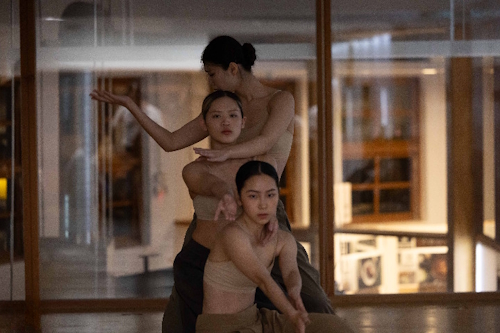
Moving outdoors, Withering Fragrance (枯香) by Chen Yong-chieh (陳詠婕), a student at Tainan University of Technology, and performed by the choreographer with Chen Hsing-yu (陳星妤) and Wu Hsi (吳熹), reflects on how withering marks the end of life while the remaining fragrance is the trace left behind. The dance beautifully encapsulated the sense of a gentle, enduring farewell, although perhaps with a sense of hope that one might meet again in the next life.
Back inside and out of the heat, Walking Corpse (走動的屍體), choreographed and performed by Chang Tzu-hsuan (張慈軒), a MFA candidate in at Taipei National University of the Arts, has its origins in what she perceives as the lived experiences of Afghan women under the strict religious discipline imposed by the Taliban. Chang claims that the work does not seek to speak for the ‘other’. Indeed, her programme note adds, somewhat intriguingly, that the piece also “reflects upon one’s own position,” noting how “fear, obedience, and resistance are… gradually shaped through prolonged regulation.” Read into that what you will.
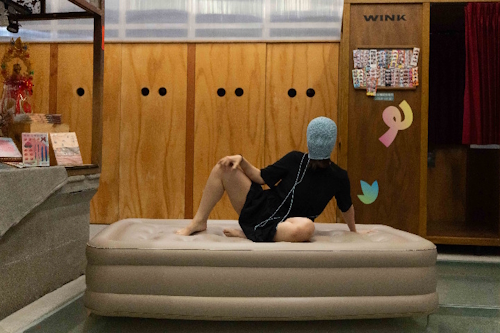
Photo Terry Lin
Whatever, it opens with her in a woollen scarf that she is seen knitting herself. As she then twists and turns, making great use of an inflatable mattress to cushion falls, she appears to be railing against something. Not so much a depiction of being silenced as the frustrations of being silenced. It was an interesting end to the day, a work and an idea clearly not yet fully formed, but certainly with scope for refinement and development.