Keelung Cultural Center, Keelung, Taiwan
May 10, 2026
A work in five sections that brings together dance and live improvisational performance by Saha World Band (娑婆世界樂團), Weaving It Together (編·織), choreographed by Wu Tsai-lin (吳采璘) for Tai Gu Tales Dance Theatre (太古踏舞團) has no narrative. Rather, and as the title suggests, it takes threads as its theme as a number of ideas and dance styles are brought together.
It’s also a piece that reflects the long-standing ethos of Tai Gu Tales Dance Theatre and its artistic director Lin Hsiu-wei (林秀偉), which has always sought to produce dance that has vitality and life, but that also reflects a particular Eastern philosophy and New Age spirit.
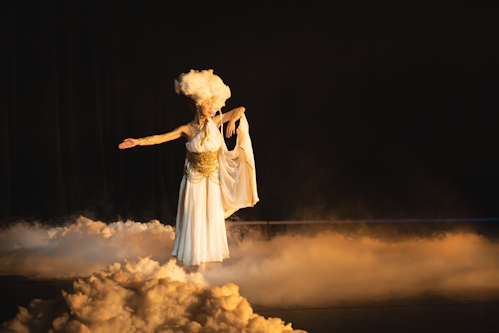
Photo Wang Yang-dun
The work opens with an image of the goddess Athena before moving into more contemporary territory. Dressed in white, Chin Pei-tzu (覃珮慈) moved gracefully around a stage set with three large piles of white wool. When Chin sort of magics two of the heaps to life, they first appear to move on their own, before dancers appear from each in turn.
In a shift in movement style, Lin Hui-chun (林慧純) and Chang Yueh (張岳), described as a Modern Cowherd and a Weaver Girl, come together in a gentle, sometimes playful duet that has just a hint of romance about it. There are not only threads in the choreography but in the costumes too, and later in the staging, all by Bitter, then better Weaving Team (苦瓜編織團隊).
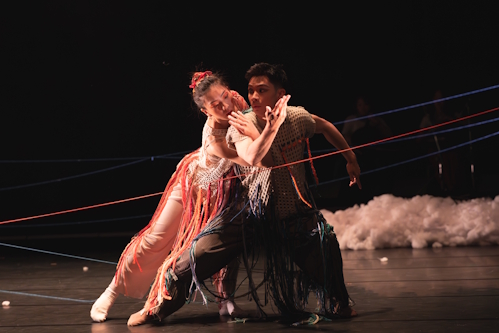
Photo Wang Yang-dun
But while thread provides links, it can also be restricting, and can be tugged and broken. At one point, more bits of wool blow across the stage in a manner reminiscent of clumps blowing through a mill. Or, on reflection afterwards, perhaps a storm brewing in the relationship. A subsequent more dynamic solo certainly suggests fighting or seeking release, which is eventually achieved. Broken threads, perhaps?
Thread does not only come from wool, of course. Spiders produce some of the strongest, a fact reflected in the third section, Arachne, which combines modern dance with aerial silk work. Both music and choreography are edgier than anything previous. The returning Chin certainly looked very insect-link. The aerial silk idea works well, although would perhaps be better if higher off the floor. Unfortunately, the view was rather spoiled by a dazzlingly bright ground-level striplight behind her, which left one barely able to see anything. An effect with lasers that made it appear she was dancing in a prism was terrific, however.
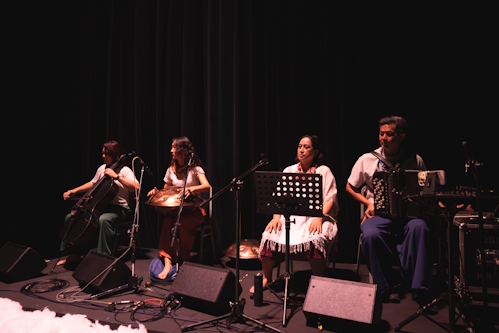
(l-r: Grace Huang, Wei Li-hsuan, Su Yang, Lin Cheng-ching)
Photo Wang Yang-dun
Also terrific throughout were the four musicians of Saha World Band: hand pan musician Wei Li-hsuan (魏莉軒), cellist Grace Huang (黃懿德), accordionist Lin Cheng-ching (林呈擎) and Atayal female vocalist Su Yang (蘇婭). Sat upstage left, they kept up a constant stream of wonderful sound that seemed to breathe as one with the action. Their accompaniment was wonderfully layered. Sometimes it emphasised intensity or agitation, sometimes it was smoothly lyrical, sometimes it was more textural noise.
Choreographer Wu Tsai-lin told me afterwards that while there is some recorded sound, the quartet are improvising most of the time. She explained, “I will give some options to the musicians for each part of the dance but they can still change the melody or the beats. For each section, we usually discuss in advance which instrument will take the leading role, or what kind of atmosphere should be created, and about roughly when the voice should come in. But the actual content, what they play, really depends on them and the dancers’ presence in that moment.” Never disconnected from what was happening in front of them, they were seriously impressive.
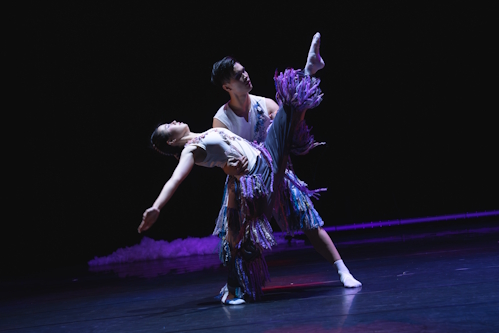
Photo Wang Yang-dun
Act Two seems to flow better than Act One. The links between dances, sections, feels more organic and natural. It opens with a very pleasing lyrical duet for Lien Lu-chieh (連律絜) in blue and Lin Yu-jung (林侑融) in purple. Their characters feel more mature than those in the earlier pairing. Quite balletic at times, their dance features some excellent partnering.
When the first couple return, threads are stretched across the stage, at first giving the impression of a giant loom. But when the male dances on and between the strands, music and dance are so at one, the timing so terrific, that it was impossible to not to see his body as plucking strings on an instrument. Or perhaps even notes on a musical stave.
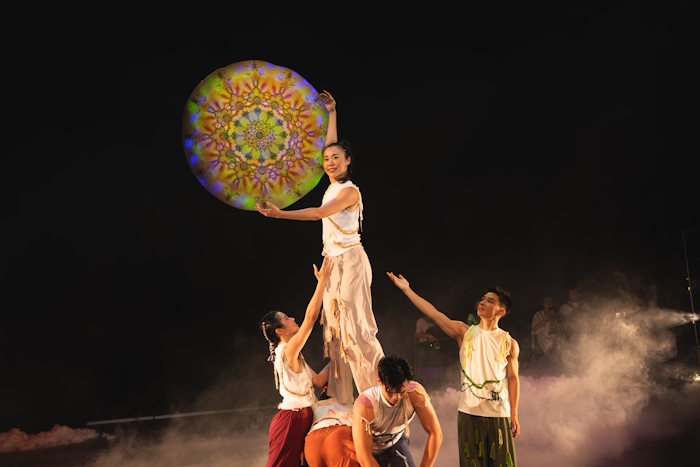
The closing ensemble section, ‘A Sunlit Field of Weaving’, symbolises harmony and the power of the collective. The various threads in the work coming together, the five dancers interweaving in interesting ways before one is held aloft by the others.