
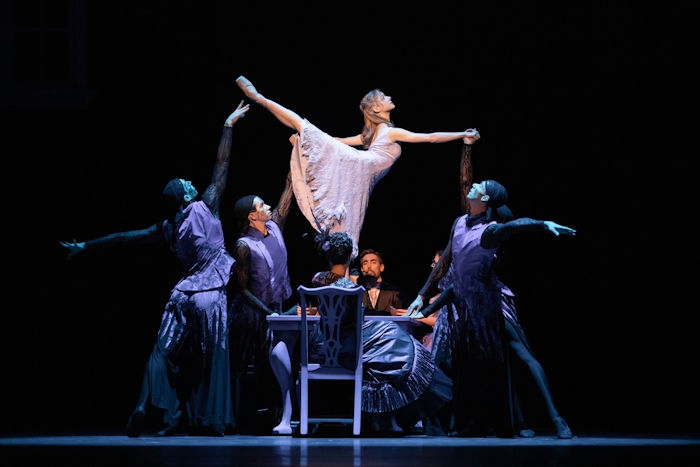
It was four years ago, in May 2022, that Laurent Hilaire took over the directorship of the Bayerisches Staatsballett in Munich. With his contract now extended to 2031, he talked recently to Jeannette Andersen about his achievements in making the company world class, how he defines his role as director and next season’s repertoire.
I met Laurent Hilaire, a former étoile and ballet master with Paris Opera Ballet, and from 2017-2022 the artistic director of the Stanislavsky and Nemirovich-Danchenko Music Theatre in Moscow, in his sun-lit office. To the sound of a distant piano in one of the rehearsal studios, we talked about his four years as artistic director with the Bayerisches Staatsballett.
Within just a few minutes I was smitten by his enthusiasm for everything dance: the dancers, the repertoire, the choreographers, the theatre… The list is endless. But at the same time Hilaire is humble, he knows he has done well, but that the result is not a given. He insists that he and the company have to keep on working harder, but at the same time he is very respectful of the dancers, their achievements and needs, and their very short careers.
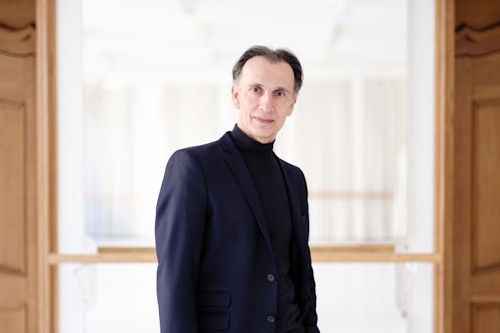
Photo Geoffroy Schied
Asked about his success he starts with a detour and then boils it down to the way he leads the company, his focus being on the dancers. Hilaire says, “I am the fruit of my history. The people I worked with, what I learned, what I understood. I have a clear vision about what I expect on stage, the quality of class and the academic training. I am very much involved in rehearsals and spend more time in the studios than in my office. The dancers write the choreography with their bodies, they create a translation of meaning, and this is what the audience understands.”
Achieving his vision is closely connected to Hilaire’s relationship with the dancers and the way he works with them. He says, “I tell the dancers, push your boundaries because you are able to. Don’t be afraid. Go for it. But respect the choreography, the technique and your academic training. Develop yourself. I will always support you. Even if you make a mistake, we the choreographer, the ballet master and I are with you. I think this makes the company feel a kind of confidence, trust and respect. And then they are not afraid to move on. This is perhaps the key to our success.”
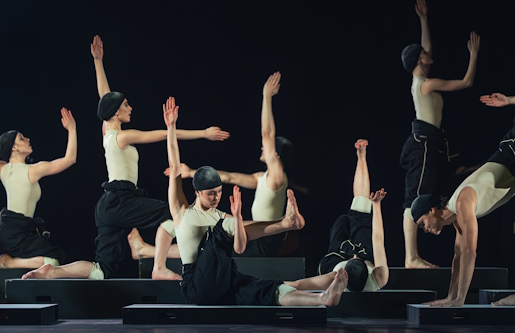
featuring Alexander Ekman’s Cacti (pictured)
along with Johan Inger’s Impasse and Jiří Kylián’s Bella Figura
Photo Nicholas Mackay
Until 1989, dance was a mere footnote in Munich. Then, the Bayerisches Staatsballett became an institution with its own budget, independent for the first time from the opera. This season the company has performed to a 100 percent sold out house, even beating the opera.
Hilaire has not been part of this long-term development but nevertheless ventures an explanation of why dance has become so popular. He says, “I think, that people are much more conscious about their bodies than before, and the ballet has changed. Nureyev created the big actor ballet, and Neumeier real characters like Ludwig II in Illusionen wie Schwanensee, which is in our repertoire. And when the dancers perform in a way that the audience feels the energy, the pleasure, the characters concerned, a performance turns into communication. But it is also about how we stage a piece, about theatricality, about the dancer’s attitude towards how they ‘explain’ something; their awareness about it. They have to be in charge of the ‘meaning’ of what they are doing, to be the character, then everybody can understand you. We have a very good audience, who support us, nevertheless we have to worry about the quality. It is never enough.”
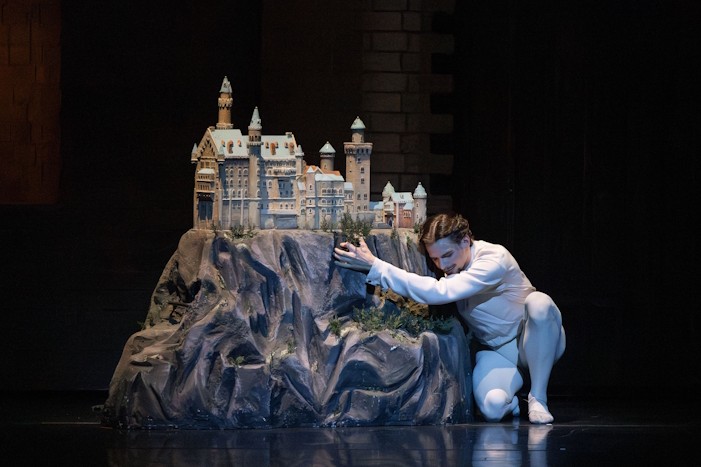
in Illusionen-wie Schwanensee by John Neumeier
Photo Katja Lotter
The repertoire for Hilaire’s first season was already set by his predecessor, Igor Zelensky but since 2023/24, he has been able to select it himself. He has sought to present a mix of the classics, modern ballets and new works. He explains, “We cannot stay fixed in the past, we need the contemporary works, and there is a link between the two. In classical ballet you learn about the way to use your body, different styles and different ways to work. The contemporary work opens up the potential of a company. I think it is my duty to make these different propositions to the audience, and then it is up to them to decide whether they like it or not.”
The company has also become popular with dancers. For next season Hilaire received 700 applications for four spots, three male dancers and one female. The applicants have to submit a video with a classical piece and a contemporary work, by a choreographer, an improvisation or something they did themselves. Hilaire says, “I watch the videos to see if they have a good classical technique, which is a prerequisite. Then I make a selection. I want to see them in real life, to feel the people, to discover their personality and character and to see if they fit into the company’s profile and its dynamics.”
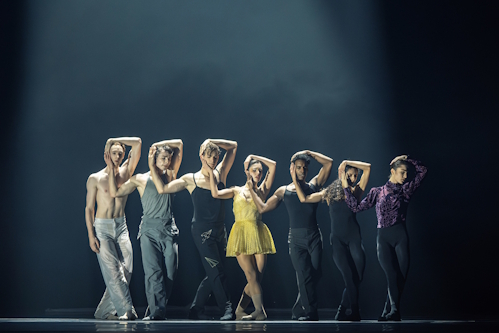
including Emma Portner’s Megahertz (pictured)
Photo Nicholas Mackay
Sometimes Hilaire casts a demi-soloist or soloist in a principal role, which makes you discover completely new sides of the dancer. They suddenly stand out and you realise they can much more than you expected. He explains, “I do it as much as I can, because I remember when I was a young dancer, you need hope, You need to know that there is a possibility, that you have a chance, an opportunity to do something, to grow. Otherwise, the dancer leaves. So, it is part of the process and it is a stimulation.”
For next season Hilaire has commissioned a new ballet by Edward Clug, Carpathia – The Myth of the Undead, named after the region in Romania, where the choreographer was born and lives. It will be about Count Dracula, the vampire, who once roamed Transylvania. Hilaire has long wished to have a piece by Clug, so when he agreed, he visited him. They discussed all sorts of ideas, but did not come up with any definite plan. As disappointing as it was, Hilaire says, “I would never say to a choreographer, you have to do this, because I think that approach does not work. The choreographer has to be entirely involved in it. But then on the way back in the train, he called me and said, ‘I have an idea. It is going to be about Carpathia.’ I asked what he meant. He answered, ‘It is going to be about vampires, Count Dracula.’ I was like, ‘Yeah?’ But he was so enthusiastic, that I agreed to it.”
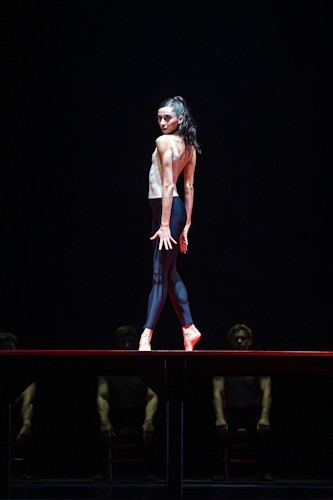
Maurice Béjart’s iconic Bolero,
pictured with Elisabeth Tonev
Photo Nicholas Mackay
Working with a choreographer is a very important element in a dancer’s career, Hilaire considers. “It is the holy grail. Somebody creating on you, who understands who you are, uses you or a part of you so that, in a way you become a little part of the process of the creation.”
Even though the company has Sir Peter Wright’s Giselle in the repertoire. Hilaire is going to create his version of the ballet next season. He stresses that he is not a choreographer, but he does it, because, “Of course respecting the context of the story, I want to update it a little bit, the way the dancers are on stage. I danced many versions of Giselle, and I know what I think is good and hope I am right. I want to share my experiences with the dancers. The structure will stay the same, but I want it bigger and better and hopefully create a new connection with the audience.”
Last season the company performed Pina Bausch’s Sacre du printemps to great success. Next season they will do her Orpheus and Euridice. Asked why, Hilaire bobbles with enthusiasm, “Because it’s a masterpiece, something really special, a different and fantastic universe. Everything is linked together, the dancers, the singers, the orchestra. There is this interconnection between the different art forms. I never worked with Pina Bausch. But I thought it could be a fantastic experience for the dancers to do a Bausch piece.” Unfortunately, the company will only do eight performances during the Ballettfestwoche in April 2027.
Hilaire’s contract was recently extended to 2031. He says his vision for the company for the next five years is, “To continue to grow, to have a varied repertoire and be connected with the audience. To bring in new choreographers and update the vision of what ballet means. And of course, to keep alive the passion, the enthusiasm. I would like to have three instead of the two premieres each season we have at the moment. I am trying my best to be a good director. In the end, the audience decides if that is the case. I am happy and lucky to be leading this company, to have the possibility to create the program, to work in this beautiful theatre with a big stage and over 2000 seats.”
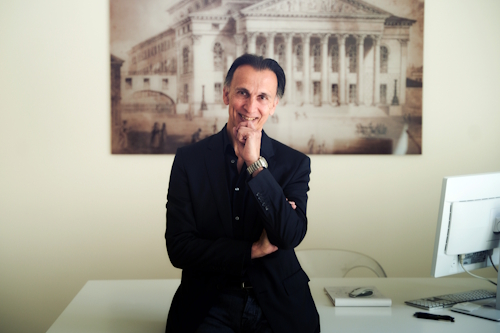
Photo Julian Baumann
Our conversation concluded by talking about Hilaire’s happiest moments as director. He says, “When I can see the dancer, taking charge of the project, being happy on stage, I’m happy and I know why I’m doing this.” And he adds, “But it is not only me, or the dancers. We have a wonderful team, the administration, the press, social media, costume department, technicians. Everybody is working for what is happening on stage. Everybody is important. I have respect for all the dancers, when they are doing the job. And they are doing the job. I am very proud of them.”