Dance Theater, Taipei National University of the Arts
March 27 & 29, 2026
This year’s season by Focus Dance Company (2026焦點舞團), the graduating student company of Taipei National University of the Arts (國立台北藝術大學), Sleepless Utopia (昨日樂園), features the usual two programmes, both with six works by company members bookended by pieces by the well-established and well-regarded Huang Yi (黃翊), and the very much emerging Yu Wan-lun (余宛倫).
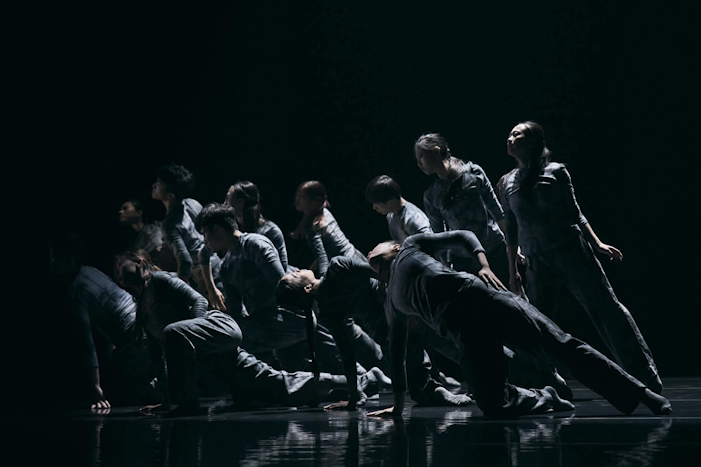
Originally created for the then Cloud Gate 2 in 2009, Huang Yi’s Wicked Fish (流魚) explodes into life. It’s a non-stop tumble-drier of a dance that matches well the dissonant high-energy of its accompaniment, Shaar by Greek composer Iannis Xenaxis.
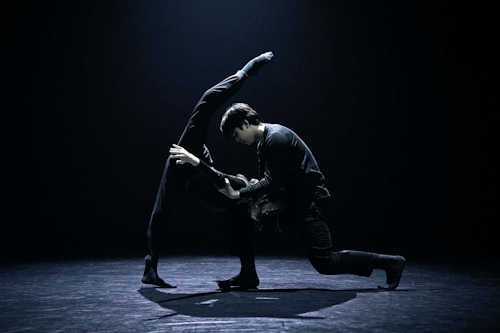
in Wicked Fish by Huang Yi
Photo Chang Chia-hao
It opens with a thin beam of light in front of a line of dark clad dancers. Arms, heads, legs are momentarily caught in its beam. They do look like fish peeking out from their shadowy hiding place. Emerging from the blackness, although the piece is never brightly lit, the ensemble does resemble a shoal of fish as the dancers dart around the stage, although whether they are ‘wicked’ in any sense I’m less sure. The Chinese translates directly as ‘flowing’, which is nearer the mark.
Whatever, cracking brief duets emerge, with two longer ones especially impressive. There are a lot of lifts of countless varieties, and a lot of dancers being slid and swung athletically around by their arms. It makes for a dancer’s fine opener that certainly challenges the dancers’ partnering technique and movement quality.
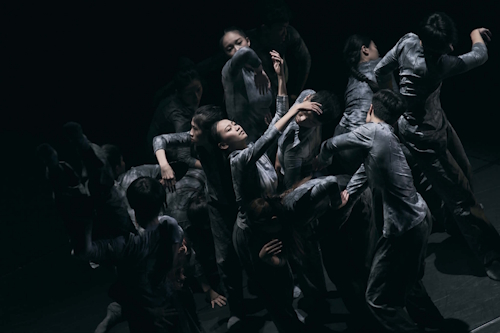
Photo Chang Chia-hao
Both programmes close with Once again, and again, commissioned specially from TNUA alumnus Yu Wan-lun, now dancing with Belgian dance theatre company Peeping Tom, well-known for the way their works take on a hyperrealist perspective and are set in an unconscious world of nightmares and desires where the viewer sees what usually remains hidden.
As it opens, smoke and fog roll in, from which dark figures in hooded capes on roller skates emerge only to disappear once more. It’s firmly in Peeping Tom territory and promises much. But that Once again, and again is Yu’s first ever piece for a large ensemble shows. Structurally, it’s all as fractured and chaotic as the soundscape, which shifts between music by British experimental composer Mica Levi, American multi-instrumentalist Eartheater, Latvian-born Himera, a Chopin nocturne, Johan Strauss II’s Blue Danube waltz, Pavarotti singing ‘O sole mio, Ravel’s Bolero and a lot else besides.
Dancers often appear as couples, the choreography appearing to show relationships in various phases. It’s very busy. Very busy. Almost nothing is given time to develop, a single and very impressive male duet being the sole exception. In tone, it’s different to everything else too, beautiful even. But while some of the brief scenes intrigue in themselves, the work quickly starts to feel like a collection of individual ideas and moments in random order. While that might reflect the comment in the programme that its’ all a “non-linear accumulation of lived, sensory experience,” it also makes it very difficult to make any sense of the work as a whole. It particularly loses its way in the final few minutes.
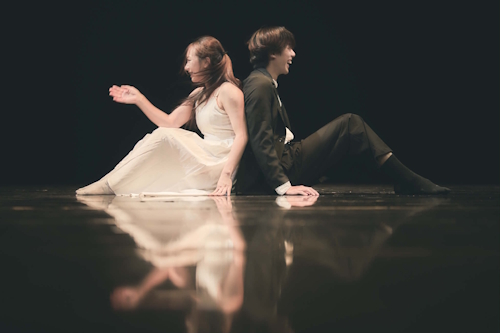
Photo Chang Chia-hao
The student choreographers are still discovering their choreographing skills too, but there are some very promising pieces among their creations. Like Yu, sometimes it felt they were trying to do too much though; to include too many ideas. The best works were those that stuck to their theme and kept it simple.
Most straightforward of all, Falling Maple Parting (楓落式告別) by Liao Shih-hsun (廖士勛) pictures a man (Wang Siang-yu, 王祥宇) walking on a carpet of autumn leaves of red and gold. When he picks one up, it sparks memories and the appearance of a woman (Yeh Yu-wen, 葉育妏) who clearly still has a big place in his heart
When hands eventually meet, there’s a lot of inventive partnering. Feelings appear to be mixed, though. Hints come of what might have happened. When he tries to push her away, she clings, again and again, but eventually does leave, her departure causing a few more leaves to fall like tears of regret. It really was quite poignant. When cleaners appear, sweeping up the leaves, it feels like they are sweeping away what happened. Except, of course, they can’t sweep away the lingering memory of what was. Perhaps, what might have been.
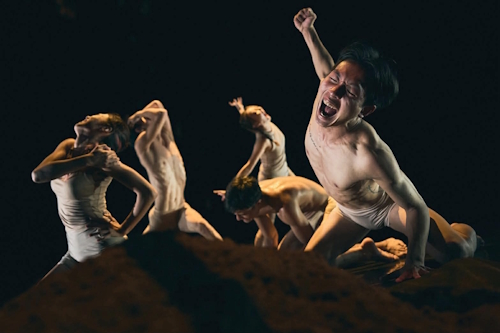
Photo Chang Chia-hao
Body Mind by You Yi-sian (游伊嫺) opens with a female dancer bringing on a sack of earth that’s carefully opened, an act that appears to release other dancers. What follows is intensely primal, the choreography sometimes very frenzied but with some terrifically athletic moments. It’s impossible not to see an echo of Pina Bausch’s Rite of Spring, although this is a very different work.
It is an impressively impactful piece although there is one uncomfortable moment when one of the men quite forcibly smears the woman’s face with earth from the pile. I feel sure the moment is meant to illustrate the power of the earth over the human body but, as she meekly accepts his actions, it felt and looked like an assertion of male power and dominance.
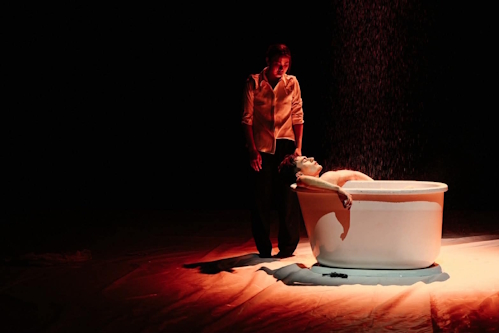
Photo Chang Chia-hao
For The Bath Murder Case (浴室殺人事件), You teamed up with Mo Ci-siang (莫棨翔) to choreograph and perform a sometimes amusing, sometimes surreal story. It centres on a bathtub. But why is the smartly dressed You hiding in it? Why does she want to murder the Mo? Who cares? Because what follows is great theatre, with super dance moments between the dark comedy of the drama. There are numerous failed attempts to stab him, a great danced fight, a super chase around the bath. And a gun. And a surprise as he takes it and shoots himself, the firearm emitting a shower of colourful streamers.
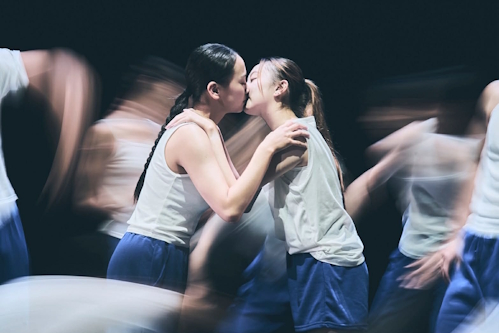
in l0v1 by You Yi-sian
Photo Chang Chia-hao
A third and again different in style piece by You, clearly a versatile choreographer, comes in the shape of l0V1. There are echoes of Eyal in the excellently constructed and danced opening: the tightness of the ensemble, the precise but small movement, the absolute oneness with each other, the pounding beat of Michael Wall’s music. Later, a great picture when two of the women are lifted and held aloft horizontally in an extended kiss. As the work explores the gradually deteriorating forms of communication in contemporary society, the togetherness of the ensemble falls apart. Unfortunately, so to some extent, so does the movement quality and the appeal.
Trail (痕) by Chang Zhi-xuan (張芷瑄) is Chinese dance influenced but with a very contemporary feel. Well-constructed, it makes excellent use of the ensemble of large dancers. Fabulously lit too.
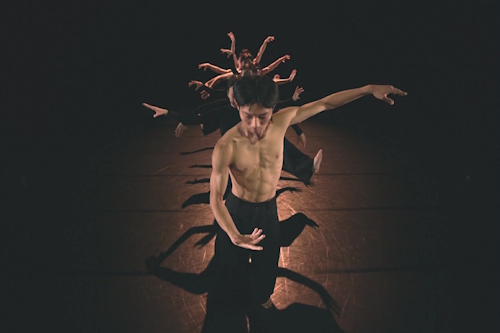
Photo Chang Chai-hao
Almost Awake (在夢裡見過你) by Yeh Yu-wen (葉育妏) deals with the way memories can suddenly come to the fore while awake. A couple in a spotlight are backed by other couples. It’s tender. But when she undresses to her nude underwear, I found the way he rather objectifies her, rather awkward. It seemed at odds with the programme, which talked of “the love… only grew warmer.”.
Vivid by Lin Jia-jhen (林佳蓁). one of two ballet pieces, is attractive exploration of ecstasy with lots of lovely choreographic moments. Attractively lit too, it also comes with a nice colour palette. The second, Imprints of Us, choreographed and danced by Li Meng-jie (利孟潔) and Lin Jia-jhen (林佳蓁), is slight, the two dancers frequently echoing each other without performing the same movement. But it was most memorable for the dreadful over-amplification of the Einaudi composition used for the first half.
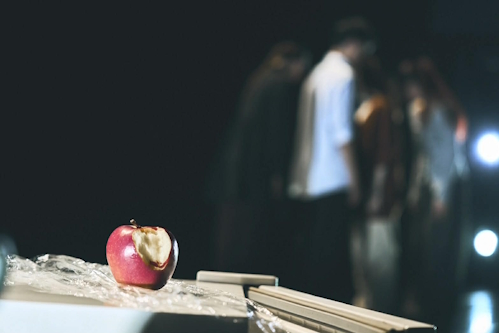
Photo Chang Chia-hao
RF. (冰箱) by Tsai Chen-jhen (蔡忱蓁) muses whether, if a fridge can be used to keep food fresh (an apple is used to good effect), can memories be preserved too? A great first half includes a quicky, light dance by Tsai and three men to Grace Lane Gallico’s ‘Bla, Bla, Bla, Cha, Cha, Cha’. Also by Tsai, oO includes some excellent dance, but the use of balloons as bubbles, which apparently long ago, perhaps we all lived inside, does not always work well.
Hit the Island by Lee Yu-cheng (李祐丞) is another look at human relationships. Including multiple ideas and movement styles, it felt somewhat confused.
Finally, Shadows (異影) by Mo Ci-siang never quite took off after starting well with the old trick of a woman dropping something, here a bag, in the expectation that a man, who she wants to attract, will pick it up. An exploration of reality and illusion, she may be very conventionally attired but he seems to ‘see’ her in a red dress.