
Royal Ballet & Opera, London
April 18, 2026
“Double, double, toil and trouble.” In Wayne McGregor’s Alchemies, the cauldron yields three transformations. In Untitled, 2023, the body turns to matter, brushstroke, paint and particle. In Yugen, it becomes voice, as if song had taken visible form. In Quantum Souls, the experiment grows stranger still, until dancers, musicians and audience all seem drawn into the same unstable field. McGregor’s title proves exact. This is an evening of transmutations.
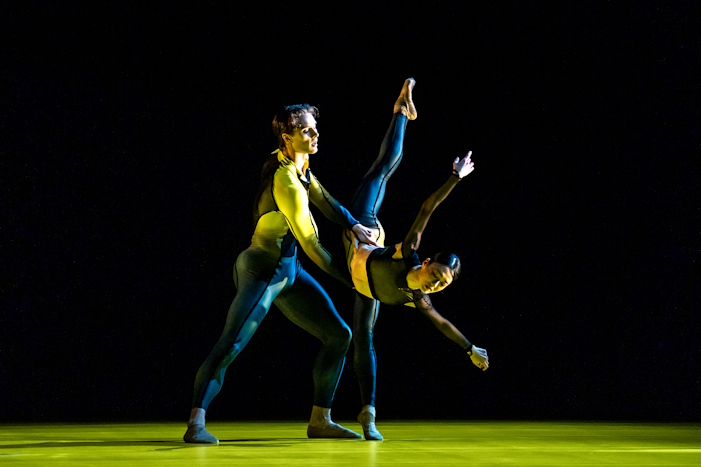
Untitled, 2023 begins in a near-clinical whiteness, split by a thin green line that reads at once as horizon, incision and abstract proposition. At first the dancers resemble pigment being mixed and stretched across a surface; more matter than recognisable human figures. White and green bodies gather, separate and recombine, as though the stage were moving from image to brushstroke, from brushstroke to paint, and from paint to something smaller and less stable still. By the end, with the violin line trembling on and on, the dancers seem almost particulate, matter that cannot stop vibrating.
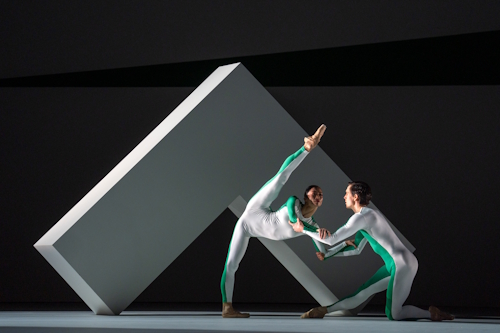
Photo ROH/Andrej Uspenski
This is one of the evening’s most compelling acts of abstraction. McGregor asks what kind of matter the body can become. The movement is controlled and beautiful, though not flawlessly so at first. A few early wobbles briefly expose the sheer precision the work demands before the dancers settle into its logic. Once they do, the piece clarifies.
Unlike more regular abstract works that flatten time through repetition, Untitled, 2023 resists hypnosis through irregularity. Synchrony appears only in flashes. More often, dancers move as if each were carrying a local logic of its own. Small clusters form and dissolve before they can settle into any stable pattern, so that the eye keeps shifting between single bodies, duets and larger constellations. The group shares a stage without fully sharing a common fate. Relation emerges most clearly in the duets, while the larger ensemble reads like multiple brushstrokes held in the same canvas.
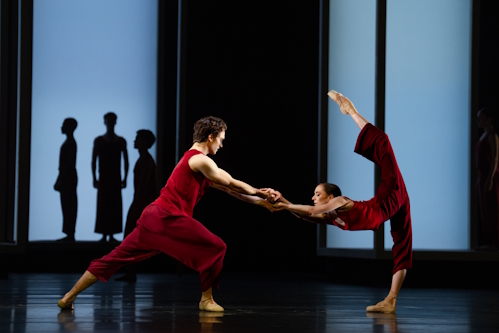
Photo ROH/Andrej Uspenski
In Untitled, 2023, the body becomes matter. In Yugen, it becomes voice. The shift is immediate. Cold white and green give way to warm yellow light and costumes in different shades of red. Edmund de Waal’s tall rectangular structures read both as display cases and as windows, flat and spatial at the same time. As the light within them warms, they begin to suggest a stripped-back sacred architecture, like sunlight entering a church through long unadorned windows.
I could not always tell whether McGregor was responding directly to Leonard Bernstein’s Chichester Psalms line by line, and in the end it hardly matters. The choreography’s real achievement lies elsewhere. The dancers do not seem to illustrate the text so much as embody the music. They feel like the choir’s voices given visible form. Phrases seem to swell, suspend and release with the choral line, so that the dancing carries the music’s breath rather than merely accompanying it.
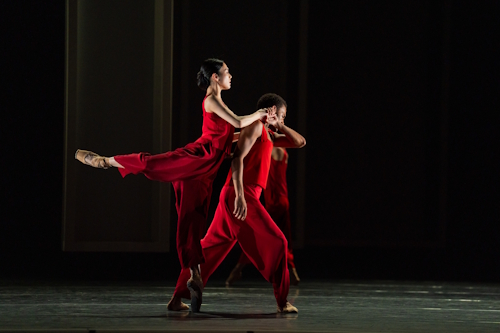
Photo ROH/Andrej Uspenski
Bernstein’s score is gloriously sung by the Royal Opera Extra Chorus, and the presence of Alexander Wright’s solo treble gives the sound a striking purity. When body and voice truly align, the calm that emerges can feel genuinely sacred. That is the work’s deepest strength. Human sound and human movement, two distinct expressive modes, suddenly operate as one.
Then comes Quantum Souls, the evening’s oddest creature and its most entertaining. On paper, this is the work in which live percussion, orchestral sound and dance are meant to enter a more immediate and unstable relation. On stage, that relation often feels curiously unmade.
Bushra El-Turk’s score drives hard, and Beibei Wang’s percussion presses insistently for attention, yet the eye keeps returning to the dancers. A few times, though, Wang’s percussion suddenly matches the dancers’ movement texture, and the whole stage comes alive. Those flashes show how thrilling the piece could be, which only makes the longer stretches of disconnection more noticeable. At many points I could barely hear the music as music at all.
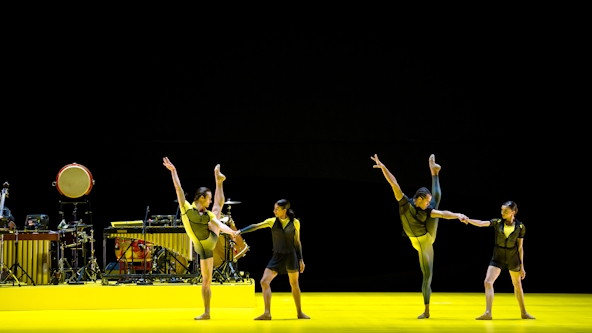
in Wayne McGregor’s Quantum Souls, part of Alchemies
Photo ROH/Andrej Uspenski
Oddly, that made the piece more interesting. Once I stopped trying to understand the score as the key to the choreography, the dancing opened up. With narrative stripped away and musical correspondence no longer something to rely on, the dancers themselves become the true instruments. What comes to the foreground is texture.
Among them, William Bracewell brought beautiful shaping, Melissa Hamilton extraordinary length and finish through the legs and feet, Emile Gooding a striking combination of control and tensile pliancy, Ella Newton Severgnini a softness that kept rounding into clear curved movement, and Harris Bell a more forceful charge. Their differences felt like those between orchestral players: even within a shared rhythm, each body retained its own grain, phrasing and small habits of emphasis. I found myself watching them as though they were the score.
The auditorium also became impossible to ignore. As Quantum Souls stretched on, the audience developed its own counter-rhythm of deepened breathing, shifting bodies, suppressed yawns and visible impatience. By the curtain call, that restlessness had entered the evening’s final texture.
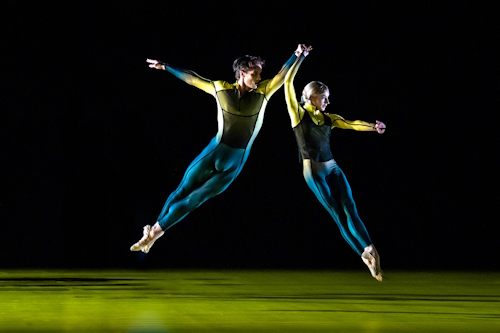
Photo ROH/Andrej Uspenski
I still do not know if Quantum Souls succeeds on its own terms. Even so, it became the evening’s most fascinating event because it gradually pulled the whole theatre into play. In the end, it felt as though everyone was performing it.
That, perhaps, is the clearest thread running through Alchemies. Three works, three very different strategies, one shared demand: look at the stage, look at the people on it, and do not blink. In one, McGregor makes the body into matter. In another, he turns it into voice. In the last, he turns spectatorship itself into part of the event. He remains, as ever, a builder of theatrical machines that swallow the viewer whole. Once inside, you do not simply follow a story. You dream within his system. Each return reveals something new, partly because the cast changes, and partly because you do.
On a personal level, the evening stirred intensely private feeling in me, drawing old conflict and unresolved memory into the act of looking. That has happened before in McGregor’s work. His stage opens a field in which performance and self begin to blur, and whatever the body has failed to put down rises back into view.