NTUA Performing Arts Center, Banqiao, Taiwan
March 28, 2026
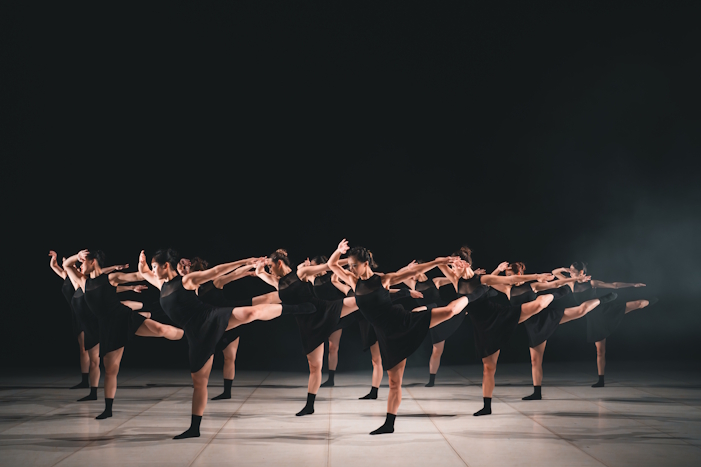
The graduation performance of Class 111 of the Dance Department of National Taiwan University of Arts (NTUA, 國立臺灣藝術大學舞蹈學系), titled 在Dˋ(zai D, a sort of wordplay that doesn’t translate well but that essentially means ‘here’ or ‘local’, referring to place) proved a superb evening of dance, not only of excellent performances, but also of very good student choreography, with a couple of works especially impressive. And, to top it all off, a restaging of Japanese choreographer Toru Shimazaki’s marvellous Zero Body (零極限).
Originally created in 2014 for the dance majors at Kobe College’s School of Music, Zero Body is inspired by part of the lyrics in a song from an animated film by Hayao Miyazaki. The choreography has no other connection with the movie, but Shimazaki was intrigued by the idea of the body becoming zero. With the aid of Dance Forum Taipei, who performed the piece in 2016, Shimizaki’s 30-minute creation was reworked for NTUA to accommodate greater numbers of dancers. If anything, it adds to its impact and power.
With the women dressed in black tops, short school-like skirts and socks, the single male in the ensemble in trousers, the choreography features rapid shifting footwork and straight, very defined rotating movements of the arm, and precise hand gestures. Softness sits very comfortably with sharpness and accuracy in a powerful modernist style, the almost non-stop dance capturing well the changing rhythms in American cellist Zoë Keating’s classical minimalist, looping music. The structure and formation draw you in completely.
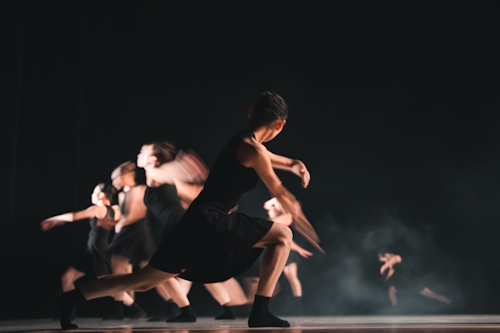
Photo Wang Yen-tun
But only occasionally are the dancers in unison. Rather, groups of varying size dance in canon. So, in the opening section for ten performers, four groups of four, three, two and one dancer follow each other, each group together but several counts behind or in front of the others. It’s quite mathematical in construction, and in one sense quite simple, but the resulting machine-like movement produces rippling patterns that are quite transfixing.
The second part has more individual moments but look around and there are connections everywhere, before it once more comes together in unison. The fluidity again paired with accuracy and elegance. Later, one section is particularly fast, another feels semi-robotic.
Zero Body calls for great concentration and timing. It needs discipline and dynamism, and absolutely got both. The whole cast was terrific.
There was much to admire in the student choreography too. Two works stood out in particular but everything was well-structured and well-lit as well as being excellently danced. Their mentors clearly did a fine job.
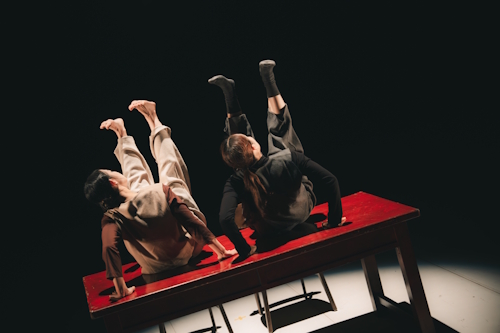
Photo Wang Yen-tun
Two women, two chairs and a farmhouse-kitchen style table. That’s the set up for Being With (同在) by Chao Chen-yu (趙晨羽) and Li Yi-yun (李宜芸), who also performed the piece. What follows is a very inventive dance, sometimes appearing as a conversation in movement, the dance often fast-paced, but with occasional pauses just as there would be if one was using speech. Meaning might not always have been clear, but the relationship between the two certain was. The interplay between Chao and Li was fabulous, as was their synchronicity in the brief unison moments. Their timing was spot on throughout, and it needed to be for the piece to work. And very neatly, it ends as it begins. Great music too in the form of Max Richter’s On the Nature of Daylight.
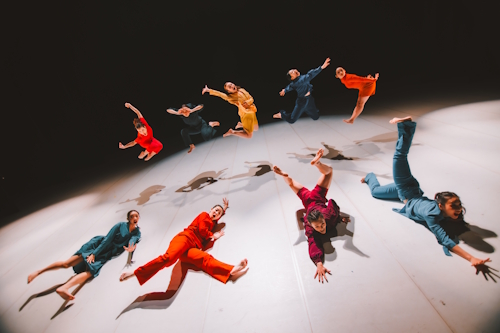
Photo Wang Yen-tun
Joy in Resonance (快樂ムメㄥ`) by Hsieh Chu-yen (謝竺諺) certainly brought a lot of smiles. Incredibly colourful and very inventive, it includes one dancer arriving late and getting changed on stage, human wheelbarrows, unison cartwheels and one dancer being chased around the stage by another while doing grand jetés. And a lot more. All to a wonderfully eclectic mix of music that was very cleverly used and that included Delibes’ Mazurka from Coppélia (it’s going to be very difficult not to recall this next time I see the ballet), and Offenbach’s Galop Infernal (Can Can). Yet, despite the offbeat choreography, it remained intensely musical. Bubby, energetic, a little bit crazy maybe; and great ,great fun.
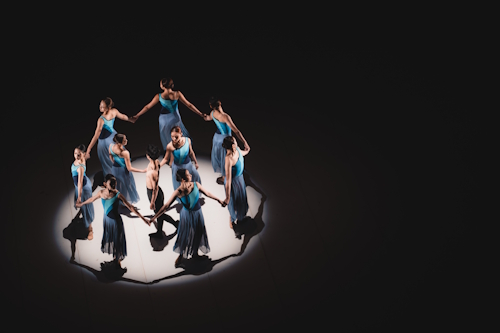
Photo Wang Yen-tun
Ravel’s Bolero is difficult music to choreograph to, as many have found out, but Chuang Chia-jie (莊嘉杰) did a pretty good job in Re-trace (波返), which picked up neatly on the cyclical nature of the score. Hsieh Chu-yen (謝竺諺) the sole male performer of the evening was especially impressive, the work at its best when he was at its centre
Elsewhere, ballet came in the form of an adaptation by Cheng Su-chi (鄭夙棋) and Yeh Chih-yun (葉芷妘) of the Waltz of the Flowers from George Balanchine’s The Nutcracker. A dance of pleasant patterns, it was neatly performed. In different classical vein, Ethereal Grace in Flowing Sleeve (婉旖仙韻) by Wu Yun-hsuan (吳畇萱) is a Chinese dance exquisite in form and as pretty as a picture. Making great use of water sleeves, it was performed with perfect lightness and grace.
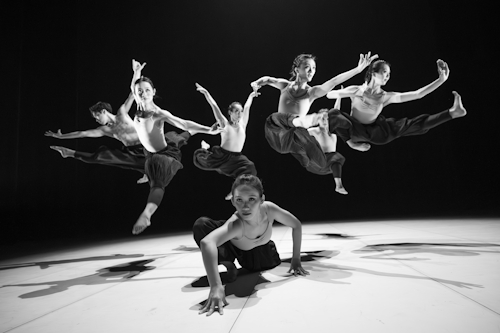
Photo Wang Yen-tun
Completing the contemporary pieces, Tongue of the Serpent (巳語) by Shao I-hsuan (邵翊萱) and Lin Chia-hung (林家虹) drew inspiration from martial arts movements found in Chinese dance, using the image of the snake to great effect.
Finally, Enigma.exe (謎·執行) by Li Jing-jie (李境潔) took up the theme of AI. Humans create machines, machines mimic humans. But if programs run autonomously, who is in control?
It was, by some distance, the most impressive evening of dance I’ve had the pleasure of at NTUA for many years. That, I feel sure, must be down in large part to the influence of artistic director for the performance, Lin Wen-chung (林文中), an excellent choreographer in his own right.
As he noted in his programme introduction, these performances are a sort of coming-of-age moment in the students’ dance careers. They should challenge the young dancers, their bodies and their minds. I hope 在Dˋ left a lasting mark in their memories. It certainly should have done, in the best possible way.