
Deutsches Theater, Munich
May 14, 2026
This spring and summer, Limonada Dance, led by Enrique Gasa Valga, is performing in Munich, presenting the choreographer’s latest works: in May Dorian Gray (2025), in July Der Fall Wagner (2024) and in August Carmen (2025). Spanish born Valga joined the Tiroler Landestheater in Innsbruck, Austria in the 2003/04 season as a dancer, and was then the theatre’s dance company from 2009 to 2023, when he founded his own company, which now tours Europe with a repertory of more than 40 shows, always with a live band on stage.
Dorian Gray is based on Oscar Wilde’s famous novel The Picture of Dorian Gray from 1890. It tells the tragic story of the extremely handsome and narcissistic titular character, who has his portrait painted by Basil Hallward. In the studio he meets the cynical dandy Lord Henry Wotton, who not only tells Dorian about his fleeting beauty and the transience of life and death, but also introduces him to all life’s vices. Dorian takes the painting, puts it in his attic. His vain wish that it ages instead of him is fulfilled. He abandons his girlfriend, who commits suicide, and he kills Basil Hallward. In the end he cannot live with his remorse and slashes the painting. It survives in its original appearance. Dorian dies.
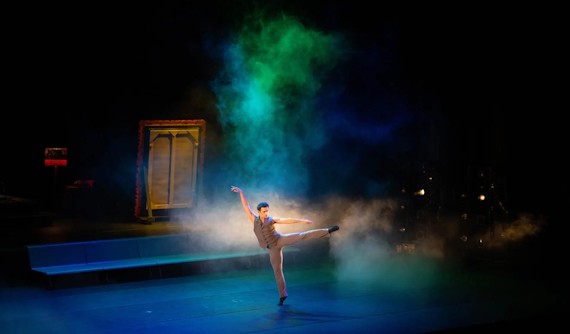
Photo Peter Koren
It is a complex story to put into dance, but Valga successfully reduces the action to the essentials: sex, drugs, two murders and an array of music ranging from compositions by the leader of the five-member band, Roberto Tubaro, who also did the arrangement, and by the Andrew Sisters, Lou Reed, Amy Winehouse and Bono. The band sits upstage on an elevated platform. Two singers, the Dark Soul Girls (Elisa Boggi and Greta Marcolongo), follow Dorian with songs expressing his moods and feelings, almost turning the piece into a musical.
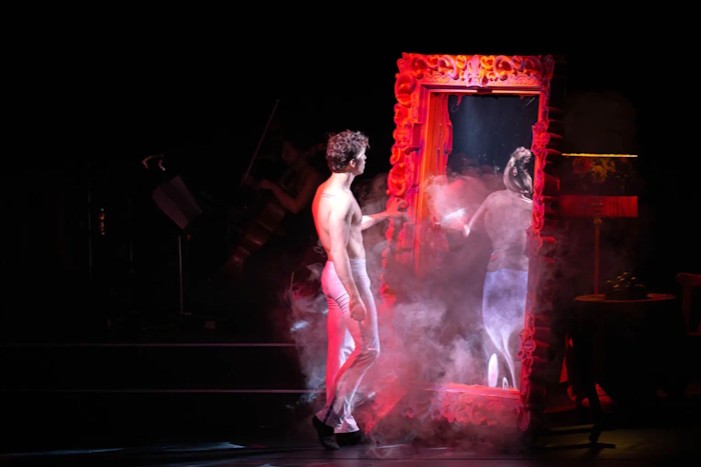
Helfried Lauckner’ set is an oversized mirror in a thick, heavy frame that is shoved around on wheels; an armchair, in which Dorian rests or seeks refuge; and a couple of benches being pushed in and out by the dancers. Costumes are 1950’s inspired, by Birgit Edelbauer-Heiss.
The action is a mix of solos, duets and ensemble pieces in quick succession. The choreography fuses ballet with jazzy hips and shoulders and body rolls, which the dancers master very well. The women are all ballet trained and standing splits seem like the easiest thing to do.
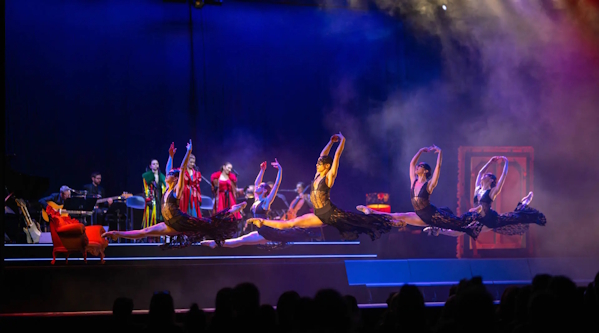
Photo Peter Koren
Dorian Gray begins with Basil (Gabriele Tamolli) and Lord Henry (Martin Segeta), raving about the painting in a duet with many turns in attitude. Then comes Dorian (Locke Venturato). Taller than everybody else, clad in white and with his black, wavy hair he, looks like a star. Entering a party, society, represented by an ensemble of six and four dancers in characters roles, clusters around him. It becomes clear that he is everybody’s darling.
Dorian weaves in and out of ‘talks’ with Lord Henry and raving parties. At one, he meets Sybil (Camila Danesi), and they fall in love. Their first duet is full of loving gentleness. She tells her mother (Chiara Malavasi) and brother James (Gabriel Marseglia) how happy she is. Dorian tells Lord Henry, who reproaches him, which makes Dorian reject her in their next duet. This causes Sybil to commit suicide in a grueling solo, her body rippling in convulsions, and that ends with her strangling herself.
Reproached for his depravity by Basil, Dorian kills him. Then follows scenes in a nightclub with the women in skimpy, sexy attire, the men with naked torsos. The dancing is wild and unrestrained. And then, in an opium den with everybody in purple bathrobes, the action centered around Lord Henry.
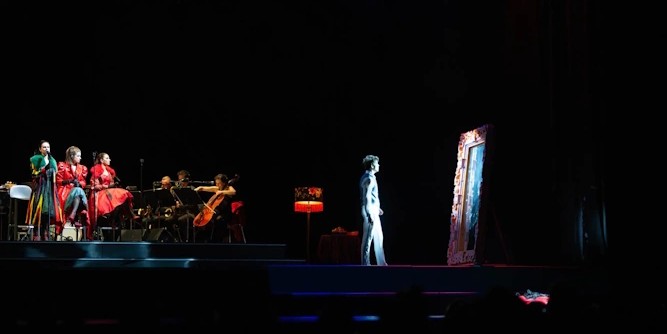
Photo Peter Koren
When Sybil’s brother confronts Dorian about his sister’s death, they perform a duet full of aggression, like two boxers in a ring, both wearing coats flying around their bodies. It ends with another murder. Dorian strangles James with his bare hands, a variation from the novel, where he dies in a shooting accident.
Towards the end Dorian’s past comes to haunt him. He sees Sybil’s, Basil’s and James’ ghosts, tries to follow them, talk to them and touch them, but only grips empty air. He also falls out of favor with society, who inexplicably now wear masks with ears. Dorian returns to the mirror now crinkled, distorting his looks. A woman closes in on him and smears his naked torso with what looks like blood. He slashes the mirror, and everything turns dark.
The dancers were good and the characters well drawn. What also makes Dorian Gray work well is the condensing of the story, the swift changes between dances by the main characters and the ensemble, and by not placing of the work, musically, or in sets and costumes, in the time in which the novel takes place. It is fun, tragic and entertaining throughout.