
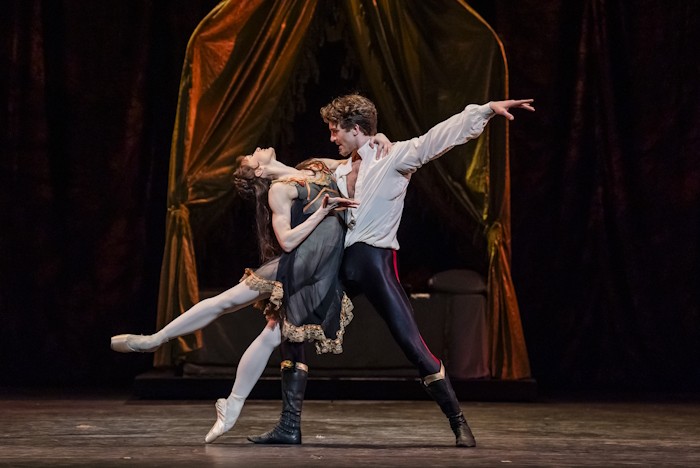
The Royal Ballet at the Royal Ballet & Opera, London
March 30, 2026
At first glance, Mayerling looks like a Seurat painting brought to life: glittering uniforms, sweeping dresses, formal dances, aristocratic surfaces, a world of ceremony holding its shape at a distance. Up close, the image breaks apart. Sir Kenneth MacMillan’s ballet is built from fractured needs, twisted intimacies and bodies that say what the characters themselves cannot.
Its power lies in the way relationships become visible as bodily structures. Crown Prince Rudolf does not move through the ballet in search of one great love. He seeks different things from different women: dominance from his wife, a form of impossible comfort from his mother, pleasure and release from Mitzi Caspar, and, in Mary Vetsera, the dangerous pull of youth, desire and life itself. MacMillan gives each of these needs a different physical language: touch, weight and rhythm all change.
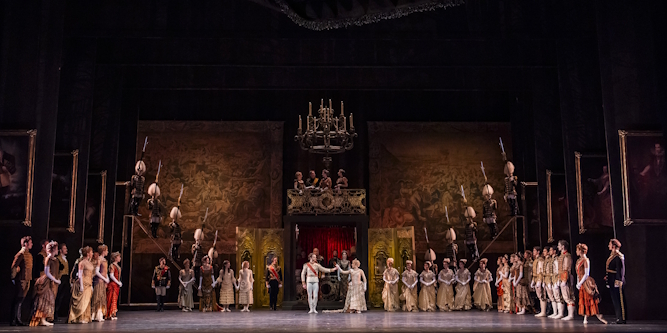
Photo Tristram Kenton
That precision is there from the first act. Rudolf’s duet with Princess Stephanie is not intimacy gone wrong. It is a structure of intimidation, coercion and humiliation. Threatened first by the revolver and skull, Stephanie still tries, briefly, to claim some initiative. MacMillan then strips that away step by step.
Matthew Ball’s Rudolf pushes, pulls and manipulates her body with increasing force, lifting her without letting her settle, denying her both balance and escape, until resistance drains into helplessness. Meaghan Grace Hinkis makes Stephanie’s trajectory painfully clear, from the first flicker of resistance to a body gradually emptied of the power to resist. By contrast, Rudolf’s exchanges with Princess Louise (Mica Bradbury) are more extended and languid, with a softer stretch to them, while his encounters with Countess Larisch (Mayara Magri) are shorter, sharper and more impatient, as though he is pushing away something that still wants to remain.
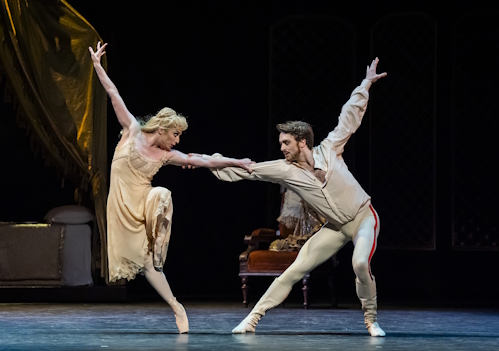
in Kenneth MacMillan’s Mayerling
Photo Tristram Kenton
Rudolf’s scenes with his mother are among the ballet’s most unsettling. He appears to want comfort, recognition and some form of maternal acceptance, yet MacMillan choreographs their encounters with an intimacy too physically charged to remain innocent. Kristen McNally’s Elisabeth holds herself with the reserve of someone unwilling, or unable, to yield what her son most wants from her. Their duet offers entanglement rather than consolation.
The second act complicates any easy reading of the ballet’s women as mere casualties of Rudolf’s collapse. Mitzi Caspar, in particular, emerges as one of its strongest centres of agency. In the tavern scene, she knows exactly what she is doing and shows no shame in it. Even in the sequence with four men, the axis of choice still seems to belong to her. She controls the terms, even when she appears to yield them. Mariko Sasaki gives Mitzi the assurance of a woman who understands both the value and the limits of what she offers.
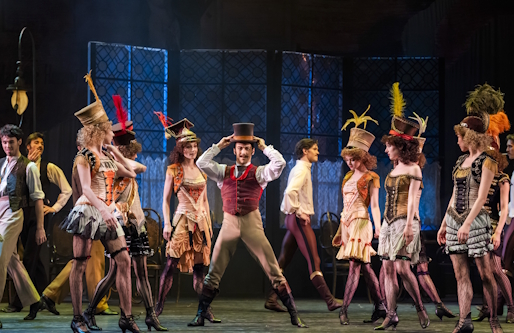
Photo Tristram Kenton
Rudolf, for his part, is loosest here in every sense. In the brothel his body sheds some of the stiffness and ceremonial tension that cling to him elsewhere. Desire, pleasure and temporary escape replace the pressures of dynasty and decorum. Yet Mitzi finally betrays him. She is no refuge, and certainly no possession.
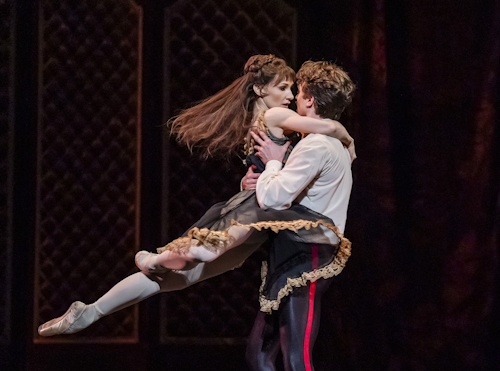
Mary Vetsera is more difficult, and more tragic, precisely because MacMillan does not make her innocent in any simple way. She is young, but not blank. She chooses to believe the fortune telling, chooses to write, chooses to meet Rudolf, and plays with skull and revolver as someone already fascinated by danger. In the bedroom duet of the second act, she does not merely submit to Rudolf’s desire. She helps drive it.
Ball’s Rudolf can look like a creature maddened by erotic provocation, while Melissa Hamilton gives Mary more than youthful softness, making it active at first, full of provocation, appetite and reckless life. That is what makes the third act so devastating. The same softness that first reads as vitality and seduction becomes, in Hamilton’s performance, the source of Mary’s vulnerability. Her pliant body no longer suggests promise or erotic charge. It begins to register pressure, constraint and the terrible fact of being overruled.
in Mayerling
Photo Tristram Kenton
Countess Larisch, too, emerges as a far sadder figure than the synopsis suggests. On stage, Mayara Magri never lets her slip into mere plot function. Even when Rudolf dances with Louise, Larisch watches, thinks, waits. She remains emotionally alive to her own humiliation and exclusion. When Rudolf’s mother blocks her from reaching him in his collapse, Larisch calls Mary into the space left empty by her own exclusion. Larisch uses Mary as a way back towards Rudolf, while Mary uses Larisch as a way into his orbit.
Throughout the ballet, MacMillan repeatedly places women in opened yet constrained positions, especially with the arms drawn or held behind the body. The motif appears across different relationships, even in scenes involving Elisabeth, and can suggest pain, struggle, erotic charge, surrender, display or control, sometimes all at once. At times a woman is forced into that shape by her partner. At others she seems almost to choose it, knowingly placing herself there. In Mayerling, submission, pleasure and coercion remain dangerously close to one another.
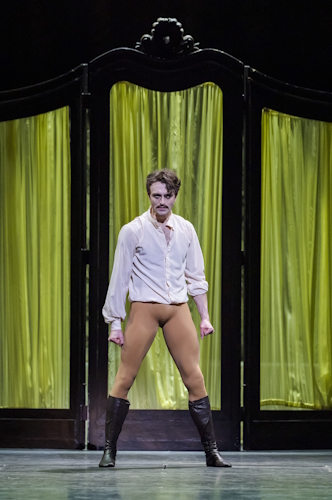
Photo Tristram Kenton
Music deepens this unease. There is almost no genuine romantic shelter in the score’s atmosphere. Even the bedroom duets carry danger in their pulse. In the final scene, when Rudolf and Mary struggle on the floor before the murder-suicide, the timpani beat out something like a human heartbeat. It is a brilliant, chilling choice. Life is still audibly there, still pounding in the body, even as death has already been decided.
Ball’s performance anchors all this with remarkable stamina and psychological clarity. By the third act, his Rudolf enters almost as a ghost. The body is present, but the person seems already elsewhere. Something in the small, restless footwork and the unstable shifting of direction makes him look uninhabited, as though thought and flesh have come partially apart. After the accidental shooting, the body registers psychic collapse through muscular tension, imbalance and moments of failing support. The role is punishing physically, with its relentless lifts and duet work, yet what lingers is the sense of mental and spiritual exhaustion.
Ball’s real achievement lies in differentiation, however. Hinkis, McNally, Sasaki, Magri and Hamilton each draw a distinct physical and psychological response from him. Rudolf kisses, grasps, drags, clings and collapses his way through the ballet, a man feeding on different women for different needs and destroying each relationship in the process.
Earlier in the day, I had been reading Oscar Wilde’s The Critic as Artist, with its line about mourning tragedies that are not one’s own. Mayerling leaves something like that behind. The ballet carries grief, control, desire and collapse through the body until the tragedy feels physically lived, not merely narrated. After the curtain falls, what remains is the pressure of those bodies, pulled, opened, resisted, spent, and finally broken under the weight of need.