
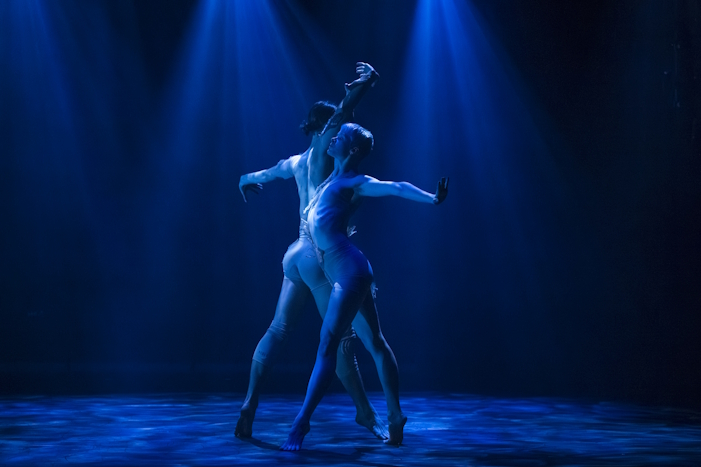
Linbury Theatre, Royal Ballet & Opera, London
April 16, 2026
International Draft Works 2026, presented in the Linbury Theatre, brings together The Royal Ballet and eight international partners in a platform for emerging choreographic voices. In one compact evening, nine works from nine companies sit side by side, offering a snapshot of how ballet and contemporary dance are being shaped across different institutions and training cultures.
The evening also reveals how quickly the language around new work begins to blur. Across the programme notes, the same words recur with striking frequency: resonance, connection, communion, human connection, shared energy, shared excess. The evening only starts to sharpen when those ideas stop sitting in the notes and start taking on weight, pressure and consequence in the body.
That is why the evening comes most alive in works such as the excerpt from Flux by Katya Bourvis for Ballet d’Jèrri, À perte de vue et au-delà (Beyond what the eye can see) by Maxime Thomas for Paris Opera Ballet, and Gush by Alyssa Martin for The National Ballet of Canada. These pieces do not merely gesture towards connection. They give it pressure, texture and consequence.
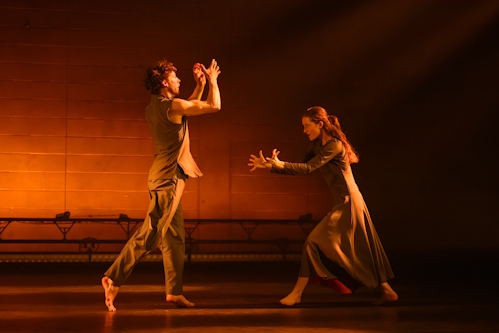
in Flux by Katya Bourvis for Ballet d’Jèrri
Photo Foteini Christofilopoulou
In the excerpt from Flux, presented in two sections danced by two different pairs, the witch-trial premise matters less than the way power shifts through the duet form itself. The first section has an underwater quality, slow and pliant, with Tabitha Dombroski and Stanley Young moving like strange aquatic creatures in flesh-toned costumes edged with something like seaweed.
The second part is far clearer and more unsettling. Here, the woman, Anna Daly, begins in command, hissing, laughing, summoning the man, Donovan Délis-McCarthy, into her rhythm and making him follow. Her authority is theatrical at first, almost exaggerated, as if the work wants to make her otherness unmistakable. Gradually, though, that advantage drains away. The duet changes direction almost without announcing it, until the woman’s body reads less as a source of power than as a body being contained and overpowered. By the end, one image lands with particular force: his arms reach over her shoulders and cross in front of her chest; she pulls against that crossed hold and throws her head back, and the image lands almost like a beheading. Here, persecution enters the movement grammar.
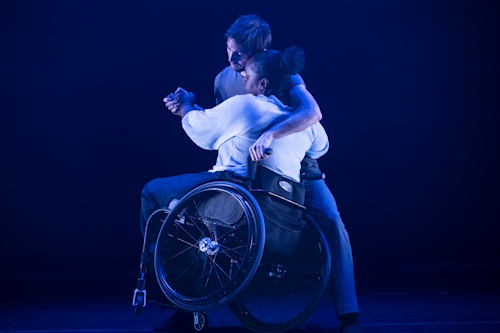
in Thomas’ À perte de vue et au-delà (Paris Opera Ballet)
Photo Foteini Christofilopoulou
The Paris Opera Ballet duet reaches its strongest point by very different means. In À perte de vue et au-delà (Beyond what the eye can see), a wheelchair quickly becomes an active part of the duet’s structure, supporting, carrying and redirecting the movement. It changes the logic of partnering from the start.
As the pace quickens, the most interesting passages are those in which dancers Gladys Foggea and Maxime Thomas both retain a degree of independence. The dance holds support and autonomy in tension, giving both dancers room to remain distinct. The relationship itself remains open, and that uncertainty keeps the piece alive. By the end, when the wheelchair returns to the stage with a presence of its own, the duet shifts towards something closer to memory, trace and the afterlife of contact.
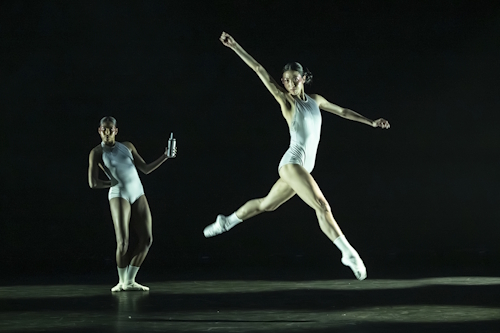
by Alyssa Martin of The National Ballet of Canada
Photo Foteini Christofilopoulou
Gush takes female communion in a louder, messier direction. Set to an eccentric vocal score full of odd, non-singing human sounds, it begins with one dancer holding a drink in a sharply stylised pose, all attitude and crooked ease, while the other moves beside her. Only later do the two women, Agnes Su and Tene Ward drink together, crush the cans and throw them aside.
From there the duet feels closer to a club ritual than to any conventional pas de deux. The dancers slap their bodies, clap, tug at their costumes to create sound, and move with a swagger that is playful, charged and knowingly performative. The work has real pulse because its idea of togetherness arrives through shared attitude, shared rhythm and shared excess, giving the duet a charged, social life.
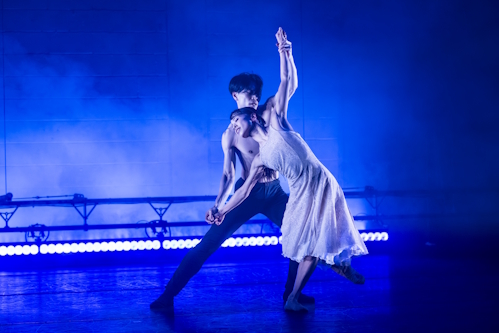
in Re:sonance by Yoshito Kinoshita
Photo Foteini Christofilopoulou
Elsewhere, the evening is less persuasive when the choreography remains gentler or more abstract than its own description. Re:sonance by Yoshito Kinoshita for the National Ballet of Japan is graceful, flowing and carefully danced, with a soft, continuous quality that matches its stated interest in energy passing between two bodies. Danced by Ryosuke Morimoto and Haruka Soutome, the movement stays gentle and elongated, even in the turns, with little sense of attack or interruption, so that the duet keeps returning to smoothness rather than risk. The programme’s language of resonance and mutual fusion remains more legible as concept than as stage event. The duet is tender and polished, but rarely sharpens into anything more distinct. What lingers is a sense of calm continuity.
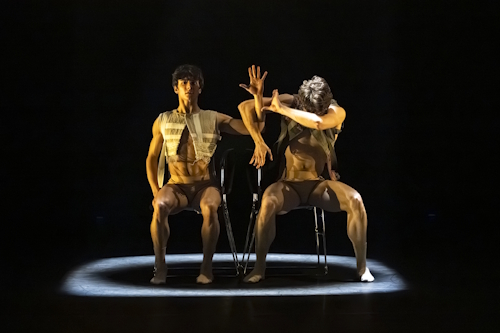
in Words to the Wind by Denilson Almeida
Photo Foteini Christofilopoulou
Words to the Wind by Denilson Almeida for The Royal Ballet, danced by Martin Dias and Caspar Lench, is framed in the programme through Brazilian rhythms, Afro-Brazilian culture, vulnerability, guidance and human connection. In performance, what comes across most clearly are several attractive passages of partnering between two young men, especially in the slower, more open stretches of the duet.
There is tension and cooperation in the dancing, but the work’s larger promises remain indistinct, with the movement often staying broad and lyrical where one hopes for a stronger choreographic pull. The piece points towards emotional and cultural depth, but never gathers enough choreographic force to make that depth fully present. A few passages stay with the eye. The world around them never fully arrives.
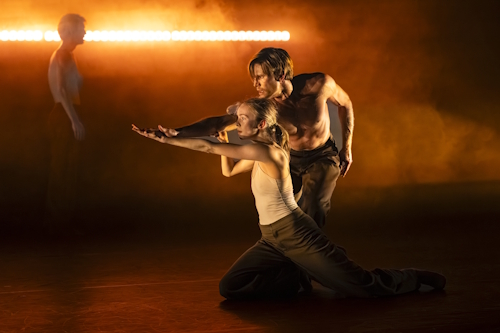
in un:discovered by Douwe Dekkers
Photo Foteini Christofilopoulou
un:discovered by Douwe Dekkers for Norwegian National Ballet, danced by Nell Ramstad-Petersen, Silas Henriksen and Simon McNally, also leaves a lighter impression than its programme note suggests, though its structure is clear enough. Ramstad-Pedersen dances inside a rectangular block of light. One of the men watches from outside it; the other reaches into the lit space, takes her hand and draws her out. Later she returns to the rectangle, another man approaches, and the pattern shifts again. The piece is organised around approach, withdrawal and exchange, with the rectangle of light functioning as a boundary of possibility. The field of light gives the work its clearest image, while the relationships formed around it remain comparatively faint.
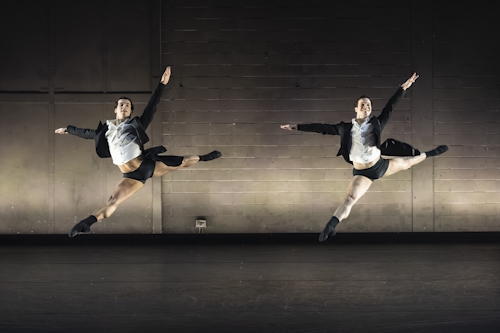
by Heather Lehan for Northern Ballet
Photo Foteini Christofilopoulou
A third group of works succeeds on a smaller scale by being clearer about its own character. Staves by Heather Lehan for Northern Ballet opens the evening with charm, precision and a bright theatrical good humour. In cropped tailcoats, with immaculate hair and smiling faces, Noah Benzie-Drayton and Archie Sherman make musical structure visible through obvious but effective phrasing, so closely tied to the score that melody and rhythm seem to pass directly into the body. There is even something faintly reminiscent of Paul Taylor in its cheerful polish and lightly comic air. Its wit and polish give it buoyancy, and its lightness never feels cheap.
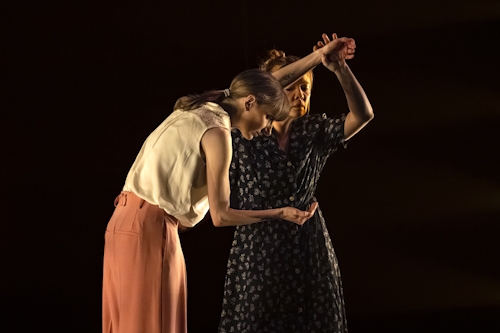
Photo Foteini Christofilopoulou
Houndstooth by Carling Talcott-Steenstra for the Royal Danish Ballet, performed by Mads Blangstrup, Esther Lee Wilkinson and Kizzy Matiakis carries a faintly neurotic domestic air. Its voiceover sounds like the inner script of a wife or mother, full of tasks, corrections and the pressure of keeping things running. The older woman is repeatedly drawn into acts of care, adjusting clothes, tending, maintaining order, while the others move around her with a vaguer, more elusive logic. I did not find the piece wholly legible, but I did not need to in order to feel its structure. It places the woman inside the labour of upkeep, then simply lets the evening move on without her. When she is gently lowered to the floor and the other two put on their coats and leave, the image lands with a chill the rest of the work only intermittently reaches.
Ultra Folly by Sarah Foster-Sproull for the Royal New Zealand Ballet brings a lighter, more playful kind of social choreography. It is the only work of the evening in which the women dance on pointe, while the men also wear skirts in costumes that lightly unsettle expectations from the outset.
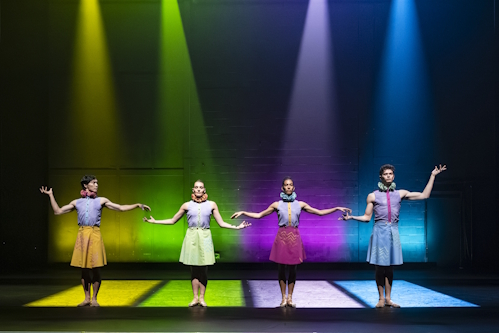
Photo Foteini Christofilopoulou
At the start, dancers Ana Gallardo Lobaina, Joshua Guillemot-Rodgerson, Kihiro Kusukami and Kirby Selchow stand in a line with their hands poised above or below one another, almost touching, looking at each other while contact never quite happens. From there the piece moves through a series of shifting combinations: male-female, male-male, female-female, full quartet. At one point the group briefly picks on one of the women, only to fold back together again. By the end they return to a line, wiping their hands on their skirts and casting one another sidelong, faintly disdainful looks. Nothing here needs to be profound. The game is clear, and the piece knows how to play it. Its pleasures lie in pattern, attitude and shifting group dynamics.
Seen as a whole, International Draft Works earns its keep by refusing to resolve into a single picture of what new dance should be. Instead, it lays out nine attempts, some vivid, some thin, some sharper in thought than in movement, and lets them sit side by side. By the end, the evening has quietly redefined its own favourite word. Connection is no longer a soft aspiration. It has become something more exacting: synchrony, coercion, care, swagger, support, instability, exchange. The strongest works make these conditions visible in the body. The weaker ones leave them suspended in language, still waiting to become dance.