
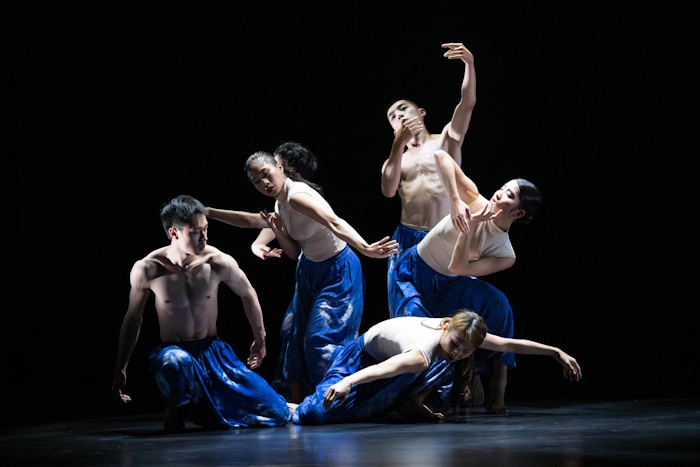
Taoyuan City Culture Center Performance Hall, Taiwan
April 12, 2026
In 2025, Chun Dance (君舞蹈劇場) from Taoyuan in Taiwan delighted audiences at the Gothenburg and Edinburgh Festival Fringes with Trace of Belief (痕跡). This year, following up on their success in 2024 with Portrait of the Body (關於身體的書寫), dance-goers at Avignon Off will get to enjoy what is a fine fifty minutes of dance that recently returned to home stages.
Artistic director Hsieh Yi-chun (謝宜君) is known for contemplative choreography that’s expressive while avoiding any linear narrative. Traces of Belief follows that path being an exploration of self, at the centre of which is Hakka culture, Hakka being one of the larger of the many ethnic groups in Taiwan. It is, in many ways, a personal letter in movement.
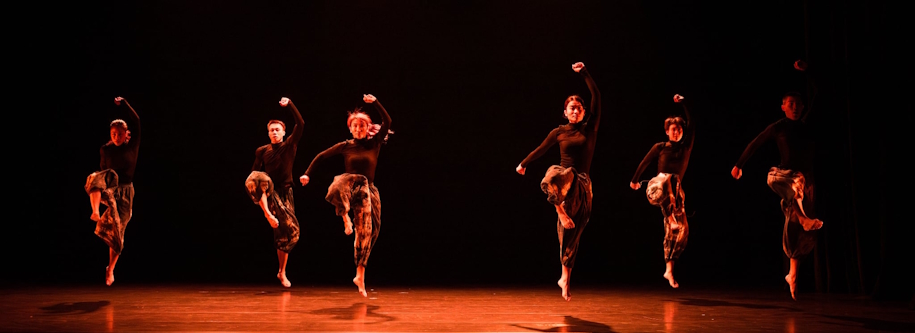
Photo Chang Chen-chou
The choreography is, in part, reflective and to some extent draws on memories. But while full of cultural symbolism, it is also very much of today as Hsieh reinterprets Hakka culture through a very modern lens. While the movement undoubtedly references tradition, her choreographic language equally includes significant elements from contemporary dance.
The soundscape by Hans Tsai (蔡秉衡) equally fuses modern sounds with traditional elements including gongs, drums, cymbals and suona horns or flutes, the latter a Beiguan instrument played during weddings, funerals and at festivals in honour of deities. It’s also used in opera and sung music where it’s remarkably good at imitating the human voice.
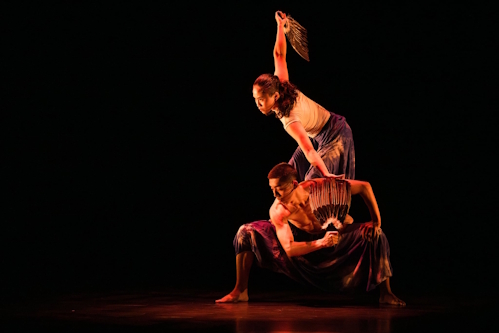
Photo Chang Chen-chou
Traces of Belief opens with the ensemble of three men and three women, all dressed in stunning blue wide-legged trousers with splashes of white, standing, swaying gently, reflecting the sound of dripping water heard in the soundscape. The natural world is to the fore. There’s birdsong song. As the choreography develops, and the sextet awakens, images of waves or water swirling come to mind, individuals sometimes breaking away from the ever flowing, shifting group before rejoining once more. Very slowly, those groupings become more complex.
Later, the dancers carry feather fans, often seen in temples and at traditional festivals. As they hold them in front of their faces, they sometimes take on the appearance of mythical creatures. A male duet in which both carry the fans is intense and full of power.
The importance of human relationships is more than hinted at. One duet that opens with the man carrying the woman on his back is particularly impressive, the partnering complex but all performed with ease.
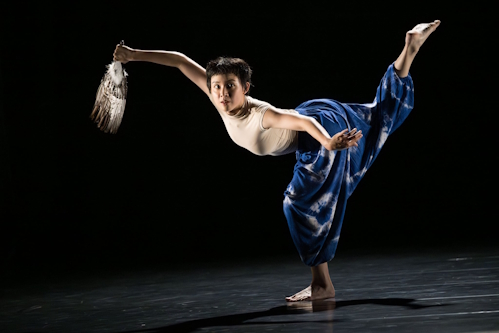
Photo Chang Chen-chou
There may be several changes in the landscape of the work, but the dance is always beautifully paced, changing colour and sound as well as variations in movement vocabulary guiding the viewer. At times, the choreography is almost meditative but elsewhere it drives forwards with urgency. The narrative or emotion always shifts organically, however. Changes in tone are never sudden or jarring. One section in particular comes with a very modern dance energy and movement vocabulary. It’s all beautifully lit by Wang Yung (王墉), whose subtle colour variations and occasional haze add to the atmosphere and ambiance.
Traditional and modern, religious and secular. All blended and overlapped in pleasing ways that draw the viewer in and that leave space to create images and personal meaning in his or her own mind. That’s Traces of Belief. But constant throughout is the human body, and that’s where the work ends, with Hsieh stripped of her outer garments, standing proudly, staring out at us defiantly. You feel she’s making a statement. There are no words, but none are needed. ‘This is who I am.’