
Sadler’s Wells, London
April 7, 2026
At Sadler’s Wells, I paused in the corridor over a glass panel in the floor and looked down at the old well beneath the building. For a moment, the theatre seemed to open onto its own history. Watching Kontakthof – Echoes of ’78, I found myself returning to that downward glance. It asks the present to stand above the past and look into it: into black and white images, vanished bodies, absent colleagues, and the performers’ younger selves still moving below the surface.
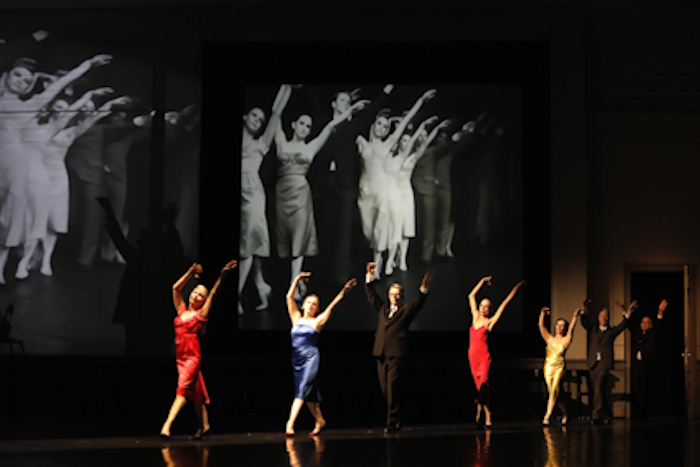
Conceived and directed by Meryl Tankard, the work brings together surviving members of Pina Bausch’s original 1978 cast, placing their present-day bodies alongside archive footage of their younger selves and of colleagues no longer alive. Now in their seventies and eighties, these performers carry time on stage as visibly as movement itself. On this evening, Elisabeth Clarke was absent through sudden illness, a real-life gap that deepened a piece already shaped by memory, ageing and loss.
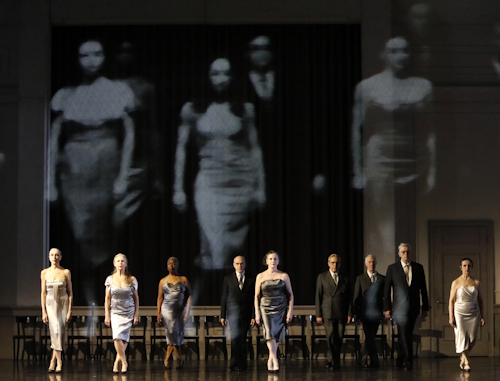
Photo Oliver Look
Black and white archive footage gives the evening its first shock. I had almost forgotten that old images once came in black and white. Here, that fact matters. The past arrives already marked by a different texture of time. Young faces look full and mobile, bodies quick and buoyant, while on stage those same performers move with age written into them: loosened flesh, altered weight, a different pace. Arthur Rosenfeld captures the strangeness of this encounter with simple precision: “It’s you and not you.” For those no longer alive, the effect is stranger still. Those no longer able to step onto the stage remain present in another way, the archive carrying them back among the others.
What follows is much harder to reduce to story. The opening has the air of a school inspection: clothes, hair, teeth, palms and backs of hands all examined in turn. After that, the stage erupts into fragments of social ritual, half comic and half cruel. People shout, jump, sing, speak, moan; men and women circle one another in ways that shift by turns between flirtation, humiliation, provocation and conflict. A naked couple appears in the archive footage. There is often no clear sense of narrative, yet the emotional atmosphere remains strangely exact. The social grammar remains too, but age changes its flavour. The gestures now carry awkwardness, humour, fatigue and sorrow all at once.
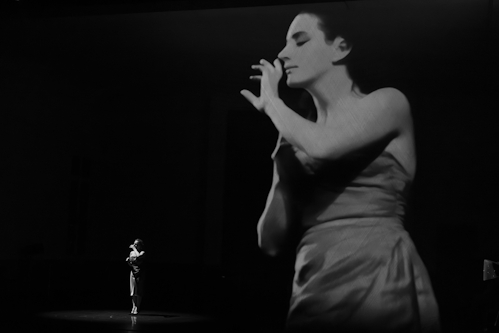
Photo Oliver Look
Before the interval, Tankard sits down with Josephine Ann Endicott, Lutz Förster, John Giffin, Ed Kortlandt, Beatrice Libonati, Anne Martin and Arthur Rosenfeld, who introduce themselves by name, age and birthplace. Some speak of regret, some of long partnership. One brings a baton. One says nothing beyond the bare facts. What moves is the weight and fullness inside their calm voices. Humour, gratitude, regret, love and longing were all present, only carried now with greater steadiness.
The second half draws the body closer to the centre. It is Endicott who climbs carefully onto the chair and then the small raised platform, her caution almost childlike, before turning to the screen image of her younger self and speaking with playful affection, admiring both her sweetness and that younger body’s unstoppable dancing. The moment is funny, but it lands with the full force of time.
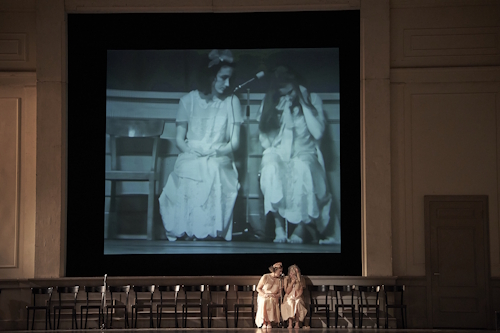
Photo Oliver Look
Before the interval, Endicott speaks of always being grateful for her body. Later, when the words ‘bring back my body’ are sung and she breaks into tears, the phrase opens in several directions at once. It may suggest bodily autonomy, but it also seems to call out for something age has taken away: the younger body, the tireless body, the body one once inhabited without thinking.
A different, darker line runs through Tankard’s material. In the long sequence with a pink childlike dress, men crowd around her image in the archive footage, touching, lifting and handling her in ways that feel by turns invasive, playful and clinical. On stage, she first echoes those touches with her back turned, then slowly faces the image. The scene lasts long enough to become genuinely uncomfortable. Age makes the work’s cruelties harder to bear.
The women, in different ways, seem to return to their own bodies as much as to former colleagues, with delight, wit and renewed presence. The men bring something gentler: companionship, warmth, and a quieter form of return.
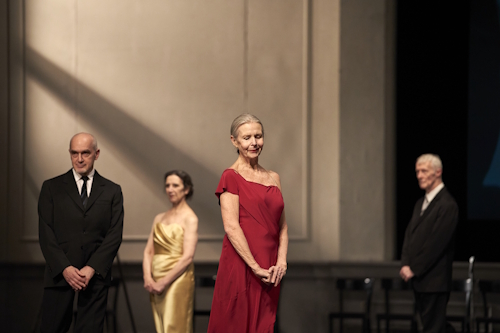
Photo Oliver Look
A stage once built around the rituals of display and negotiation between men and women becomes, here, a reunion. The love on view is no longer simple. It carries gratitude, memory, companionship, loss, and the strange tenderness of meeting one’s former self again.
Throughout the evening, chairs remain on stage as places both occupied and unoccupied. Many of them seem to hold absence as strongly as presence. They recalled empty chairs and empty tables: spaces where people should be, and are not. Even the instant photographs taken during the ballroom sequence seem shadowed by that feeling, as if they might capture only a gap, a trace, a place where somebody once stood. What this version finally holds is the continuing life of bodies that have changed, endured and outlived others. Youth is not restored. Loss is not resolved. The stage gathers humour, embarrassment, memory, longing and grief, then lets them remain side by side.
Kontakthof – Echoes of ’78 brings Rainer Maria Rilke uncannily close. Der Sommer war sehr groß. Wir alle fallen.
The summer was immense. We all fall. For a moment, the stage lightly holds that falling.