
Sadlers Wells, London
May 12, 2026
Twenty-five years after Michael Nunn and William Trevitt first launched BalletBoyz with Pointless, the company returns with Still Pointless: BalletBoyz at 25, an evening that looks back without feeling trapped by nostalgia. It is, essentially, a retrospective: nine works, by choreographers who have helped shape the company’s identity across a quarter of a century.
That identity remains clear. BalletBoyz has always sat slightly aside from the usual ballet and contemporary categories. It is a company built around physical attack, technical sharpness and a willingness to place ballet-trained bodies inside rougher, more theatrical, more cinematic worlds, with Nunn and Williams making films of the works in rehearsal, and in the case of Young Men, an actual film on location recreating the dreadful conditions of the trenches in World War One.
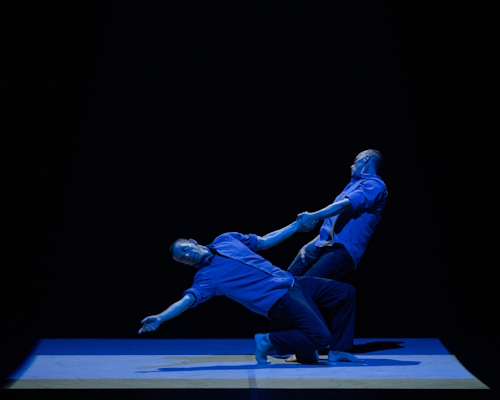
Photo Amber Hunt
The evening opens with Russell Maliphant’s iconic Critical Mass, an important work in BalletBoyz history and a fitting place to begin. The dancers fold into and around one another, weight shared and redirected, contact becoming almost sculptural. There is an intimacy to the partnering, a flow of pure grace. They do not simply support one another; they test, absorb, copy, and reshape each other’s movements.
What remains striking is how little the piece needs in order to hold attention. The movement seems to grow through pressure, counterweight and release. It carries the sense of the BalletBoyz discovering a language that would become central to their identity: athletic, grounded, serious, fluid, and creatively inventive.
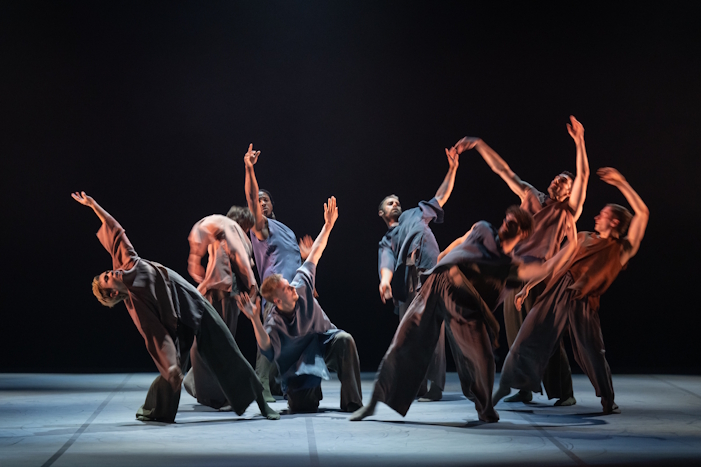
Seirian Griffiths’ Motor Cortex, a new work, brings the full company into play. It is an ambitious piece, alive with repetition, reflection and recombination. Individual dancers break away, return, echo and interrupt one another, until the stage begins to feel less like a collection of solo bodies and more like a moving organism.
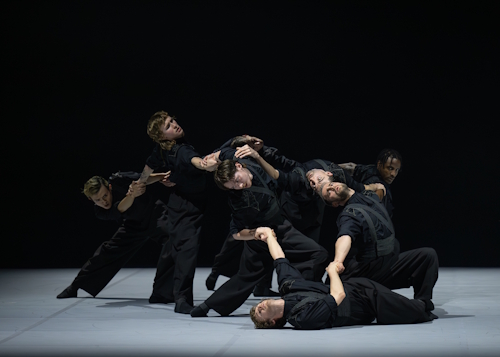
Photo Amber Hunt
At times, the piece suggests a dance orchestra: separate lines, impulses and rhythms gathering into one larger physical score. It is not always entirely clear where the work is heading, but that uncertainty is also part of its interest. Griffiths seems drawn to the mechanics of motion itself: how movement begins, how it is transmitted, and how a single impulse can pass through a group. It is a promising and confident first work for the company from a rising choreographer with a great deal of talent on show.
Xie Xin’s Ripple shifts the evening into a more fluid register. Here, the dancers seem to move as if shaped by water. Bodies flow, separate, recombine and pass energy from one to another with an ease that feels both natural and meticulously controlled.
The title is apt. Movement rarely stops; it travels, softens, rebounds and leaves traces behind. The piece offers some of the evening’s most lyrical dancing. It does not push for obvious drama, but allows its atmosphere to build through texture and continuity. There is a sense of constant transformation, as if the dancers are being pulled by currents just beneath the surface.
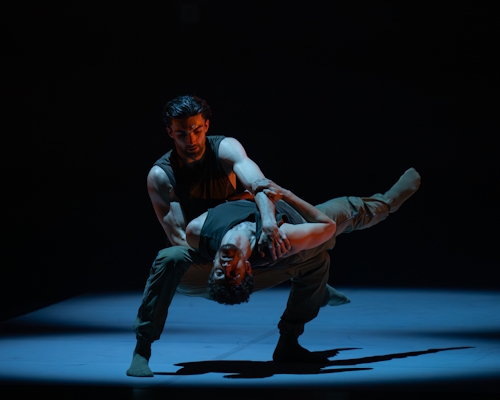
Photo Amber Hunt
Maliphant returns with Fallen, and again his ability to create tension through structure and weight is evident. The choreography draws strength from accumulation: repeated patterns, shifting formations and bodies that appear caught between collapse and recovery.
The company responds with impressive control. The dancers’ athleticism is never merely decorative; it is bound to the work’s internal pressure, and achieved through meticulous technique. There is a powerful sense of endurance here. The dancers move with precision, but also with the suggestion that every action costs something. That balance between grace and strain is where the piece finds much of its impact.
The strongest work of the evening, however, is Iván Pérez’s Young Men. Its subject matter gives it immediate emotional weight, but the choreography earns that weight rather than simply leaning on it.
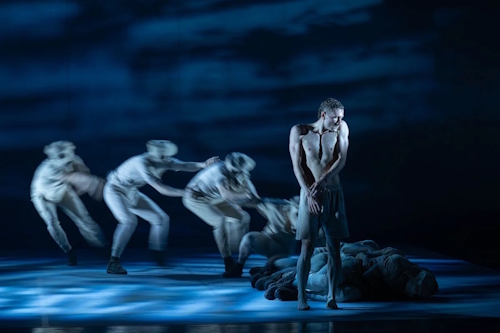
Photo Amber Hunt
Created in response to the devastation and brotherhood of war, the piece evokes mud, desolation, comradeship and the terrible vulnerability of bodies placed under extreme pressure. What makes it so affecting is the way it holds together the individual and the collective. Men fall, gather, support, confront and carry one another.
The stage becomes not just a battlefield, but a landscape of memory and survival. The movement has a rawness that cuts through the more polished sections of the evening. The score intensifies this atmosphere, helping to create a world in which tension and tenderness exist together. There are moments when the dancers seem almost invincible in their unity, and others when that unity appears unbearably fragile. Of all the works in the programme, Young Men lands with the greatest force.
Liam Scarlett’s Serpent offers a different kind of intensity. It is darker, more ambiguous and more sinuous, drawing attention to line, temptation and unease. The dancers move with a controlled sensuality, the choreography playing with the tension between beauty and threat. It is an effective contrast after the broader emotional sweep of Young Men, though it does not quite reach the same depth of impact.
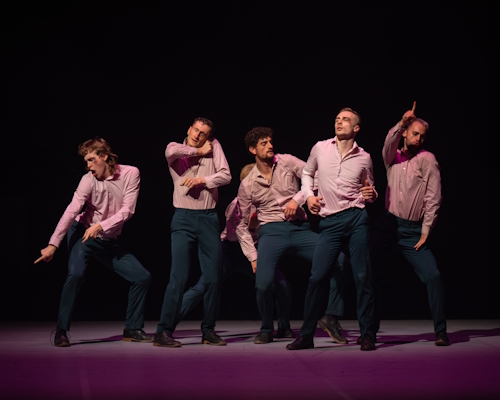
Photo Amber Hunt
Maxine Doyle’s Bradley 4:18 brings the focus back to personality as much as performance. The piece explores shifting ideas of masculinity, pride and social presentation. It has a restless, theatrical energy, with the dancers appearing at times trapped inside roles they are expected to perform.
Doyle’s strength lies in allowing cracks to show. The work is powerful because it does not present masculinity as one thing. It can be proud, exposed, aggressive, funny, brittle and deeply unsure of itself. The dancers catch those contradictions well, moving between sharp physicality and moments of vulnerability.
Christopher Wheeldon’s Us provides one of the evening’s gentlest passages. It is intimate, lyrical and openly present. The duet invites the dancers to live in the room, in the moment, and in relation to one another.
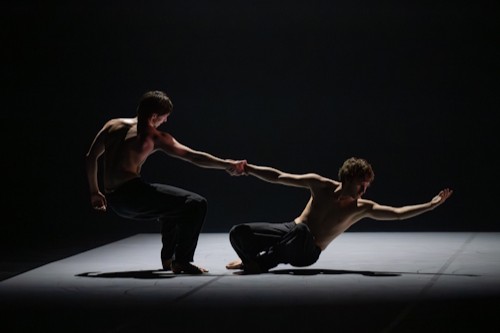
Photo Amber Hunt
Its emotional clarity is refreshing. After several works driven by group pressure, violence or tension, Us offers space to breathe. Programme notes tell that there is apparently a narrative idea behind the piece, though it has never been disclosed. The choreography communicates through touch, proximity and shared focus. Its restraint is part of its appeal.
The evening closes with Javier de Frutos’ Fiction, a strange, witty and slightly anarchic piece built around the imagined scenario of the choreographer’s own death during a performance before the show has ended. It is an odd conceit, but a memorable one. The tone shifts between the macabre, the playful and the absurd, giving the dancers a chance to show a different side of themselves.
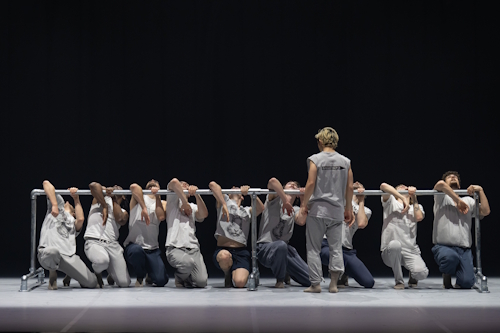
Photo Amber Hunt
Set around a ballet barre, the choreography is full of clever invention. It can be thematic in parts, softer in others, and frequently funny. After an evening of high physical intensity, Fiction ends the programme with a welcome sense of mischief. It reminds us that BalletBoyz has never been only about strength and technical ability; irreverence has always been part of its charm.
As an anniversary programme, Still Pointless works because it does not try to smooth out the company’s history into a single neat statement. Some pieces resonate more strongly than others, and the evening inevitably has the unevenness of a retrospective. But it also shows the breadth of choreographic voices BalletBoyz has brought together over 25 years.
What remains most impressive is the calibre of the dancers. Across the evening, they show athletic power, musical responsiveness, sharp ensemble work and superb technique. They can be sculptural one moment, volatile the next; lyrical, brutal, playful and exposed. That range is what holds the programme together. Still Pointless is both a celebration and a reminder. BalletBoyz has built its reputation on commissioning distinctive choreographers, and placing exceptional dancers at the centre of bold, accessible, physically demanding work. Twenty-five years on, Ballet Boyz is if anything stronger than ever. I look forward to what the next 25 years will bring.
Still Pointless: BalletBoyz at 25 continues on tour.