
Wilton’s Music Hall, London
May 15, 2026
Choreographer and company director Mathieu Geffré has dedicated his company, Rendez-Vous Dance, to engaging with LGBTQIA+ themes and producing work about non-heterosexual relationships. But, in The Monocle at least, the limitations of only focusing on sexual relationships are all-too apparent. People are so much more than their sexuality but you wouldn’t think it from this production.
The Monocle focuses on the notorious club Paris club, open from the 1920s to the early 1940s, where glamorous lesbians could dine, dance, sing and socialise without fear of persecution. It was a place of secrets, where affairs were commonplace. And of glamour, sex and cocktails.
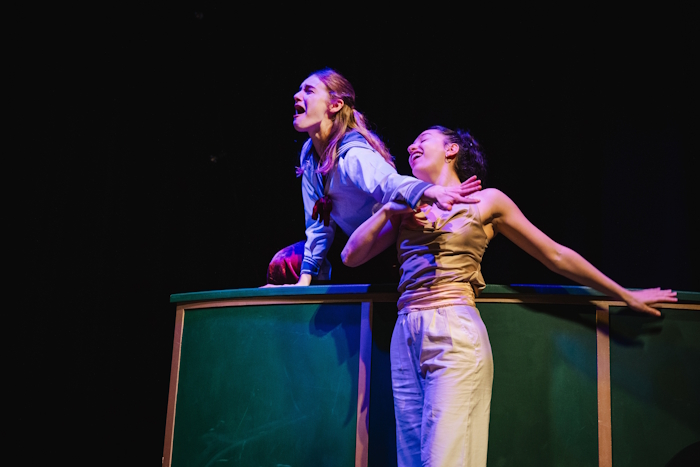
Nate Gibson’s and Helen Herbert’s set is effective and, on Wilton’s stage, creates a neat sense of a play-within-a-play. Their costumes though, completely miss the mark. There is no sense of period created by them at all.
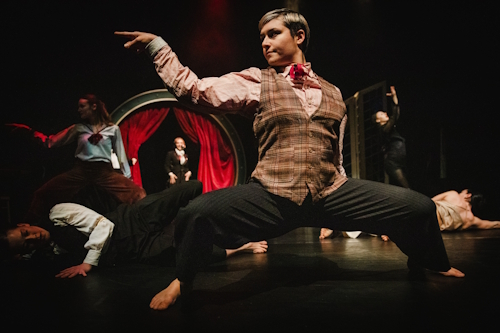
Photo Rhiannon Banks
It is impossible not to make comparisons with I Am A Camera, Goodbye to Berlin and of course, Cabaret. Van Druten, Isherwood, and Kander and Ebb contextualise the Kit Kat Club, however. And while we all come to a sticky end as Nazism encroaches, most important is that we know something about the people involved. We care for them, regardless of how flawed they are and how seedy the club. That is missing from The Monocle. The characters dance together and perform their acts. But who are they? Why do they choose to seek sanctuary in the club rather than any other secret tryst? We don’t know so it is difficult to engage, difficult to care.
While Geffré’s choreography is eminently watchable, unfortunately it never really gets anywhere in the work’s 90 minutes. The singing is less good, however, although that is probably the most authentic thing about the piece. After all, patrons of such establishments were hardly there for the quality of the vocals.
There are some amusing moments, not least an excellent routine by the bar tender ending in a back flip over the bar. But an extended sequence where two women compete in a mock boxing match over a third women works less well. A few in the audience laughed uproariously at the slapstick but it does go on.
The choreography is quite athletic in places too, the dancers doing well in the confined space that is the Wilton’s stage, but it rarely matches the music or makes us feel as if people in a 1930s club would move like this. Perhaps that is why it jars emotionally; everyone is too contemporary.
In these days of chem-sex and discussions of all sorts of sexuality openly engaged in in schools, a lesbian-only bar in 1930s Paris doesn’t even raise the eyebrow sufficiently for the monocle to fall out. The most interesting thing about the evening was the small, framed picture of the real Monocle club discreetly placed on a shelf in the foyer. If only that image had been recreated, we may really have learned something about lesbianism in 1930s Paris.