
Woking Theatre
May 6, 2026
Carlos Acosta’s Carmen has heat in flashes, but rarely enough pressure to make the evening catch fire.
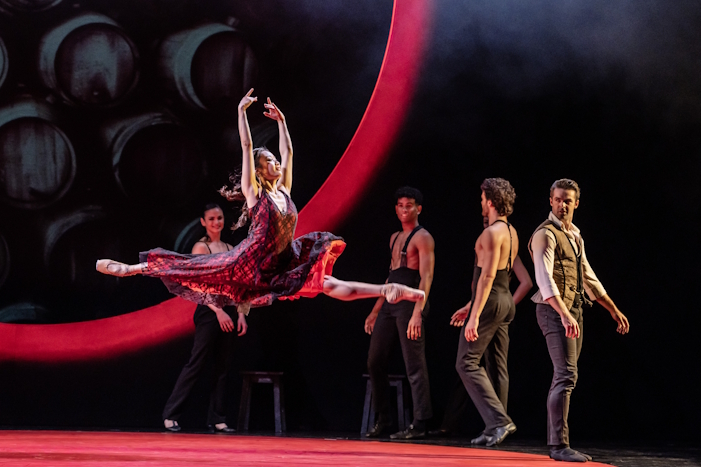
The problem is partly musical. The score suits each scene well enough, but the sections do not bite into one another. What should gather as fatal momentum often feels episodic. A tavern scene with drinking, tables and flamenco inflections raises the temperature, yet never quite releases the collective charge the ballet needs. The point becomes clearer in the curtain call, when the company returns with a short flamenco-inflected encore. Suddenly the rhythm has attack, the dancers seem freer, and the stage briefly finds the heat the drama itself has been missing.
There may also be a question of scale. On Woking’s stage, busy ensemble scenes often feel crowded rather than exciting. The men, especially, seem to hold back in some of the bigger travelling movement. During one front-stage tour en l’air, Paul Brando landed so close to the edge, and so unsteadily, that the limits of the stage briefly overshadowed the drama.
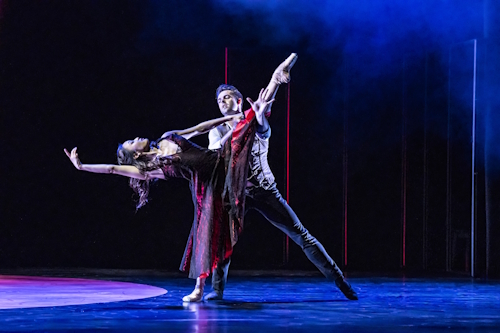
Photo Johan Persson
The evening is strongest when the stage clears and the relationships sharpen. Adria Díaz gives the production its pulse. Her Carmen has beauty and bite, but more importantly, she has will. In the prison duet, Don José holds a rope attached to her wrists and repeatedly pulls her back as she tries to escape. The image is blunt but effective. He thinks he has caught her. She turns the same rope around him, binds him, and leaves.
Díaz is also excellent opposite Paul Brando’s Escamillo. Their duet has a real spark: weight exchanged, bodies entangled, attraction made legible. Brando’s Escamillo could be more lush, more dangerously public, but the chemistry still works. Carmen seems to choose him, and that choice makes sense.
Alexander Arias’s Don José is less convincing early on. His possessiveness lacks weight, and his scenes with Carmen can feel oddly muted. He comes into focus late, in the final confrontation, when his jumps and turns suddenly open out with real force. At last, the character’s weakness hardens into violence.
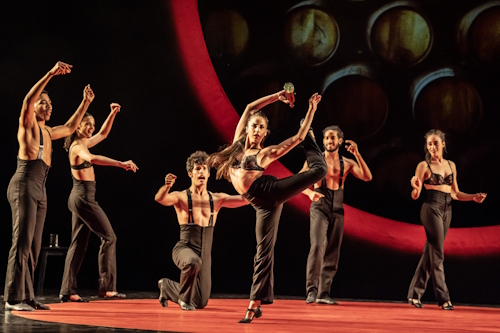
Photo Johan Persson
Frank Issac’s Bull remains a frustratingly thin symbol. He arranges bodies, interrupts scenes and gestures towards fate, but the role often feels more decorative than necessary. The problem is that he marks fate without making it felt. Only in his duet with Carmen does the idea fully land. There, the choreography takes risks: lifts, falls, a body rolled and thrown with real impact. Díaz makes the struggle readable, caught between fear, resistance and recognition.
The production often reaches for obvious signs of heat, from bare torsos to lingerie-style costumes, but its strongest sensual charge comes elsewhere: in the rope duet, in Carmen’s sparring attraction to Escamillo, and in the final refusal that pushes Don José into violence.
This Carmen has committed dancers, and Díaz gives it a strong centre. It works best in concentrated moments rather than as a sustained tragedy. Its flashes of danger remain just that: flashes. What it lacks is the gathering fire that should make Carmen feel inevitable.