
The Place, London
May 13, 2026
Following the success of Burnt Offering in 2024, 99 Art Company returned to the UK with a double bill, Ekah and Abyss, as part of A Festival of Korean Dance 2026. Both works are choreographed by the company’s artistic director, Hye-rim Jang, and both sit in the territory of grief, ritual and remembrance. It made for an evening that was certainly distinctive, occasionally compelling, but also frustratingly limited in its choreographic range.
Ekah is a duet between Jang and pianist Daniel Kang. The premise is strong: a meditation on grief, and on whether sorrow is something to be grasped, resisted or simply endured. It begins with the two performers circling the space, humming a repeated phrase that is later taken up by the piano and returned to again and again, in different keys and with slight shifts of emphasis.
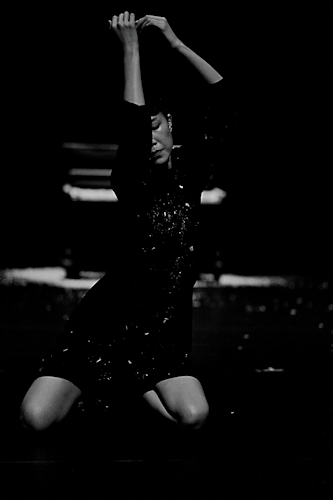
Photo Son Gwan
There is something strange and arresting about the opening. The atmosphere is spare, inward and ritualistic. Yet the relationship between dancer and pianist never quite develops with the clarity one hopes for. At times, Jang’s movement appears to respond directly to Kang’s playing, catching a rhythm or phrase. Elsewhere, the connection becomes harder to read. The choreography is largely concentrated in the arms and upper body. That can, of course, be eloquent, especially in a work concerned with containment and grief. But, here, the restricted movement palette becomes increasingly repetitive.
Jang’s gestures have moments of delicacy and tension, but they do not accumulate enough complexity over the course of the piece. What initially feels like restraint begins to feel underdeveloped. That is not to say Ekah is without power. It has an unusual quality, hovering somewhere between concert, lament and movement study. But there is very little dance in it, and too often the choreography feels as though it is circling the same emotional point without deepening it.
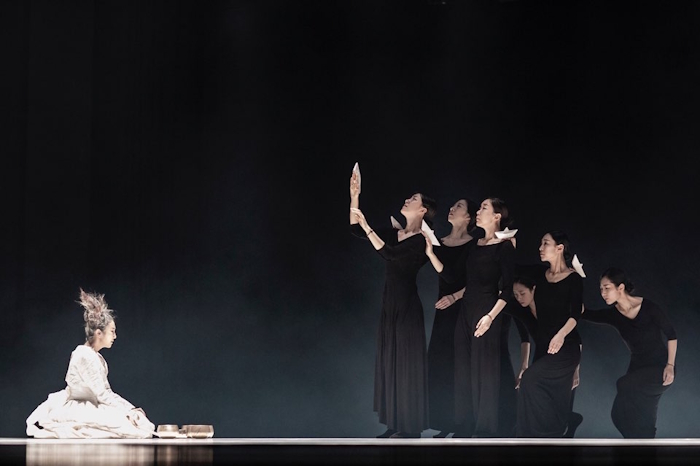
Abyss is larger in scale, danced by seven performers, with music by Young-jo Leem and intermittent vocals that add to its ceremonial tone. The work draws on the Korean concept of han, a deeply embedded sorrow mixed with endurance and resilience. Its stage world is one of slow ritual, sorrow, iconography and worship.
The central image is striking. A woman moves around the stage with extreme slowness, ghostly and remote, faintly reminiscent of Miss Havisham from Dickens’ Great Expectations. She later sits with her back to the audience and becomes, in effect, an idol. Around her, the other dancers flow, gather and worship. There are suggestions of devotion, grief and ecstatic release, though the reasons for those emotional shifts remain difficult to grasp.
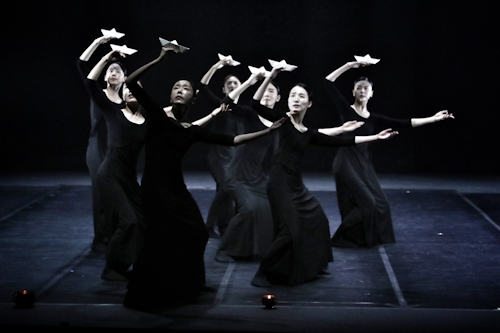
Photo Jeong Jaehoon
As with Ekah, repetition dominates. The dancers move with impressive discipline and are often tightly synchronised, but the choreography gives them too narrow a physical vocabulary. Much of the work remains focused on the upper body and arms, with limited opportunity for the performers to reveal the full extent of their technical ability. That changes briefly towards the end, when the piece suddenly seems to move into another gear. The dancers break into fuller-bodied movement with greater energy and exuberance. In those moments, their skill becomes immediately apparent: the group is controlled, committed and highly accomplished. It is a shame the choreography allows so little of that physical capacity to emerge earlier.
The lighting also works against both pieces. The stage is so dimly lit that, at times, the dancers quite literally disappear into areas untouched by the small pools of light. With the performers dressed largely in black, the effect becomes tiring to watch. Atmosphere is clearly intended, but obscurity is not the same as depth. Too often, the visual world hides the dancers rather than intensifying their presence.
There is no doubting the seriousness of 99 Art Company’s artistic intent. Both works are rooted in meaningful ideas: grief, ritual, sorrow, resilience, remembrance. Nor is there any doubt about the dancers’ discipline. They move as one when required, sustain demanding slowness with control, and bring commitment to a highly stylised physical language. The problem is that the choreography does not give enough back. Its images are sometimes memorable, its atmosphere carefully held, but its movement vocabulary is too repetitive and too restricted to sustain the evening fully. The result is interesting, but only intermittently absorbing.
As a double bill, Ekah and Abyss offer a serious, ritualised encounter with grief and endurance. The clarity of the works is admirable. But, while for some, its slowness and repetition may feel meditative, for others, it will feel over-extended.