
National Theater, Taipei
May 8, 2026
She is certainly iconic. She does have almost cult status among her followers. And come to Taipei’s National Theater in their droves they most certainly did. To the extent that a last-minute extra Monday evening show was sold out almost as soon as it was announced.
In some ways, “…como el musguito en la piedra, ay si, si, si…” is a special work. It is the tenth in her series of works inspired by cities around the world, an idea that has its genesis in a mid-1980s suggestion by the Teatro Argentina in Rome, who suggested working together on a piece that reflected her experiences of that city. It proved to be final piece, premiering in in Wuppertal in June 2009, just eighteen days before she passed away just five days after being diagnosed with cancer.
“…como el musguito en la piedra, ay si, si, si…”
Photo Lee Chia-Yeh
The title comes from the chorus of influential Chilean singer-songwriter Violeta Parra’s ‘Volver a los 17 (To be 17 again), a track from her final album, Las Ultimas Composiciones (The Last Compositions) released in late 1966. A standard in the Latin American songbook with numerous cover versions recorded, the lyrics describe love clinging and spreading “like moss on the stone.”
As with all Pina Bausch works, there’s no synopsis that neatly explains meaning. The work is what it is. You take it as you see it, maybe feel it. But one scene in particular aside, there’s little that’s obscure about “…como el musguito en la piedra, ay si, si, si…”. The choreography does reflect the song. Essentially a series of scenes, it’s a collage, where the only connection is relationships, usually men chasing after women one way or another, not always getting them, and sometimes getting their comeuppance.
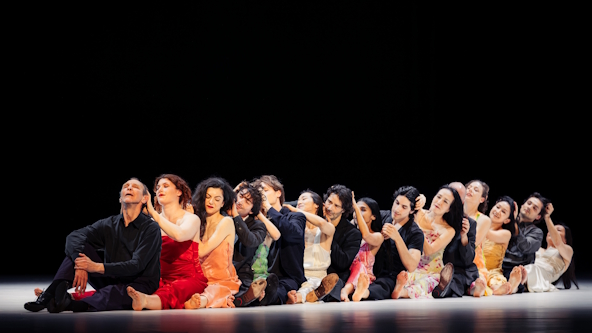
Photo Lee Chia-Yeh
The work has aged significantly better than many of Bausch’s works. Of course, it’s the most recent anyway but it’s also less full of the now outdated attitudes of the time in which it was made. Added to that is the fact that, while it may have its roots in Santiago, the sorts of relationships, the games the men and women play in it, are decidedly timeless and universal.
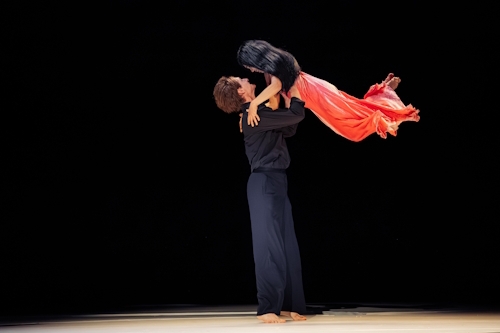
It is a work of sexual politics. The men and women play together and taunt one another. In general, it’s on more equal terms than previous works although, the women probably edge it when it comes to being savvier. It does however start and end disturbingly with a woman kneeling, as if a dog, before being lifted and passed from man to man as if a mere object.
Continuing what seemed to be becoming a trend in Bausch’s work, it’s also much more colourful and lighter in tone than many of her tanztheater creations, including the early ‘Cities’ pieces.
“…como el musguito en la piedra, ay si, si, si…”
Photo Lee Chia-Yeh
Amidst the metaphor and symbolism, coded sexual dynamics and anxieties, there are certainly more than a few joyous ‘make you smile moments.’ The stand out is probably when two men with eyes for their dance teacher are put through their paces by her in a series of sit-ups, press-ups and so on. Ever wanting to oblige the woman of their dreams, they comply.
“…como el musguito en la piedra, ay si, si, si…” is also full of what most people would term ‘dance’ than in most of her pieces, including many solos. Some are seriously stand-out terrific, one long one by Dean Bisoca in particular, but some are quite forgettable. At the time, and days after, I do wonder that, if it wasn’t by Bausch, would everyone be lauding it so greatly. I think I know the answer.
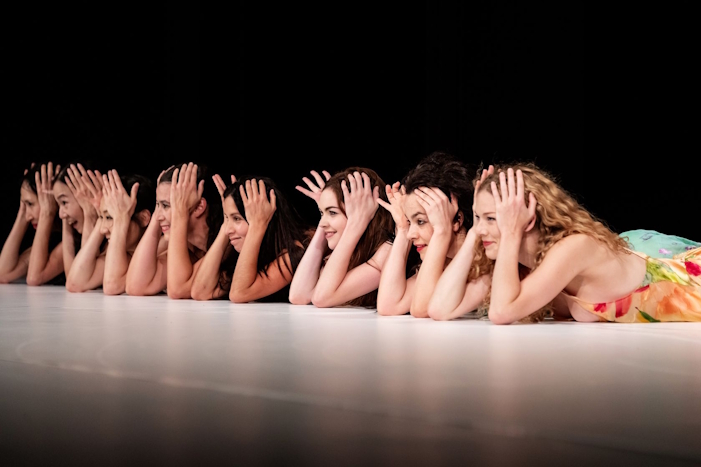
The evening has its fair share of genius pictures though, not least that which ends Act One. The cast lie on their fronts, facing the audience in two lines: one men, one women. The gestural dance is quite brilliantly conceived and performed.
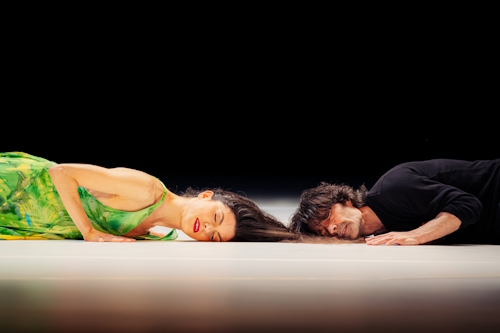
“…como el musguito en la piedra, ay si, si, si…”
Photo Lee Chia-Yeh
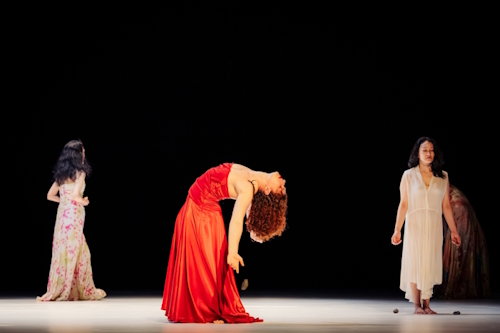
But the work is also heavily loaded with Pina Bausch tropes. She was quite predictable in a way. Needless to say, the women are in elegant long dresses, their hair free-flowing. It’s not long before high heels make an appearance. Many of the men come in formal suits, but worn a little more casually than is often the case in her pieces. Many of the scenes include elements seen previously. Water tipped on a head, food offered to the front row of the audience. There are a lot more.
And amidst it all, something was missing. Bausch once famously remarked that she was not so much interested in how people move but what moves them. Here, there seemed a lot more of the former than in the past. Even repetition, which Bausch was superlative at using to make a point, doesn’t have the same impact.
For the most part, it all takes place on an empty stage. Gone are long-time collaborator Peter Pabst huge sets, replaced by a white floor that occasionally splinters and cracks. The emptiness does help highlight the performers, especially in those solos.
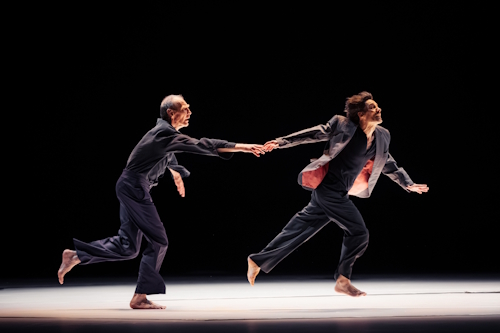
“…como el musguito en la piedra, ay si, si, si…”
Photo Lee Chia-Yeh
Musically, Bausch’s regular collaborators Matthias Burkert and Andreas Eisenschneider keep up a constant stream of Chilean popular songs and music, everything from lyrical tunes, through jazz and cinematic soundscapes to heavy drum and bass.
Pina Bausch has a status like no other choreographer. Ever. And Tanztheater Wuppertal Pina Bausch is a company like no other. I can’t think of another where the founder’s shadow continues to loom so large, so many years of their death. Some companies, like the Graham Company struggled to break away, but got there in the end. For many, Tanztheater Wuppertal remains a temple, ‘Pina’ (she is often referred to by her first name only) its goddess about whom not a negative word may be said.
The arrival in Taipei of a Bausch work ahead of one of the company’s newer creations highlights yet again just how much the company still rely on her. Audiences flock to see her work, so one can hardly blame producers for asking for it. But how long can this go on? will the company ever truly free itself? And if not, especially given some works already feel very dated, what are the long-term prospects?
You can argue that the ballet classics are similarly revered. But there is not one of those that today is even remotely like the original. All have been reimagined, restaged, countless times. And in most cases also by the original choreographer as well as those who came later. No company should ever forget its past, but equally, no company can survive long-term by living in the past, or should be asked to do so.