
The Place, London
October 17, 2025
National Dance Company Wales’ Surge (Gwefr) triple bill presents three very different works set in three very different worlds. All showcase the company terrifically. Fine dancing, striking designs and, in Osian Meílír’s Mabon, something uniquely Welsh. What more could you ask for?
The opening Infinity Duet is a collaboration between company dancer and choreographer Faye Tan and sculptural artist Cecile Johnson Soliz, who’s huge, hanging, trapeze like creation dominates the stage. Under it, dancers Jill Goh and Ed Myhill, in costumes of the same black and white palette, dance pleasingly and with a beautifully judged sense of childlike wonder. As they play with the trapeze, swinging it like a pendulum, dodging it as it goes back and forth, the warm choreography emphasises flow, weight and suspension. It is a lovely opener.

(pictured: Sarah ‘Riz’ Golden and Charlotte Aspin)
Photo Jorge Lizalde
There is much to admire in Marcos Morau’s Waltz. The set-up is superb. And old reel-to-reel tape machine hangs above, looking for all the world like a face in the air. When it starts to run, its tape falls, piling up on the floor like ashes as a haunting waltz plays in the distance. That mound of debris turns into strange creature that then morphs into seven faceless, oily black head-to-toe, humanoid forms. The beings that were on the tape reborn, maybe. But that’s as surreal and otherworldly as it gets.

Photo Kirsten McTernan
The glittery creatures sometimes come together in a centipede-like form, Morau indulging in a great deal of cannon back and forth along the line of performers as they raise a leg, flex a foot, sweep limbs in circles and ripple back and forth. It was all razor sharp, the dancers’ timing quite remarkable.
Having separated, the creatures dart around, the movement angular, snappy and with and insect-like sharpness. It reminded me a little of pondlife. Later, after disappearing behind the curtain, they re-emerge with heads and feet visible. What was matter is slowly evolving to human. There’s more of a sense of gesture, acknowledgment and sharing. And yet, as fascinating as it is initially, as inventive as is some of the choreography, it left me rather cool and unmoved.

Photo Kirsten McTernan
For Mabon. choreographer and NDC Wales artistic associate Osian Meílír was inspired by the Mabinogion, a nineteenth-century translation of eleven fantastical Welsh folk tales by Lady Charlotte Guest, and in particular the story of Culhwch and Olwen, one of the earliest Arthurian romances.
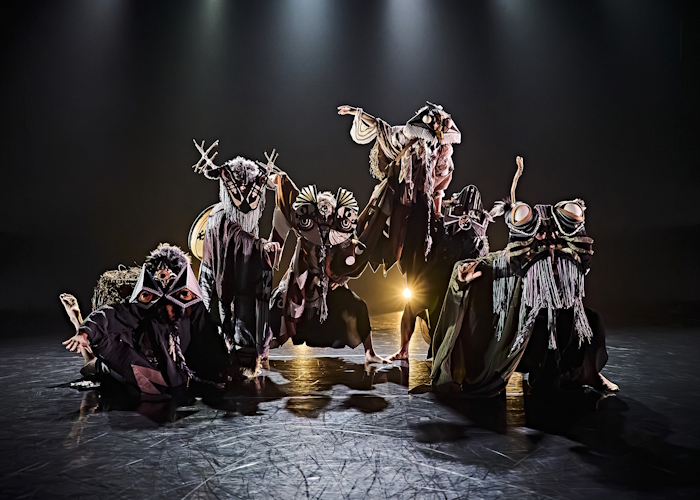
The tale sees Culhwch and Arthurian knights on a quest to free the divine Mabon ap Modron. Along the way, Culhwch has to see knowledge from the world’s oldest animals, the Blackbird of Cilgwri, the Stag of Rhedynfre, the Owl of Cwm Cowlyd, the Eagle of Gwern Abwy, the Salmon of Llyn Llyw and the Toad of Cors Fochno. All are seen in Meílír’s piece, realised through dance and the amazingly creative, fantastical costumes of Becky Davies that are both uncannily recognisable, yet strange, ancient and unfamiliar.

Photo Jorge Lizalde
Mabon is not a retelling of the story but a realisation of those animals, however. As it does so, it’s also a wonderful evocation of Welsh history and culture, one that is both dramatic and real. The fast-moving, visceral choreography is also full of joy. It has a freedom and rawness to it that is very appealing.
When the dancers remove their cloaks and masks, they reveal white tops on which one can see ribs. A reference to the magical white horses that appear several times in the Mabinogion, surely. Here, Meílír seamlessly weaves folk dance elements into the choreography.

Photo Jorge Lizalde
The whole work is helped along by Welsh triple harpist and composer Cerys Hafana’s blend of folk and electronic music. Like the choreography, the transformation of the traditional results in a very modern sound but one that retains links to the past and comes with a powerful otherworldliness.
Fabulous beasts and a fabulous end to the evening. NDC Wales are on fine form indeed.
Surge by National Dance Company Wales continues on tour to Aberystwyth and Ipswich.