
Muffathalle, Munich
April 23, 2026
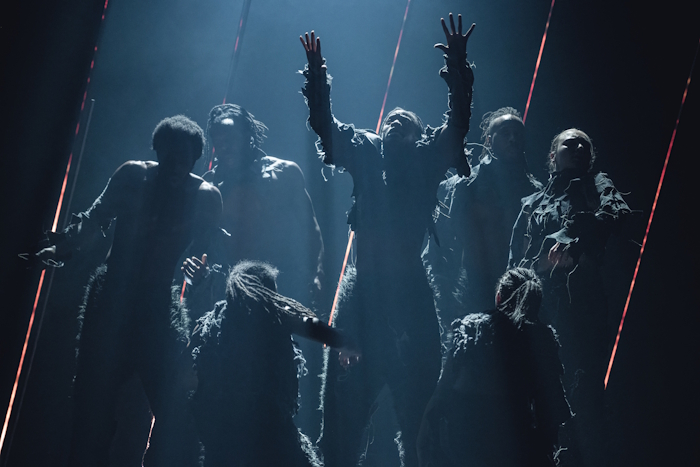
Until We Sleep, by acclaimed British based choreographer Botis Seva and his company Far From the Norm, takes place in an austere and dark enclosure defined by far-apart rods reaching into an infinite blackness. It brings associations with a prison, and as the piece proceeds, perhaps the prison of a person’s life.
The action is centered around a woman, Victoria Shulungu, and a group consisting of six dancers, dressed in Ryan Dawson-Laight’s costumes that in the darkness look like made of feathers and in the occasional feeble light like rags.
At the beginning Shulungu watches a shaman-like figure walking outside the grid, clad in a high, black, cone-shaped hat and a long coat with a huge feathery collar. As they gaze at each other, there’s a strong tension between them. You expect something to happen. But he just disappears, and she joins the six dancers, miraculously appearing in a communal dance, as if nothing had happened. It makes you wonder, if it was all a vision taking place in the midst of daily life.
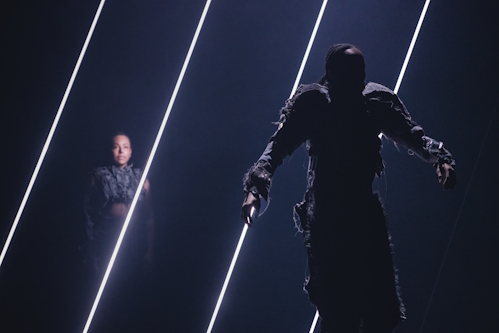
Photo Tom Visser
Building up tension between individuals and then just breaking it, before anything comes of it, by the group gathering in a joint dance often looking like a ritual, is a recurring structure throughout Until We Sleep. It creates the feeling that you do not know if you are watching reality, a dream, memories, or perhaps an unbearable trauma that needs to be suppressed in order for the individual to survive.
This feeling is reinforced by Torben Sylvest’s soundscape, a mix of strange guttural sounds, water moving, melodies like snippets from rituals and strong, hammering beats. At times Seva gives the music a physical expression, like a shoulder move turning into a hammering beat. In this way he creates an intrinsic connection between the movements based on hip-hop and the music.
The piece develops like a series of horrifying experiences. At one point a man, Joshua Wynters, rises, carrying a small woman, perhaps a child in the front of his body. She just clings to him, her legs around his waist, her arms around his neck as he walks with the group around them. In me, it raised a myriad of associations with refugees. Later a man slowly falls to his knees. Shulungu touches him from behind. He rises. She holds his head. He shakes as if on drugs, sick with a strong fever or crazy, but at the end her hands calm him down.
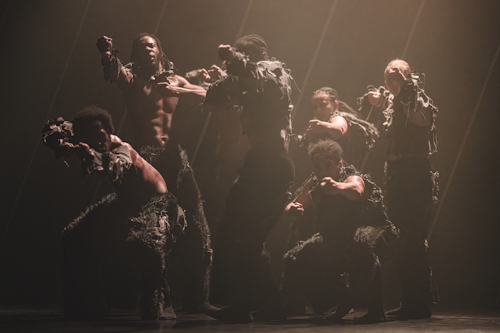
Photo Tom Visser
That Shulungu is the central figure with a certain spiritual power is clear, but her relationship to the others is not defined. All you gather is that they are around her and sharing her experiences. A man sits on the floor. She goes behind him. First, she holds his hands, then squeezes his head until it makes a sound like cracking wood. As if she forced a vision out of his head, a creature with a reptile-looking shield appears. Why, you do not know. And again, what could have been a meeting between the woman and the reptile-like person amounts to nothing because the group appears and they dance together.
The most moving scene comes at the end. A man stands outside the grid with a rifle. He shoots at a boy, again and again. The boy rises, again and again, as if he is not one, but several persons. Shulungu tries to revive him but without success. Sitting on the floor, she takes his dead body in between her outstretched legs. Eventually, he rises, stands behind her for a moment touching her shoulders, then leaves. She embraces the empty space he left, lost and alone with her sorrow and pain. The grid in the background turns red, as if hell is burning or blood is flowing. The group appears, they touch her, raise her, gently caress her, comfort her, perhaps sharing her fate, her life.
Tom Visser’s lightning is so dark, that the only faces I could distinguish were Shulungu’s and Wynters’. The effect is that whatever happens becomes a kind of generic experience. It could be the fate of anybody and not just the people, whose experiences we witness.
Even so, the illusion that Seva and his company create is that what we see is not simply theatre. It felt like having witnessed something happening in real life; something that you cannot hold on to. That feeling is enhanced by the way the piece ends. The dancers disappear while the music continues. And that is it. No curtain call. Which left me feeling a little deprived because I could not show my gratitude to the dancers, who were all very good, for their wonderful performance by giving them some well-deserved applause.