
Queen Elizabeth Hall, Southbank Centre, London
October 15, 2025
All too often, dancers vocalising on stage results in a less than satisfying spectacle. And not only speaking. I despair sometimes as the shrieking, screaming, laughing out loud and more that some choreographers insist on inserting. Is it really that they cannot say what they want to through movement? So, when Jan Martens’ Voice Noise opens with the work’s six performers chirruping, whispering, squeaking, squawking, making guttural sounds and other unintelligible sounds into a microphone, the heart sinks a little. Fortunately, things pick up quickly as he lets their bodies speak.
Voice Noise is inspired by Anne Carson’s feminist essay, The Gender of Sound, first published in 1992, in which she charts the gendering of sound in Western culture and what she sees as the silencing of women in public discourse by patriarchal society. Not that any of that is particularly visible.

Photo Klaartje Lambrechts
There is a connection of sorts in the playlist of twenty-three music and other sound pieces by thirteen female artists from the past hundred years or so, all of whom are unknown or largely forgotten. But ‘silenced’ suggests conscious action. It has to be said that almost all of the tracks would have limited appeal with only a few the sort of thing most would want to listen to for pleasure. When set alongside movement, something new and often rather appealing emerges, however.
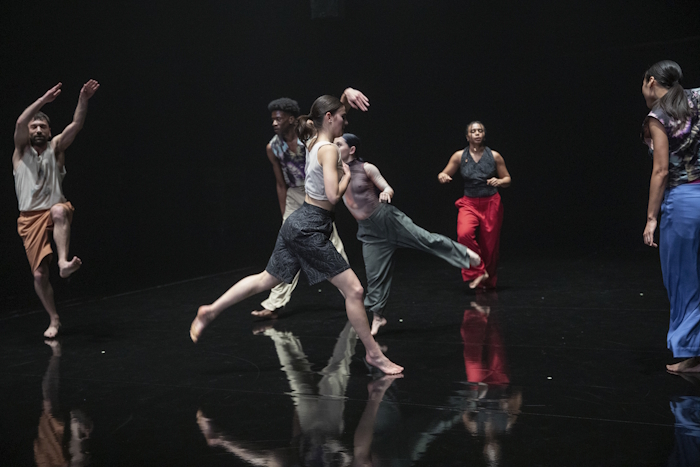
The action all takes place on and around a slightly raised, roughly nine-metre square platform whose black floor has a mirror effect. The dancers introduce themselves and some of the music, although a mix of soft voices and poor acoustics made almost everything said quite difficult to make out.
The first section, to one of American post-punk composer Cheri Knight’s idiosyncratic takes on minimalism, is a delight. One-by-one, all the dancers enter the space, dancing with fabulous clarity. While each has their own movement and movement style, when they come together, the eye constantly catches connections.

Photo Klaartje Lambrechts
In what follows, solos, duets and larger group sections come and go easily. When not performing, the others sit, mostly watching their friends, sometimes watching the audience.
Sometimes the dance is very much at one with the music, not so much adding layers or illustrating it, but being pushed and pulled by it. Sometimes the two contrast, however, most obviously in a terrifically taut and precise solo by Courtney May Robertson that’s full of abrupt, awkward, twisted, contorted movement. I’m not sure what it was trying to say, other than confusion. At the end, one of the other dancers says, “Thanks Courtney” with such an undertone that the audience laughs.
It’s not always the soundscape that one hears. Sometimes the silence feels just as loud, as in the beginnings of a group section soon afterwards. When sound does intrude in the shape of a 1935 recording of Indian classical vocalist Kesarbai Kerkar, it really does feel like it comes from afar, reaching out across the miles and years as it seeks out and finds the dancers.

Photo Phile Deprez
Every section brings something new. The much brighter number that follows is full of numbers, geometry and patterning. To music by 1970s UK band The Raincoats, of whom it has been said were post-punk before punk’s first act had fully played out, the dancers ebb and flow across the space, shifting back and forth like a metronome. It is quite joyous.
There is so much more including ‘Sometimes I Feel Like a Motherless Child’ by Ruby Elzy, also from the 1930s, perhaps the most emotionally loaded; ‘Bella Ciao’, the anthem of the Italian anti-fascist resistance movement; and rumblings of the Inuit Canadian Tanya Tagaq Gillis. Always, the sound lives on the same level as the dance.
Voice Noise does dip a little around the 70-minute mark, in part due to a succession of slower, shadowy-lit scenes. There’s also an unfortunate return to the performers screaming and wailing.
The final moments are stunningly beautiful, however. To the liturgical sound of Norwegian ensemble Trio Mediæval, we see first one trio of dancers, then the other, then both together. Crystalline voices and crystalline dance. The light slowly fades and they are gone, save for lingering sounds and sights in the mind. “Thank you” says one of the dancers quietly from the now dark stage. No, “thank you.”