National Theater, Taipei
April 25, 2026
We are faced daily with images of war, conflict, violence and the breakdown of order. Even though far away in distance, the internet and media make them feel very close. In Net (網), a new work for his B.DANCE (丞舞製作團隊) ensemble, choreographer Tsai Po-cheng (蔡博丞) responds to what he sees and feels, not only the many divisions and turmoil facing the world today, but what he calls the “invisible net” of politics, media, emotions and personal views that pull, push and divide us.
Tsai claims that Net is not merely a dance performance, but a cultural statement, proclaiming that art no longer stands aloof from the world around it but “breathes in unison with the land, the human heart and history.” While the work certainly reflects the chaos of the today, those bold assertions all get rather lost, however. And anyway, while Net may depict the contemporary world more overtly than much dance, performance art, to a greater or lesser extent, has never resided in a vacuum. It has always reflected its creator and the time in which it was made, and always will.
On entering the theatre, the audience is greeted by the sound of a distant alarm. It’s loud enough to be mildly annoying but quiet enough to be much else. And there’s no indication it’s anything to do with the piece. It could easily have been an errant alarm in the building. If Tsai wanted to make a point, just a few moments of it ramped up as the lights go down would have far more effect.
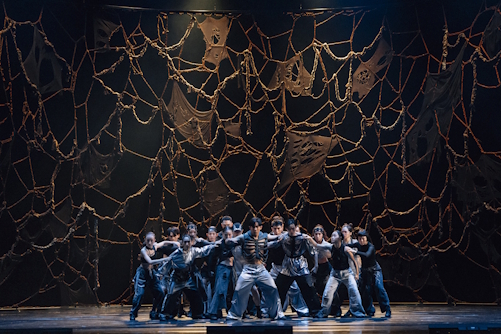
Photo courtesy NTCH
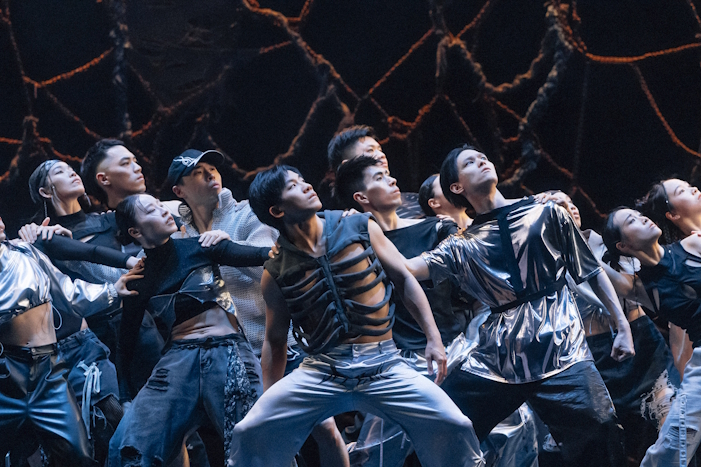
The opening stage landscape is startlingly effective, though. As throughout the piece, the action is framed by set designer Chen Hui’s (陳慧) semi-circular net of ropes of various thicknesses. Fourteen metres across at its widest and seven metres high, ragged bits of material hang from it. Liu Zhi-chen’s (劉志晨) lighting conjures up brilliantly images of explosions, although putting a gaudy red strip light across the top is unnecessary. The lighting of the whole scene by what look like stadium floodlights behind the net is a masterstroke that hones the attention on the action even more.
What initially appear to be survivors emerge; people who were probably voiceless in the destruction in which they find themselves. They seem to gather round and exalt a powerfully built central figure, but then they fight him. The confusion of war, perhaps? When we don’t know who is on which side. That fighting is quite effectively depicted; violent without being overly disturbing.
Somewhat strangely, the graphic picture of despair is interrupted by a hip hop solo that, while neatly danced, lacks power doesn’t appear to fit the context of the scene in which it finds itself. Perhaps it’s a flickering ember of hope? Whatever, it’s not convincing.
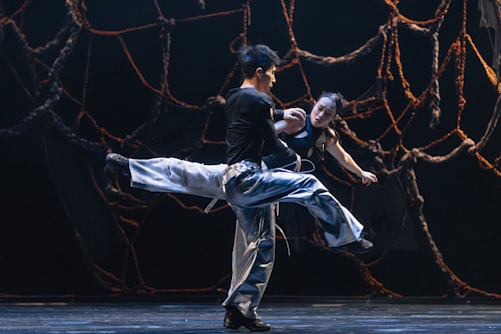
Photo courtesy NTCH
This is ‘Birth’, the first of five movements or sections. The next, ‘Entanglement’ is described as depicting the struggle to reassemble some sort of order in a shattered world. ‘Descent’ then symbolises connections forming. As its title suggests, ‘Cracks’ shows fissures appearing, power clashes and the collapse of new structures. Finally, ‘Reweaving’ is claimed to point to the possibility of re-establishing order.
They do merge into one another, though. Tsai has said that he doesn’t see the piece as having an end-to-end narrative, but if you are going to provide a road map, as he does, it’s reasonable to have some idea of what part of the journey you are on. Not only do sections merge into one another, it’s far from obvious where in piece you actually are at any given point. Like relationships, like the world, Net is complex, confusing and frustrating in equal measure.
Having said that, Net is very stylish at times. Images of a dark, violent world in choreography are hardly new, but Tsai and his creative team show themselves to be very adept at building tableaux and painting pictures. Choreographically, some of the duet and small group moments are very creative. They also show the dancers, who do all asked of them and more, at their best. But they do tend to be over very quickly and occasionally get lost in everything else. More than once, I felt Net could have been, perhaps should have been, more.
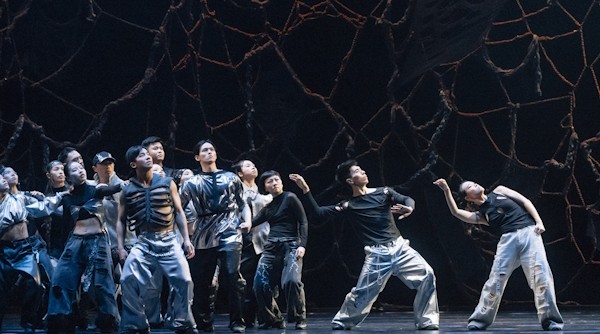
Photo courtesy NTCH
What is clear, is that the undercurrent of tension and violence continues. Conflict is never far away. Power struggles, notably between groups and individuals, appear again and again. The nature and intensity of those struggles is intensified by the techno soundtrack; not something you would want to sit and listen to, but that accompanies the action superbly. The voiceless never really find their collective voice, at least in any way that counts.
Among other confusions are coils of light tubes that drop from above like aerial roots. When red, they look like lava trails, although perhaps they are supposed to signify blood. The coils are later lit in turquoise, red again, and royal blue. The way the dancers look and reach up to them strongly suggests meaning, but quite what is anyone’s guess.
Towards the end, and following another fight, the victor has something attached to his face. From distance, it’s impossible to see quite what it is, but the scene appears to be a sort of crowning.
Net concludes with an unexpected change in the soundscape as ‘O Fortuna’ from Cario Orff’s Carmina Burana cuts in. A tattered, grey flag lowers. The Orff is undoubtedly a powerful piece of music but it does sit uncomfortably with what went before. While it has been used in all sorts of contexts previously, some nothing to do with the lyrics at all, not least a 1970s TV commercial for Old Spice after-shave, in the context of Net, it really is impossible to escape them.
Presumably, Tsai understands the music he chooses. So, given his expressed hope that Net will take the audience towards rebirth and reconstruction, it feels odd to conclude with what is essentially a lament to the inescapable power of fate. It’s all down to luck, the wheel of fortune dealing out triumph and disaster at random. “Fate, you whirling wheel. You are malevolent. Well-being is in vain. And always fades to nothing.”
And on stage, there’s little sign of hope either. If Net has an overarching message, it’s that there will always be battles for power, they may be violent, and the strongest in terms of brute force will ultimately always win. There may be a lot of truth in that, but it’s also rather depressing.