
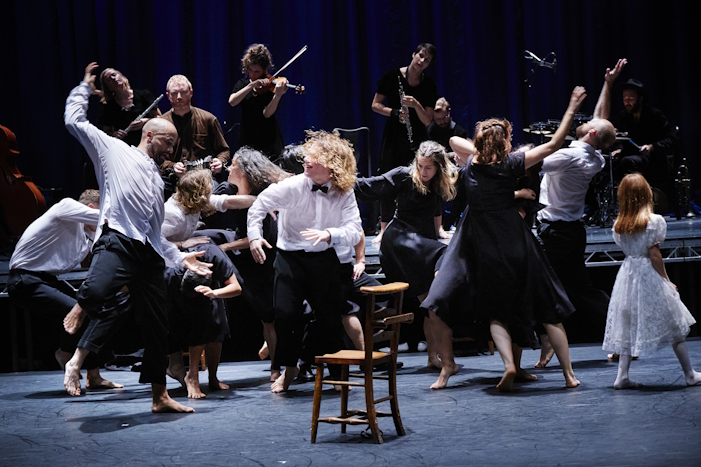
This February and March, Teaċ Daṁsa tour Michael Keegan-Dolan’s MÁM to nine venues across England and Scotland. David Mead catches up with the choreographer to talk about the work.
Featuring twelve dancers, and the live music-making of Irish traditional concertina player Cormac Begley and European classical contemporary orchestral collective s t a r g a z e, Michael Keegan-Dolan’s MÁM is a coming together of the classical and traditional, contemporary dance and the deep heartbeat of Ireland. A heady mix of movement, ancient rites and live music, it promises an otherworldly journey through the landscape and culture of West Kerry where his company, Teaċ Daṁsa (it means ‘house of dance’) are based.
Keegan-Dolan explains that the work’s title is pronounced ‘ma’am’ as in one’s ‘mother’. A word multi-dimensional in nature with many different meanings, he calls it “kind of bendy” in that it can be fluid.

Photo Rich Gililgan
Specifically, he says it can mean a mountain pass in the shape of a ‘V’ or a curvy ‘V’. Another is a handful. If you think about it, when you put two hands together, it sort of makes the same shape. Then there’s obligation, because you’re obliged, in a sense, to go that way. And it also means a yoke that you would put on cattle. “The ‘obligation’ is interesting as is the ‘path’ and the ‘handful’, the generosity or the cupping of the holding of something. I think that’s good starting point for a piece of work.”
In some ways, he says, ‘mám’ as a term embodies life, which is precisely what MÁM the work does. He tells me that the pictures it paints “are a response to moving to this part of Ireland, where people speak Irish, where the music tradition goes a long way back. So, the pictures came out of my experiences being here. And the fact that it has been invited to so many different places is an indication that something has been caught within it, something exciting or life affirming or provocative or stirring.”
Although those pictures are in a sense painted and fixed, “they do alter a little bit depending on who’s in front of them and where we are, because of the people, the architecture of the theatre, the weather and so forth,” Keegan-Dolan believes. “That’s the beauty of the live event.”
MÁM has no complicated narrative, he tells me, but is rather driven or built around the musical structure. “You know, music is so brilliant the way it goes. In simple terms, slow, fast, slow, fast, like a Shakespeare play, or loud, quiet, or sad, happy. That kind of ebb and flow. The structures of all music are fantastic, whether it’s Beethoven or Cormac Begley.
And an important element of MÁM is West Kerry concertina player Begley. “He’s been playing all his life. He learned a lot of his tunes from his father and his father would have learned his tunes from his father. There’s a long tradition of people passing tunes and stories in Ireland. Listening to him, you feel like you’re in communion with something mythological. When he plays, he’s so committed. His playing really goes deep.”
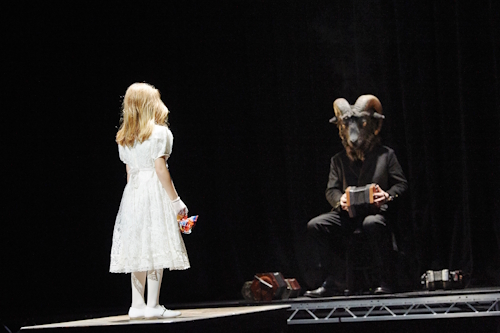
Photo Ros Kavanagh
Keegan-Dolan explains how, when Begley plays polkas, very big in West Kerry although they come originally from Poland, “It’s almost like in a fairy tale. Your feet start to move, and before you know it, you’re dancing. It’s like you can’t but dance. It’s kind of magical.”
He also has a really intelligent musical head, says Keegan-Dolan. “He’s very clear about what he likes and what he doesn’t like so much, which is very advantageous in the creative process because you know where you are. He’s brilliant.”
Keegan-Dolan describes his coming to dance and choreography as being “a bit unorthodox in a sense.” He explains that it was on television that he first really saw the artform, even then, through the eyes of his mother, who was very fond of the films of Gene Kelly and Fred Astaire. The interest grew through pop videos and a musical at school, leading eventually to the Central School of Ballet in London.
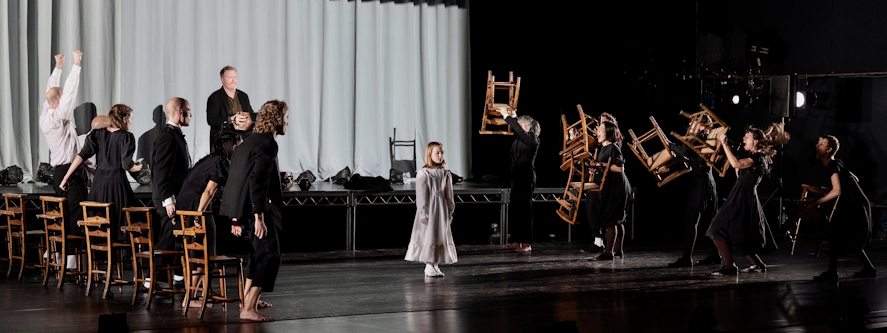
Photo David Gray
Looking to classical dance was, he thinks, maybe a way to validate what was still then seen as a rather unconventional career path, one somewhat problematic for his academically gifted father, who he says, “thought of dance as a kind of an endless poverty situation.”
Keegan-Dolan was at Central at the time of Christopher Gable. “A Renaissance man. Very bright and very light. A lovely man and very kind to me because I was absolutely terrible. But I guess I was very creative by nature and that made it. Choreography was a very natural kind of thing for me. It was it was kind of no thought. It was completely instinctive.”
Keegan-Dolan doesn’t consider himself a ‘step maker’ as such, however. “I’m more of an image maker, but the images generally have music in them and they have people dancing in them.”
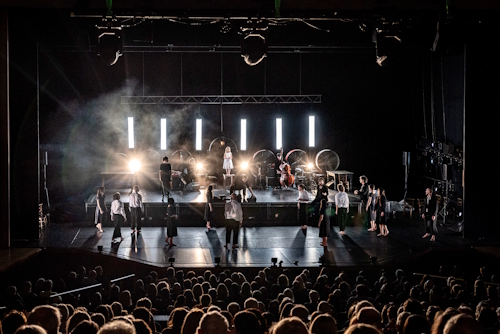
Photo David Gray
Many of his works appear rooted in Irish folklore and mythology. But do the Irish in general have a particularly close connection with their past, I wonder.
“The Irish do have a close relationship to mythology and spirituality,” he says. “There’s a cultural disposition. There’s a very strong connection in the Irish language to story, to myth, to the unseen, I suppose to the imagination. It’s kind of a given. I know in the house I grew up in, it was story after story. The Irish have a predisposition to think about the past. And if you’re in the past, you’re thinking about the ancestors and the dead ones, the ones that have come before. And that’s kind of mythological in a sense.”
But he is absolutely not trying to paint pictures of Ireland or the Irish, he insists. “I think that would be a very complicated picture and way beyond my capacity.” Rather, he explains that he sees the fundamental role of an artist is, in a sense, to share what they see. “And while there’s a kind of material seeing, there’s also imaginative seeing, sort of visioning. So, I guess a lot of the work I make is sharing what I imagine, which is very much affected by where I live, who I am and who my people are. They mostly happen to be Irish, so I guess it is an Irish perspective, but I don’t really think about it in that kind of linear graphic material way. It’s more a feeling and an imaginative response to who I happen to be in this world.”

Photo courtesy Teaċ Daṁsa
Keegan-Dolan’s creation process is sometimes thought of as unusual in that the remoteness of Teaċ Daṁsa’s home on the cliffs of the West Kerry Gaeltacht means that dancers, musicians and others do not go home at the end of each day but stay locally in bed and breakfasts or suchlike.
“But I think probably the most fundamental thing is that we eat together every day. That gives a kind of a continuity to the process that stretches beyond the kind of the rules of being in a rehearsal room. Other things like sharing food and conversation become important. The other thing that’s very significant is the quiet. You don’t get distracted. And the night is very dark. So, you can connect. The darkness is a very creative place.”
When it comes to works, Keegan-Dolan says he’s often asked, ‘What you want to happen? What do you want from making a piece?’ “They are difficult questions to answer because really you don’t want to want anything. But I think what is nice is exactly if the openness and spirit in his creations extends to them.”
He says that dancing for him is about making connections happen, getting into the feeling. “It’s about reducing the distance between the object and the subject, or the observer and the observed, or the Irishman and the Englishman, or the man and the woman, to find commonality, universality in a moment, even in a moment.”
Looking ahead, Keegan-Dolan says he would like to develop further a work called 1975 (in Irish, Naoi Déag Seachtó Cúig), shown in Teaċ Daṁsa’s own studio last summer. “So, the audience had to come to us for a change. That was lovely experience.” He explains that the title comes from an album released by The Bothy Band in 1975 when he was six, and which has a kind of iconic status for some people. The idea is to try to expand it, then take it into the Cork Opera House and other large venues, he tells me.
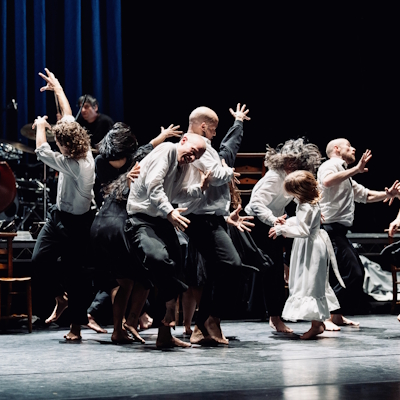
Photo David Gray
He says he would also like to revisit Nobodaddy, “A complicated piece that I just need to, I want to, get at again, maybe in 2027. I want to try to figure some things out that eluded my understanding. I’ve been looking at the video footage a lot, studying it and trying to understand more what’s going on with it. So that’s what I’m going to be working on, I think.”
A Dance Consortium tour, MÁM opens at The Lowry, Salford on February 3, 2025, then tours to Birmingham, Brighton, Norwich, Southampton, Canterbury, Aberdeen and Plymouth. Visit www.danceconsortium.com for dates and booking links.