
Nationale Opera & Ballet, Amsterdam
December 29, 2025
Dutch National Ballet’s production of The Nutcracker and the Mouse King by Toer van Schayk with additional choreography by Wayne Eagling, out of which English National Ballet’s previous version was born, has a warm child centred approach.
At its heart is little Clara whose devotion to her nutcracker doll takes her on a journey through Drosselmeyer’s magic lantern to become the Sugar Plum Fairy of her dreams. Van Schayk gives a sensitive reading of a little girl on the cusp of adolescence, a thoughtfully nuanced character entranced by both the mechanical doll and Drosselmeyer’s young nephew who will become her dream prince. Van Schayk makes an amusing contrast with flighty older sister Louise, who is very much into boys and fashion.
The story opens in the attic bathroom as the nursemaid struggles to get the two excited children washed and dressed for the party while Louise commandeers the mirror to check hair and dress details. The action returns to the attic in the final moments. Clara’s dream dissolves in a split-second crossover that takes us instantly back to the small room and a startled girl sitting up in bed. The image is expertly timed and encapsulates the ballet. Clara runs downstairs joined by Frits and they run onto the balcony. An enigmatic closing moment has the pair facing a crowd of children all in simple nightwear, who raise their arms in greeting, possibly suggesting the dawn of a new world.

Photo Altin Kaftira
Tchaikovsky’s blissful score with its imaginative orchestration plays its part along with snowflakes and flowers but this production is unique in many ways. It is set in Amsterdam and, as the focus is on Clara’s gift of a nutcracker doll, the party date moves to 5 December 1810, and the feast of St Nicholas when children get their presents.
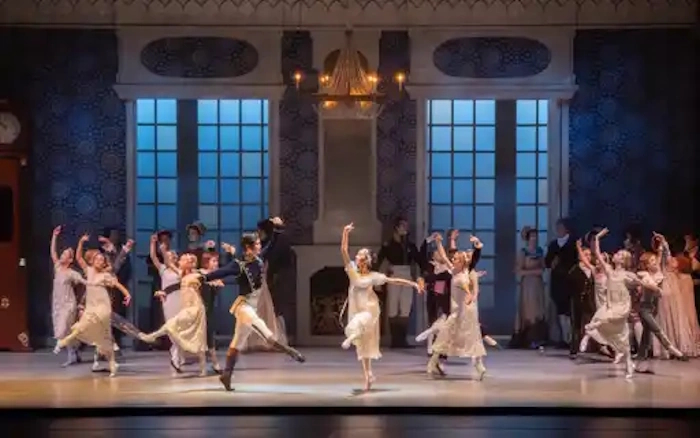
The grand reception room at the Staalboom’s house on the canal may lack a Christmas tree but the canal offers a playground for the ice skaters. It proves a lively party, with set dances in graceful Regency style dresses, interwoven with playful children and a wealth of characters, old and young. Louise, a frisky Erica Horwood, flirts with the Poet, Edo Wijnen, while keeping her other two suiters at bay, Frits behaves badly and Drosselmeyer’s nephew, Semyon Velichko steps in gallantly to partner little Clara. This sets her heart racing and when it comes time for guests to leave, she seizes the moment to offer the bemused nephew, the blue ribbon from her hair.
However, the title is Nutcracker and Mouse King and with these characters played by dancers of powerful physicality, namely Giorgi Potskhishvili and Robin Park, the fight scenes were a treat. The battle is keenly fought and is not over with one blow from Clara’s ballet slipper. In the Staalboom’s living room the fighting rages as wicked mice reinvent their mouse trap as a catapult and fire cheese bullets while the piano becomes a battering ram. Wounded mice are carried from the battlefield and a cageful of soldiers become prisoners of war before Clara, now played by Riho Sakamoto and her nutcracker doll escape to the snowy fields.

Photo Altin Kaftira
Drosselmeyer, a most impressive performance from Bela Erlandson, still has some magic tricks in hand. He tends the wounded Potskhishvili who magically changes to his nephew, still dressed as the Nutcracker but without the distorting nutcracking jaw. He dances with a radiant Sakamoto but their joy is short-lived as Mouse King is by no means defeated. They engage in further fighting between the flurry of well-rehearsed snowflakes and the act closes as Drosselmeyer helps the Nutcracker and Clara escape through the magic lantern.
In Act 2, the trio emerge into Drosselmeyer’s workshop where skilled dancing mechanics manage the operations. The trio dance with an ecstatic Clara flying high and Potskhishvili executing a brilliant solo. Then the rodents return. Thankfully a giant cat’s paw sends the Mouse King and Nutcracker back through the magic lantern and in their place, Velichko emerges now dressed as a Prince.
It’s time for celebration and dances from many lands, including a Spanish Jota, Chinese and Russian dances. Siblings appear in unlikely guises. Louise is the nymph in ancient Greece, still pursued by the Poet and suitors, as Mirletons are transposed to pan pipes.

Photo Altin Kaftira
In a nasty piece of cultural misappropriation, the Arabian Dance is led by a brutal slave master wielding a whip with Frits in chains. Slavery has always had a place in human history but the worst, the horrific triangular slave trade lasting over four hundred years was controlled by Europeans generating vast wealth for their industries and empires. However post-abolition, Europeans cleverly shifted the stigma of slave traders onto the Arabs. This dance needs to be rechoreographed.
In the Waltz of the Flowers, a ten-couple cohort of excellent dancers, have their moment in an ensemble piece of challenging partnering, fast paced and with intricately structured choreography. However, the grand pas de deux remains the highlight as Clara and her Prince adorned in silver and white, created magic.
Sakamoto is a dancer who adds warmth to the most austere of high classicism. She dances with a graceful ease that makes you believe the steps are improvised rather than carefully rehearsed and despite the grandeur of music and performance, the thrill of a little girl wearing her first tutu still shone through. Velichko played his part as a considerate and supportive partner. The solos and coda were the sparkle on top with brilliant turns and fine-tuned musicality.
The final moments see the Flowers and Divertissement dancers return in a whirl of movement before the Clara is transported back into her bed in the attic. It is still a lovely ballet, designed with flair by Van Schayk, given excellent support in the pit under Johannes Witt and hugely enjoyed by the packed house.