
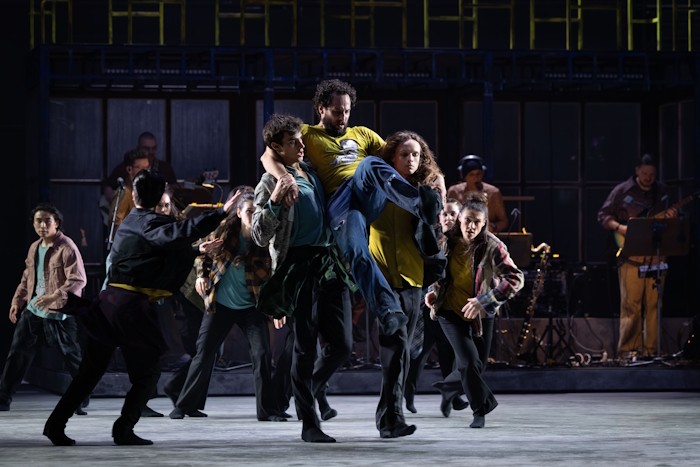
Staatstheater am Gärtnerplatz, Munich
April 30, 2026
With the somewhat pretentious title, Rock to Heaven, the Ballet of the Staatstheaters am Gärtnerplatz presented a triple bill with pieces by company director Karl Alfred Schreiner, Jacopo Godani and Frédérick Gravel with the titles Part 1, Part 2 and Part 3. The evening was a tribute to rock music. But with new music, commissioned from the German composer Leonhard Kuhn, because as Schreiner explained in an interview, he did not want people’s associations with well-known songs to compete with what was presented on stage.
The set, by Heiko Pfützner, brought associations to an empty, dilapidated factory building with smudged windows, the ideal setting for a club. The facade opened up sideways to reveal a six-member band sitting at the back between iron staircases leading to the roof above. The first to enter was Joel Distefano as George, the star in Schreiner’s piece, Part 1, which Schreiner explained was about the negative sides of stardom. Distefano came downstage and stretched out one arm to the audience like a rock-singer addressing his fans. With the stage extended over the pit, he was almost within touching distance of the first row.
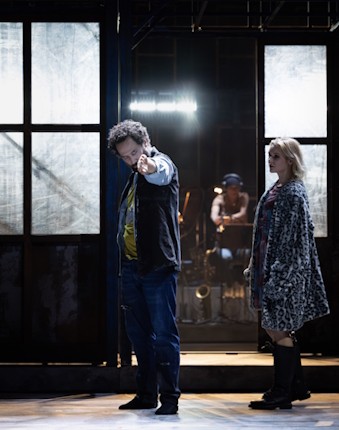
in Part 1 of Rock to Heaven
by the Ballet of the Staatstheaters am Gärtnerplatz,
Photo Marie-Laure Briane
Then the evening, or concert, unfolded focusing on Distefano’s relationships to the people surrounding him. A woman, Courtney, danced with passion by Montana Dalton, came in and tried to snuggle up to him, moving as if on drugs. They engaged in a violent push-and-pull duet in Schreiner’s characteristic jazzy movements. Every time they were close, he shoved her away holding her hand, just to stop her with a jerk und with force draw her close again. It was like love and hate, and when they whirled around on the floor, it looked as if they were having sex.
In between, twelve dancers encircled him like fans or engaged in violent fights with him and each other. At one point, a man in a golden suit, Ethan Ribeiro (BoddAH), moved down one of the stairs like a drug addict. You never got to know what he was: Distefano’s lover, inspiration? Perhaps his alter ego? They engaged in a gentle, loving duet, before rushing up the stairs, where when they had reached the roof over the band, Distefano pushed him off. At the end Distefano smiled faintly, waved as if saying goodbye and walked off. The dancers were fabulous, but the story never went beyond the well-known clichés of a rock-stars life. The music loud and rock-like carried the action.
Part 1 moved into Part 2 by Godani, a former dancer with William Forsythe’s Ballett Frankfurt, and from 2015-2023, director of Dresden Frankfurt Dance Company. The dancers from Part 1 left and a couple appeared: Yunju Lee in black shorts and a whitish top, Gjergji Meshaj in black baggy pants and a ditto top (costumes also by Godani). They created a stark contrast to Thomas Kaisercolorful contemporary-like street-clothes ofPart 1, which also featured in Part 3.
Lee and Meshaj mastered Godani’s movement vocabulary extremely well. They engaged in a duet with rippling, undulating movements, juxtaposed by jagged, flapping arms and her doing sharp développés, he catching her foot up high to slowly lead it to the ground. At times they looked like weird creatures or insects. This feeling was underscored by the music, that sounded like a dark, slow running undercurrent in a cave; broken by occasional beats of a drum. It was very atmospheric.
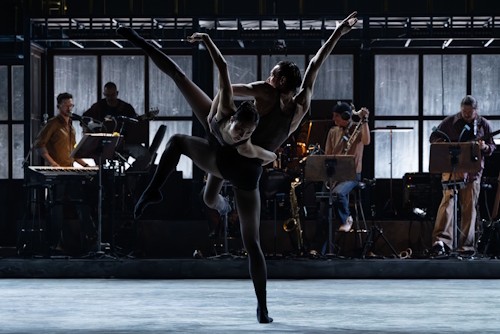
Photo Marie-Laure Briane
Canadian choreographer, dancer musician and light designer Gravel’sPart 3, for eighteen dancers, opened with the performers sitting on their knees doing poses in stop-motion. They rose and continued, until interrupted by Alexander Quetell, one of the cast. In a microphone he spoke about the difficulty of finding endings, which he referred to as dramatic poses of which he took us through six. First, the dancers laid motionless on the stairs in weird positions, while the orchestra played a very melodic tune. That structure was then repeated with the dancers in different positions spread over the stage. It was a funny intermezzo, interrupted by what Alexander called a dramatic duet, a couple doing more poses in stop motion.
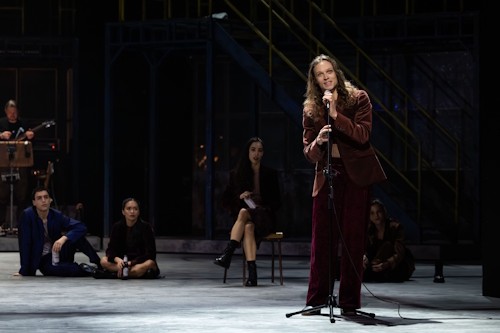
Photo Marie-Laure Briane
But despite the entertaining text, the piece did not amount to anything more than what it was: poses in stop motion. It was such a shame that this group of expressive and motivated dancers were not given a chance to dance and show their abilities. But that’s only the quips of a critic loving the flow of movements. The piece was received with a standing ovation.
The live band and the music were an essential part of the performance. The tunes changed between full-blast rock, to atmosphere creating soundtracks, to soft, heart-massaging pieces. The programme did not take me anyway near heaven, but it presented a roster of very talented, young dancers.