
Sadler’s Wells, London
May 1, 2026
Founded by Jonzi D and first staged in 2004, Breakin’ Convention is now in its twenty-second year, and remains one of the world’s leading platforms for hip hop theatre. At Sadler’s Wells, Friction, the opening night of the festival’s 2026 edition, brought together a range of works that show just how far hip hop has travelled on the theatre stage. What began as cyphers and battles is now expanded into something more layered; structured, theatrical, and at times deeply reflective. This was also a night of powerful physicality, where friction played out between bodies, surfaces, and even ideologies.
The evening opened with Where Is the Line? Created and performed by Emma Houston, it introduces a more conceptual and text-driven approach. The piece sits somewhere between dance and live performance, creating a structure that moves away from purely physical display.
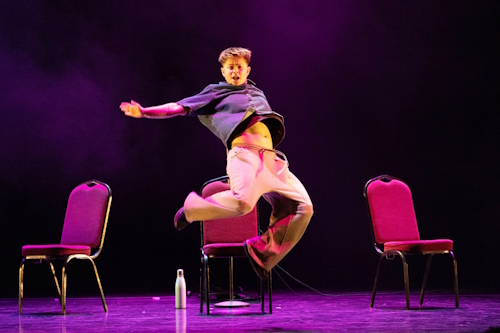
Photo Belinda Lawley
The choreography builds through pacing, repetition, and the interaction between movement and voice. This gives the work a distinct rhythm, allowing ideas to unfold gradually without immediate impact.
There is a clear interest in exploring how the body and language intersect, with the performer navigating between physical expression and spoken text. While understated in its physicality, the piece sets a thoughtful tone for the evening, opening up space for reflection before the more high-energy works that follow.
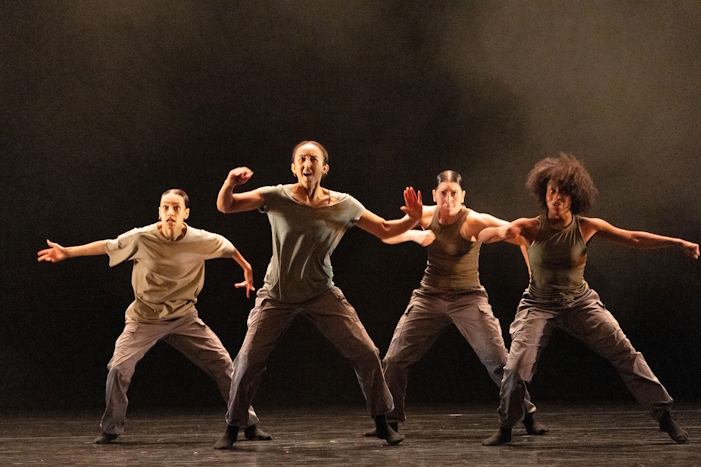
A key figure in UK hip hop theatre, JosephToonga engages with questions of identity and representation. His Born to Protest: The Reframe is an all-female reimagining of the original work.
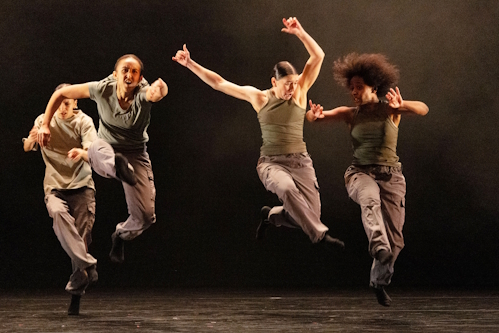
Photo Belinda Lawley
It brought a powerful shift in energy. Toonga and his cast draw on krump to create a raw, high-impact physical language, exploring themes of power, defiance, and vulnerability. Unsurprisingly given the cast, the work suggests a feminist undertone, as the dancers assert presence with strength and immediacy, claiming space within a form often dominated by male expression.
The choreography does not illustrate these ideas so much as carry them through the body. The dancers bring a powerful physical presence: grounded, controlled, and precise, giving the work a strong sense of drive and coherence.
Diggi, a duet by Kaner Scott shifted attention to a much smaller scale. A UK-based artist whose work centres on physical sensitivity and detail, Scottappears particularly interested in how movement originates from within the body, rather than being projected outward.
Movement unfolds through smaller joints, notably wrists and shoulders, and subtle shifts of weight, revealing a precise and controlled physical language. This attention to micro-movement suggests a choreographic focus on internal dynamics: how control, tension, and release are negotiated at a granular level.
The dancers move within a confined range, yet the work never feels limited. It draws the audience closer, creating an intimacy that feels almost internalized. It proved one of the most restrained works of the evening, yet also one of the most absorbing.
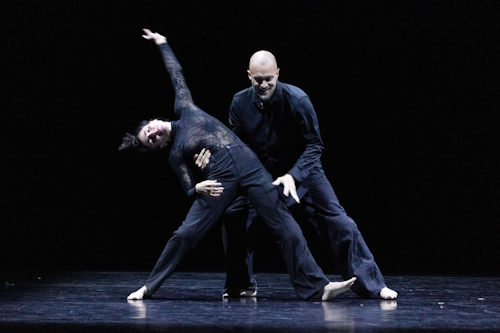
Photo Belinda Lawley
La Dolce Vita, a striking duet by Compagnia Bellanda brought a different kind of physical dialogue. Choreographers and performers Lia Claudia Latini and Giovanni Leonarduzzi share a strong physical rapport, traveling across the floor and exchanging weight with ease and precision. The work is simultaneously grounded and expansive, with transitions unfolding seamlessly. The flow rarely breaks, movement carrying forward through constant negotiation: support, resistance, and redirection passing between the two bodies.
Gradually, the relationship between the couple comes into focus. At times it feels intimate, even tender; at others, more resistant, as if testing boundaries of control and distance. The work suggests shifting dynamics of intimacy, power, and gender, without fixing them into a clear narrative.
The floorwork is fluid and continuous, and the partnering is handled with a high level of control and trust. Weight is shared, redirected, and sometimes deliberately withheld, creating a sense of tension within the flow itself.
The spoken Italian in the work, accompanied by English subtitles, appears to echo the movement, helping to create a sense that this is about communication; between two bodies, two voices, and two shifting perspectives.
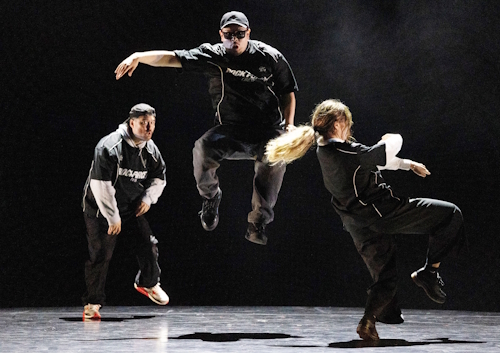
Photo Belinda Lawley
We Are One, a group work by Rock Force Crew, was one of the most visually striking pieces of the evening. Winners of the UK B-Boy Championship 2025, the performers brought explosive energy to the stage, the work tracing a journey from their crew origins toward a more global presence.
It is quite simply a pleasure to watch; the choreography, lighting, and the dancers’ physicality working together with clarity and impact. Movement phrases land cleanly into the rhythm, but what really stands out is the group’s collective precision. Even at speed, the dancers remain controlled and sharply defined, moving as a cohesive unit. This is virtuosity that feels shared rather than individual; less about showing off, and more about timing, coordination, and a deeply embodied sense of rhythm.
Across the evening, Friction demonstrates how hip hop continues to evolve beyond its roots in battle culture. What begins in the cypher here unfolds within the theatre, expanding into a broader choreographic and performative language.
The programme was constantly engaging as brought together artists from different countries and backgrounds, placing contrasting works side by side, from intimate duets to large-scale group pieces. The evening also embraced difference, allowing each work to retain its own voice. And there was a clear sense of hybridity throughout. Contemporary dance, krump, and street-based forms intersected and overlapped, creating a layered movement language that reflects the diversity of hip hop today.