Dance Theatre, Taipei National University of the Arts
March 22, 2026
At Taipei National University of the Arts (TNUA, 國立臺北藝術大學), graduating MFA students get to stage their own programme. Excellence of performance is guaranteed, but Illusory Time|Errant Tongue (妄時・妄語), a joint production by Tsai Meng-ting (蔡孟廷) and Lai Yi-fei (賴怡菲) also proved an afternoon of interesting choreography, and superb interpretation and ownership of roles.
The programme brought together four existing works by different choreographers. For Tsai and Meng, it gave the opportunity to demonstrate their ability to shift between movement vocabulary and styles, which they did superbly.
But while the pieces were different, there was something of a theme in that ideas of understanding and misunderstanding, of being and vanishing, raised their heads again and again; sometimes very powerfully. The two duets on the programme were also both very much of a physical dialogue, so well performed by Tsai and Lai that words were unnecessary.
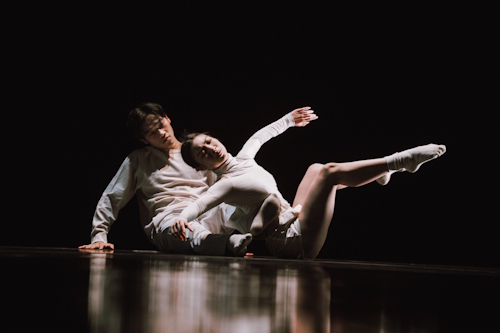
Photo @hk_w.d
Hearken was created in 2018 by Liu Fang-yi (劉方怡), former dancer with Leipzig Ballet and now choreographic assistant at Landestheater Schleswig-Holstein, which presently has no fewer than four TNUA alumni on its roster of dancers. It’s a work that explores dialogue and understanding between two people. Or perhaps more accurately, lack of understanding.
Liu presents a couple, Tsai and Annette Seow (蕭樂恩), where the relationship appears to have broken down. They start back-to-back, both in white against a sea of black. There’s a tension in the moment matched by that in Dirk P. Haubruch’s music, a tension that continues as the situation plays out. The couple collide repeatedly. Meaning and intent was all too clear. That they were hearing one another was certain. But were they really listening? There’s a large amount of physical contact. Several times, a hand is proffered as a sort of gesture of reconciliation, but time and again it is refused before it ends with Hsiao walking away once and for all, one sensed.
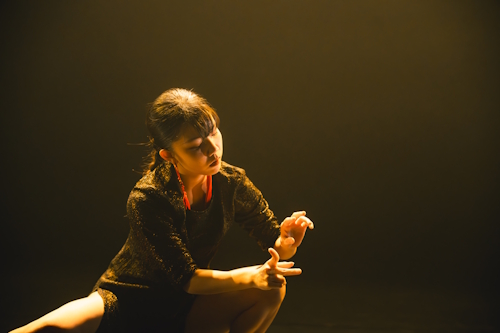
Photo @hk_w.d
Lai Yi-fei made her first appearance of the programme in Invincible Swiftness of Golden Crow (紅頭裡的金烏雲薦), a piece from 2020 by Lin Ting-syu (林廷緒). Inspired by the statues of deities found in temples it’s about a red-crowned Taoist shaman who presides over holy ceremonies, and a mysterious golden crow pf ancient Chinese literature that resides in the sun and moves like a darting arrow.
Lin’s choreography fuses religious imagery and contemporary dance. Against the growing rumbling of experimental sound artist and composer Yan Sheng-wen’s (顏晟文) accompaniment, Lai gave a performance that was intense and powerful, and delicate and subtle, in equal measure.
On another pitch-black stage, she’s lit in a golden spotlight. Her body, low and planted firmly, shifts and contorts. Her movement is sometimes swift, sometimes measured. Her torso swings, hr limbs tremble. But what really catches the eye is the clarity of detail in her hand gestures. At the end, while the lights may dim and the music fade, an aura remains.
Premiered in 2015 at the Hong Kong Arts Festival, Pardon (原) by Wong Choi Si (Tracey, 黃翠絲) co-founder with Mao Wei (毛維) of Macao-based MW Dance Theatre (末未舞蹈劇場) returns to the idea of a couple where things have broken down.
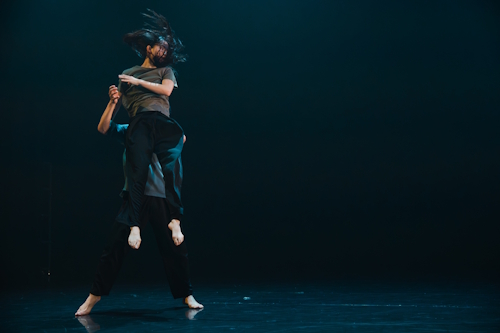
Photo @hk_w.d
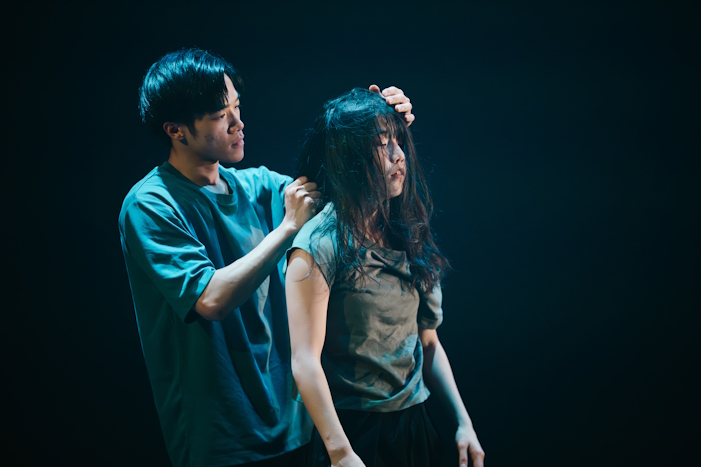
It opens in silence, Lai rooted to the spot, trapped in a square of light. A metaphorical cage perhaps. The tension is already high. When she leaves, she’s immediately confronted by Tsai. The violence isn’t long coming. They grab and twist each other’s shirts and arms. More often than not, Tsai seems to be the primary aggressor, although the tables are sometimes briefly turned as she fights back. Totally in character, totally in the moment, he and Lai made it look very real. His grabbing, pulling and twisting of her hair felt especially disturbing. That it was so is testament to how invested in their performances the couple were.
And yet, as can be the case, under all this aggression one sensed tenderness still exists. Why does someone, usually but not exclusively a woman, want to stay with, or keep returning to, someone who emotionally and physically abuses them? There is a choice, it’s easy to think. Why not just flee? A simple question but one with many answers, none straightforward. Here, and several times, Lai does go to escape, but she always comes back, at the end leaping on Tsai, wrapping herself around him as if utterly dependent upon him.
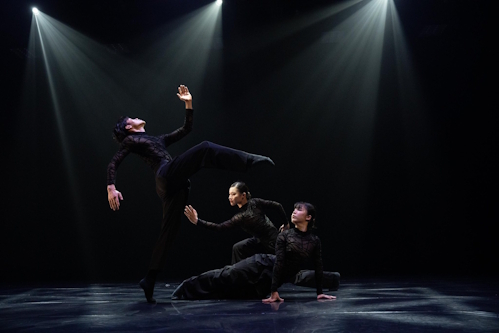
Photo @hk_w.d
Finally, to an ensemble piece, The Forking Paths of Time (歧時之徑) by Tsai Hui-chen (蔡慧貞), former principal dancer with Bern Ballet, now on the faculty at TNUA. Reworked from its smaller-cast 2020 version, it has been extended with Tsai Meng-ting and Lai Yi-fei joined by five other dancers.
All about musicality and technique, the abstract choreography flows beautifully. To ‘Nuuk (Air)’ by Thomas Köner, ‘No Time, No Future, I’m here RIP’ by 404.zero and ‘Aheym’ by Bryce Dessner, the dancers becoming travellers in space and time, shifting between light, shadow and different rhythms. Thin bands of light across the stage floor appear like a musical stave, the dancers animated notes on its lines. Solos and duets come easily. In between, the dancers flood across the stage forming momentary tableaux before breaking apart once again. It was impressive in construction, impressive in execution and a fine closing piece.
As Tsai Hui-chen observed in her programme introduction, MFA graduation programmes like this do not merely mark the completion of a degree. They are also a significant milestone in the dance journeys of the dancers concerned. For Tsai and Lai, the path ahead may be unclear right now but both are clearly very talented performers who can adapt to different styles and bring depth to what they do on stage. That will stand them in good stead whatever the future brings. I wish them well.