

This month, Tjimur Dance Theatre from Taiwan tour England with ‘bulabulay mun?’ including performances at The Place as part of Dance Umbrella. David Mead looks ahead with founder and artistic director Ljuzem Madiljin, and choreographer Baru Madiljin.
How are you? bulabulay mun? in the South Paiwan language. Such an ordinary, simple greeting, yet also one that can be a source of strength in the most extraordinary of times. It’s also perhaps something we don’t ask enough.
The phrase is also the title of Baru Madiljin’s work that Tjimur Dance Theatre (蒂摩爾古薪舞集) are bringing to the England. Commissioned by Pingdung County Cultural Bureau, it commemorates the Mudan Incident, an act of war that has been buried in time. As bulabulay mun? seeks to heal historical wounds and revive ancestral memory, it acts as a greeting to all those involved in it, reflecting on the relationship between human actions and their unforeseen consequences. Parallels are drawn with nature and our elemental connection to the world as it describes a community suddenly confronted by the immense power of wind and waves, awakening a heightened awareness of how far they have drifted from their true place.

Photo courtesy Tjimur Dance Theatre
Based in Tjimur village in Pingdung County, Southern Taiwan and founded in 2006, Tjimur Dance Theatre is one of Taiwan’s leading dance companies. Under the leadership of its founder and artistic director, Ljuzem Madiljin, with Baru Madiljin as dance director and choreographer, the company is noted for the way it brings present and tradition together, interpreting the contemporary experience of the indigenous Paiwan people through old tribal music and songs.
A little background. The Mudan Incident (牡丹社事件) followed the killing of 54 shipwrecked Ryukyuan sailors after they had accidentally entered Paiwan lands in 1871. Although what happened was due to language and cultural misunderstandings, the Japanese used the incident as a pretext for a punitive expedition three years later, during which Sinevaudjan Village was wiped off the map. Not only was it Japan’s first military assault on a foreign country since the Meiji Restoration six years earlier, which returned power to the Imperial House, but also the first time Taiwan was involved in warfare in early modern history.
It proved a moment in East Asian history that would have consequences across decades. The Chinese Qing Dynasty government, which had regarded Taiwan as something of a backwater, started paying more attention to the island, including encouraging Han settlement in the mountains to better subjugate the indigenous population. The resulting suppression of indigenous culture, which continued under the 1895-1945 Japanese occupation and subsequent Nationalist government of Chaing Kai-shek, was only reversed in the late 20th-century. Sensing Chinese defensive weakness, the event also began decades of Japanese imperial expansion.
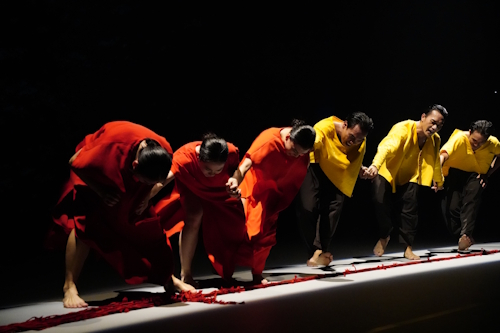
Photo Ba Sa-xi
Baru initially wondered how on earth he would choreograph the historic event but began his usual in-depth research. He soon ran up against problems. “I read a lot of documents, but most were written from Japanese point of view; and when I interviewed Mudan elders and other people, they all told me slightly different versions of the story.” Common threads emerged, however: misunderstanding was at the heart of the affair, with the killing done simply to protect their homeland.
Even so, he says it was only after he visited Bayawan, the site of the 1871 killings, that he realised what he wanted to say, how he wanted to tell his story. “Actually, the work tells many stories,” He adds.
The research and creation process lasted three years. Baru and Tjimur’s movement language comes from his and the dancers’ cultural roots. It is grounded in tradition, in old Paiwan melodies and dance steps, while simultaneously infused with contemporary, Western training and styles. The result is something quite unique and very distinctively Tjimur. But for bulabulay mun? that existing knowledge had to be put aside. The dancers had to rebuild from the ground up, learning the unique songs and dances of the Xinbaojiang people in Mudan Township, so that a new ‘Mudan physicality’ could emerge.

Photo Lin Jun-yong
“It was truly challenging,” Baru remarks. Although he, the dancers and the people of Mudan all belong to the Paiwan, they are separated by over 100km, with vastly different movement and singing styles. And while Northern and Southern Paiwan languages share some similarities, their tones, phonetics, and speech patterns are very different, he explains. The answer to learning was found by going into the villages, and being guided by the elders. Finally earning the trust of the locals, he came to understand that the power of caring, of greeting, was a thread that connected them all.
“I started to use the title, bulabulay mun? as my inspiration, a way into creating the work and then to talk. I use this, to begin with, to have people way back in 1874 asking current people and ourselves ‘How are you’.” The title also speaks of the Baru’s feelings towards everyone connected to the Mudan Incident, of which discerning the rights and wrongs of which become more and more difficult as years pass, like all historic events.
Baru explains that, while the work does not describe what happened over 150 years ago, he hopes viewers will feel fragments of memories, what is left there, how we try to make compromise, and warmth about greeting one another.
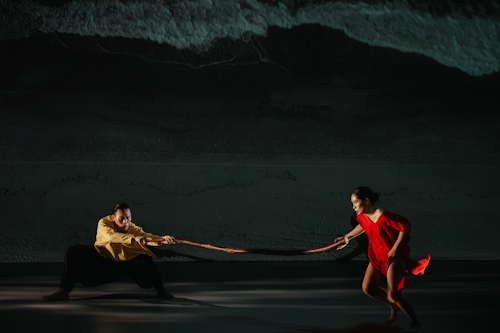
Photo Ba Sa-xi
The sensations of being buffeted by wind and waves seen in the choreography came out of the on-location filming of the work in 2022. As the elements affected them, the dancers had to adjust their movement. Sensing an opportunity to add another layer to the work, Baru urged them to bring those sensations to the stage.
“As a Taiwanese creator. I think this work is really about culture and ideology. As a Paiwan choreographer, I feel that I am in between the tribe and history. I am kind of a connector. Everything you see in the production is about the land, the flavour of the land and the feeling of our bodies. It’s honest.”

Ljuzem Madiljin
Photo courtesy Tjimur Dance Theatre
Dealing with a historic event is in many ways atypical of Tjimur Dance Theatre’s work. As Ljuzem Madiljin explains, the company is rooted in tradition, preserving it, passing it on and learning about it. “We present a bridge for people to understand what tradition means within us by expressing what we are through our dance pieces.”
The company has always been noted for how it balances modern contemporary dance and traditional culture. But the two are far from the opposites they might appear, she insists. “Tradition and modern or contemporary are not separate ways of living. They merge together. Tradition lives on an develops. We are always adding value to it. When contemporary dancers sing ancient songs, it is the life of and soul of our modern-day relationship. When we sing traditional rhymes, it is the people’s voice. It is our current breath. Tradition is like a flowing river, always flowing.”
That the company lives in and lives with the tribe is important, Ljuzem believes. “We continue to have the conversations with the people. It is very important to keep the dialogue going, to help local people understand what we are as a Paiwan dance company. I think you can feel that depth of that dialogue in Baru’s work. You can feel that fieldwork. Only by being in the field can you absorb what it has.”
When it comes to dancers, she says, “We do not look for people who are just able move and dance. We look for people who are willing to learn about and respect cultural heritage and who would love to carry the tradition forward.”

a piece based on traditional Paiwan dance but transformed into a contemporary movement language
Photo Maria Falconer
“I’m very excited. I’m really looking forward to it,” says Ljuzem about the company’s visit to England, the first extensive tour in the UK by a Taiwanese company since Cloud Gate Dance Theatre in 2008. While a highlight is appearing on stage at The Place and on screen at the Barbican as part of Dance Umbrella, the company is also performing in Ipswich, Newcastle, and Bournemouth.
But the visit is not only about performance. Ljuzem explains, “It is about having dialogue and letting the world know who we are, where we stand and what we stand for.” In the studio, the company are working with MA students at the London Contemporary Dance School for five days, and holding a half-day workshop at Oxford University. In those sessions, “We will teach the students dance, but we don’t start with the body but with the culture, learning about our culture,” she adds

and used to laugh at one’s own attitude
(l-r: Meng Tzu-en, Ljaucu Tapurakac, Yang Ching-hao, Chiang Sheng-hsiang)
Photo Chen Chang-chih
With singing or chanting an important element in many of Tjimur Dance Theatre’s works, the company’s method of training is that you have to begin with the voice. “In our work, the movement flows from traditional songs, their rhythm.” And that is where the workshops will begin. “For example, at the London Contemporary Dance School, the MA students will start by learning how to sing the traditional Paiwan songs as well as learning about the culture of the Paiwan. From there, we will go into dance technique. I think it’s an exciting thing that our work really doesn’t start from the body, but from culture and singing.”
Returning to bulabulay mun? what would Baru like audiences to take away from the work? “The energy and power of the piece,” he says. “I hope they will hold hands. I hope it makes people feel that there is great power in working together and that it can ease regrets and heal many wounds. I can imagine people, after they’ve watched the performance and left the theatre, the first thing they do is pick up the phone and call whoever they want to call to ask, ‘How are you?’”
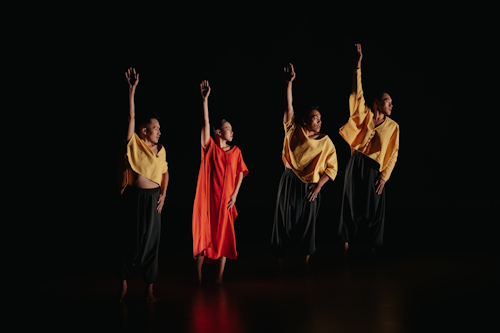
Photo Lin Jun-yong
Tjimur Dance Theatre perform bulabulay mun? as part of Dance Umbrella at The Place, London (October 21 & 22, 2025); Dance East, Ipswich (October 24); Dance City, Newcastle (October 28); and Pavilion Dance South West, Bournemouth (October 31).
The film version will be shown as part of Dance Umbrella’s Film Series: Sunday Shorts at the Barbican Cinema, London on October 12, and is available online to October 31.