
Royal Ballet and Opera, London
October 18, 2025
La Fille mal gardée, choreographed by Sir Frederick Ashton and premiered in 1960, is one of the oldest and most genuinely beloved comedic works in The Royal Ballet’s repertory. On its return to the Royal Opera House stage, the atmosphere inside the theatre felt different from the moment people walked in. It was as if the audience entered already in a good mood.
British wit takes a very tangible form in Fille. Silent film style humour is embedded in the footwork, pacing and physical attitude of the characters. The very steps that usually overwhelm the eye with their neatness are used here to build the comic rhythm of the entire piece. Each little hop and every quick change of direction pushes the emotion of the scene forward. Those tight chains of petit allegro and fast pas de bourrée feel less like steps and more like punchlines written in footwork. The lightness that the audience feels comes directly from this tight patterning of beats.

in Sir Frederick Ashton’s La Fille mal gardée
Photo Alice Pennefather
The moment the chickens appeared in Act I, people immediately burst into laughter. The children in the audience were especially delighted.
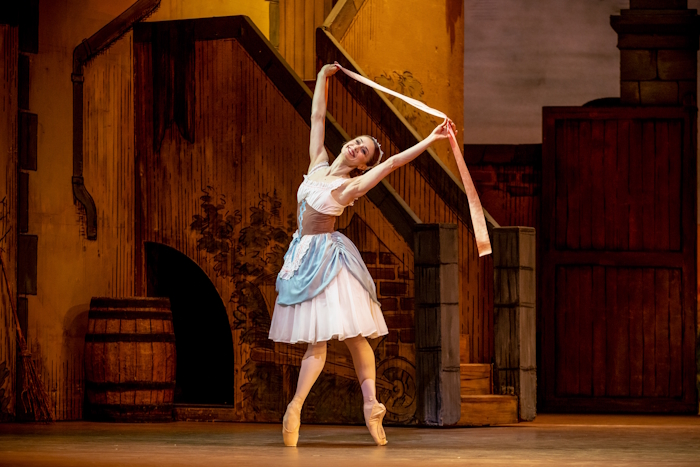
When Marianela Nuñez stepped on stage, it was instantly clear that she was not pretending to be Lise, she was Lise. There was a sense that she knew she was playing, and was enjoying it. Her presence was not the naturally innocent charm of a young girl, but the easy confidence of someone who knows perfectly well how delightful she is and chooses to share that playfulness openly. That ease was more compelling than any technical flourish could ever be.

in La Fille mal gardée
Photo Alice Pennefather
Vadim Muntagirov moved entirely within the rhythm she set. His turns were not the sealed, vertical lines expected of competition-style perfection. He danced like a human being. His weight shifted, his body breathed, and his eyes went to his partner before they went to the audience. That kind of trust on stage made their small imperfections feel alive. Their embrace held both the affection of the characters and a silent acknowledgement between partners.
The best moment came in Act II when the ribbons around their necks refused to stay in place. Those two mischievous strips of fabric kept slipping loose, forcing them to fix them while still dancing. They exchanged a glance and a quiet smile, not part of the choreography but something shared between two performers in real time. It was more alive than any polished classical phrase.
Earlier in the day, Anna Rose O’Sullivan danced Lise with the spirit of a small cat in a mood, playful as if by nature, her rebellion soft and her footwork bright and elegant.

in La Fille mal gardée
Photo Alice Pennefather
Nuñez brought something else entirely. Her mischief felt like the wilfulness of someone adored all her life, carrying a pulse of agency. Every step was delivered with full control and intention. The same role, but in one version Lise is a girl swept forward by energy, and in the other she is a woman who directs it herself. This is the particular pleasure of a repertory ballet. The character is not fixed; it grows differently depending on who dances it.
The Wedding scene held a strange, beautiful shift. The people on stage did not seem to be acting out a wedding, they looked as if they were genuinely inviting the whole auditorium into it. Nuñez stood in the centre, completely relaxed. She glanced at her partners, at the corps, and then over the audience. That was not performance but a kind of quiet sharing, a soft admission that she had also had a good time tonight. It was in that moment I realised that the magic of La Fille mal gardée lies not in the story, but in the shared agreement that, for once, everyone in the room is allowed to be happy without question.

Photo Alice Pennefather
Thomas Whitehead as Widow Simone captured that specifically British kind of strictness that is secretly tender underneath. Luca Acri as Alain was the evening’s quiet scene stealer. It takes a technically secure dancer to convincingly perform as someone always slightly out of time and he did it with precision. Together with the rest of the ensemble, they turned the stage into a playground of collective enjoyment. And, of course, the little pony, who clearly had no idea it was part of The Royal Ballet that night, yet immediately became the star of every child in the house.
After the show, as I passed the Stage Door, it was notable how Nuñez greeted each person with the same bright ease she had on stage.
The Royal Ballet has many grand, serious classics in its repertory. But a ballet like La Fille mal gardée, one that simply allows an entire theatre to be genuinely happy, is rare. A performance that plays wholeheartedly is, perhaps, the best reason a theatre should exist.