
The Place, London
January 23, 2026
It is now over forty years since the first reported case of HIV. Then to the forefront in the news, it frightened the world. Today, we barely hear of it. It feels like those days of stigma and ignorance have long gone, even though the virus and AIDS, a collective term for the serious illnesses it causes, are very much still with us. But what of those with the virus today? How do they feel? How do they cope? That’s where Sadiq Ali’s Tell Me comes in, a circus-dance work that considers the narrative around HIV today.

Photo Alberto Santos Bellido
It is a remarkably compelling production that doesn’t falter from start to finish. It’s honest. At times it’s very raw. But there are moments of great sensuality and poignancy. The end is beautifully so. Given the subject matter this may be a surprise, but there’s even a few dashes of humour.
Parallels are draws a between the mid-1980s and today. Jonah Russell uses a letter to tell their mother they really need to talk. Phoebe Knight calls on a mobile phone. We know what they want to say, we see both have a problem saying it. Some things really don’t change.
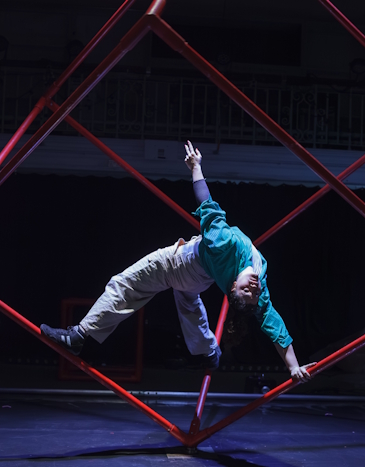
The couple dance an at times tender acrobatic duet. They climb and swing. Freedom, fun and an almost childlike innocence is writ large. As elsewhere, particularly impressive is the way the choreography flows. Devised by the cast with Jonathan Lunn (whose recent work includes a full-length Alice for Ballet du Rhin in Strasbourg) and Junior Cunningham (former Motionhouse dancer and rehearsal director), the circus and acrobatic moments almost always come naturally. Not once do they appear to be there for their own sake.
The innocence does not last of course, but before then there’s a flip back to a scene straight out of the 1980s, the very period choreography and costumes both joyous and just a little suggestive. It is impossible not to smile. I’m sure I wasn’t the only one who had memories of Village People come flooding back. But then a change as news of a new illness breaks and things turn rather darker.

Photo Alberto Santos Bellido
Ali, Knight and Russell are superb throughout making light of the choreography’s physical demands. Much of the dance takes place on the vertical poles that form one of set and costume designer Ash Özüak’s red cubes that are used throughout as a symbol for HIV. That large cube is also cleverly used to create rooms, to change location.
Elsewhere, a smaller, Rubiks Cube-sized red block is used as a sort of ‘black spot’ to indicate that a character has been diagnosed as HIV-positive. Other cubes hang above, their presence oppressive. When lowered, one bears down on a dancer like an impossible weight.
The effects of the virus are demonstrated graphically when one of the men coughs relentlessly as he struggles to dress himself. It’s a stark contrast to how we previously saw him. A more abstract moment comes when the large cube is covered with plastic and pumped full of dry ice, suffocating the dancers as they try to escape from a horned devil.
Jamie Heseltine’s lighting and Guy Veale’s 1980s-influenced sound design enhance the show throughout.
HIV and AIDS have become forgotten by many but Tell Me reminds its audience that they are as much of today as of the past. In doing so, Sadiq Ali doesn’t pull any punches. But at the same time, he doesn’t tell you what to think preferring to paint pictures in his own way; pictures that encourage reflection. And they most definitely do so. This is a work that certainly leaves its mark. It’s also a work that, for all its difficult subject matter, is one that is warm and full of hope and optimism.
Tell Me was presented as part of MimeLondon 2026.
Tell Me by Sadiq Ali can next be seen at Pavilion Theatre, Worthing on February 6 and Capital Theatres’ Studio Theatre, Edinburgh on February 9 & 10, 2026.