
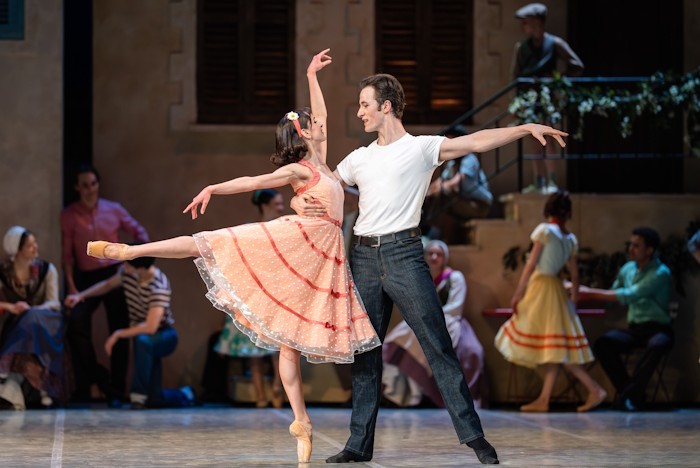
Estonian National Opera, Tallinn
May 9, 2026
La Fille mal gardée is just too good a story not to be reused. Apparently, Jean Dauberval, who created the original version of the ballet in Bordeaux in 1789, was inspired by an engraving at a printing house. It showed a fierce mother scolding her tearful daughter while a young man scarpers off in the background. His ballet libretto of the trials and loves of ordinary folk was revolutionary at a time when the subject matter of ballets dealt with kings and gods. He was obviously a man of his times as exactly two weeks later, the French Revolution was ignited by an angry mob storming the Bastille in Paris.
Marc Ribaud, former director of Ballet de l’Opéra de Nice, wrote his version for that company in 2000. He set it in the 1950s with Lise a modern young woman who wants to make her own choices in life and love. She anticipates the Women’s Liberation Movement of the ‘60s but the production has the advantage of bouffant skirts and nipped in waists that suit ballet so well.
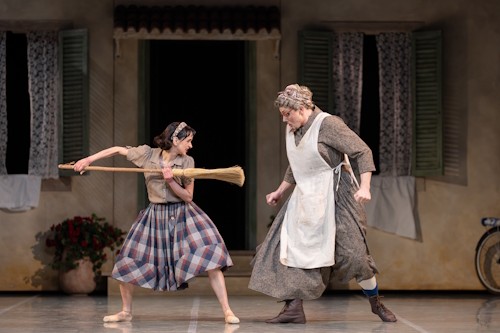
Photo Rünno Lahesoo
Ferdinand Hérold’s delicious rejigging of French folk tunes resulted in one of ballet’s sunniest scores. For Frederick Ashton’s 1960 version John Lanchbery was commissioned to reorchestrate the music, as part of which he intertwined it with excerpts from the original 1789 score and some freshly composed tunes. It is this that Ribaud uses along with Ashton’s structure of the narrative.
Estonian National Ballet proved a most suitable company for Ribaud’s version which features a great deal of dance for the young men as well as the female dancers. Widow Simone becomes the lead character and the owner of a profitable farm although the bucolic aspects, haystacks, pony cart, maypole and scything harvesters are not in evidence. Thankfully the chickens are still around to provide an entertaining dance number for Colas’ friends.
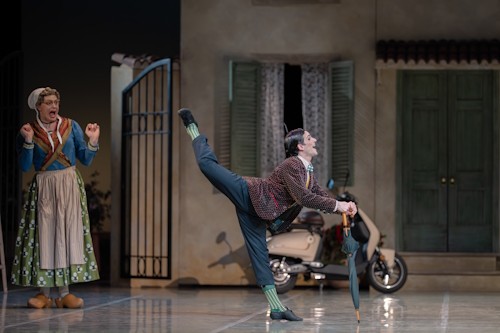
Photo Rünno Lahesoo
As Lise’s mother, William Newton was a dame in the finest theatrical tradition, a dominant force, one not to be messed with but her actions arise from wanting a secure marriage for her daughter. Newton also had an appealing stage presence, neat clog dancing skills, good comic timing, and the audience loved him!
Laura Maya and Joel Calstar-Fisher were well cast as Lise and Colas, full of joy and refusing to let anyone stand in the way of their love. Although the opening scene with the couple sharing private moments in a state of undress rather unhinges the story of stolen kisses, their fine dancing carries the show. They have eloquent duets; sweetly romantic or exuberant with exciting lifts and virtuosic choreography all showing secure technique and supportive partnering. Their solos were most often integrated into the ensemble dancing with the four main couples, all well up to soloist standard, who carry the lion’s share of the dance.
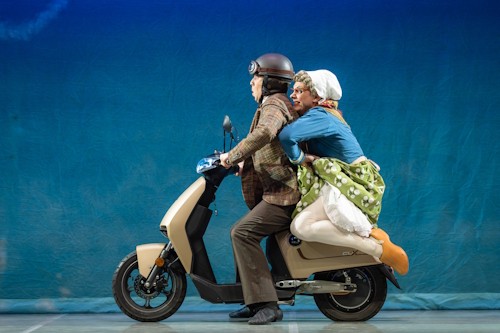
in La Fille mal gardée
Photo Rünno Lahesoo
In a good move, Ribaud disassociates Alain from the ‘village idiot’ label. Played by Antonio Gallo he is now an ostentatiously overdressed eccentric and given inventive choreography which he executes with gusto. He arrives with his father, Finn Adams, on a Vespa scooter in keeping with the ‘50s theme. The introduction of this totally unsuitable marriage partner is spiced with humour before Dad and Widow Simone ride off to the party on the Vespa. Lise and Alain follow on a bicycle and Calstar-Fisher, in a nod to James Dean, roars by on his motor bike in a leather jacket.
The celebrations at the end of the harvest now take place in the village square, the boys in their denims and the girls in wide skirts that enhance the lively choreography. The clog dance couldn’t be missed and it’s the young men who join the Widow in their tap shoes to make a crowd-pleasing number. Festivities are interrupted by the thunderstorm and Alain is whisked away on his umbrella.
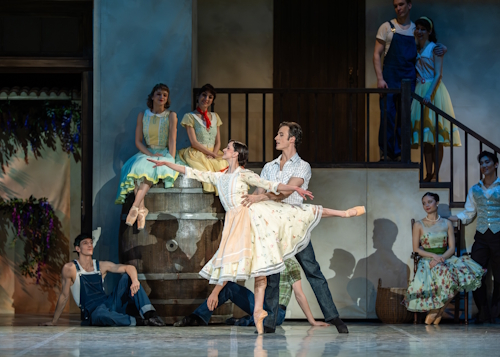
Photo Rünno Lahesoo
It is in the second act that Lise and mother get the chance to show their acting and comedic skills. Newton is most convincing as the fierce matriarch and you may well wonder if this Widow Simone was not also once a wayward daughter with an independent spirit. Maya is totally convincing as she runs the gamut of emotions; frustration, wishful thinking, joy and terror. There is a gentle and lovely pas de deux with Colas who has managed to sneak in and the usual panic when mother returns.
Of course, everything is happily resolved and there is a final duet surrounded by happy villagers. It is a good ballet to add to the repertoire, greatly enjoyed by a company of strong young dancers and an enthusiastic audience.