

Lillian Baylis Studio Theatre, Sadler’s Wells, London
February 7, 2025
The final Rose International Dance Prize double header at Sadler’s Wells featured Encantado by Brazilian choreographer Lia Rodrigues on the main stage, and Beings (捺撇) by Shimmering Productions (微光製造) from Taiwan in the Lilian Baylis Studio Theatre.
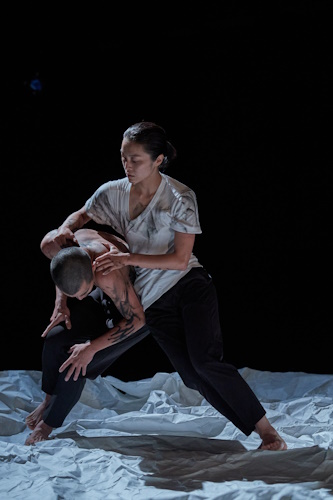
Photo Chen You-wei
An entry in the Bloom category, Beings is an unusual, and surprisingly riveting, short piece. A duet danced on reinforced rice paper, it tells of the need human beings have for connection and relationships. The work is the first part of Trilogy – Quest of Relationships (關係三部曲), the second part of which, Islands (人之島), was seen last autumn at The Place.
The rice paper is used to great effect to create different dimensions, mirroring the coming together and pulling apart of relationships. It also makes a singular noise, which becomes the music for some of the piece. Not only do the dancers’ feet imprint ink on the paper, it is then cut-up post-performance and used for cards.
Beings was conceived and choreographed by Wang Yeu-Kwn (王宇光), who also dances alongside Lee Yin-Ying (李尹櫻). The pair perform with skill and grace, their movements completely flowing into one another to such an extent that at times it was difficult to tell which dancer’s body is doing what.
Wang’s choreography is exquisite, an intricacy of forming and reforming shapes, with arms seemingly detached from bodies creating their own dances in the air. He and Lee impart a sad solemnity to the dance, as if knowing that they are doomed to be pulled apart.
The two pieces of music used (uncredited) feel so at one with the dance, that they could have been written specially. Costumes, by Eno Lin (林彥融), are simple but effective.
Beings was hard to fault, but it didn’t take the Bloom Award, which instead went to Stav Struz Boutros’ equally impressive Sepia.
Unfortunately, Lia Rodrigues’ Encantado did not reach the same heights, losing me after just ten minutes. Ten minutes in which nothing happened on the stage, except for an excruciatingly slow increase in the lighting.
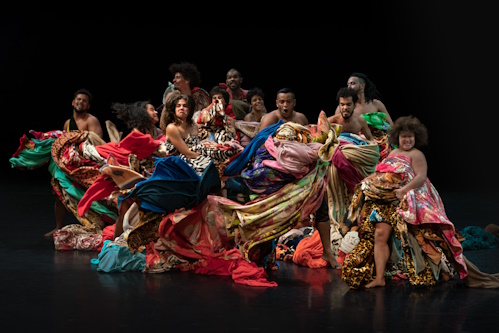
Photo Sammi Landweer
Once the lights were fully up, the dancers appeared, crawling on the floor, encasing themselves in various materials that were laid carpet-like over the entire stage. When they finally stood-up, they executed an endlessly repeated, limited repertoire of moves, while waving their arms in the air, waving the material and throwing it around the stage. The on-repeat choreographic loop gave little opportunity to showcase the dancers’ abilities or talent.
The first perhaps ten minutes or so of this was mildly engaging. It was certainly highly colourful. It looked like a festival, with ritual dancing taking place. This appeared at odds with Rodrigues’ programme note said she considered it a mournful piece, created during lockdown and difficult political circumstances. Perhaps the clue comes in that apparently asked herself the question of how we could “enchant our fears,” recreate a dynamic collective and bring individuals closer together.
While it turned out to be quite joyful, it also got sillier with some dancers stripping off before shaking breasts and wiggling bottoms and other male appendages at the audience. Whether it was designed to shock or amuse is unclear. It didn’t really do either.
While the music provided a cultural link to Brazil’s indigenous peoples and their ancestral lands, this was also played on repeat.
A number of the audience left quietly. I know how they felt. Encantado had a run time of 80 minutes. Had it been a 30-minute piece, it may, just possibly, have justified its place on the shortlist.
No surprises then that it didn’t win the main Rose Prize, which was awarded to Christos Papadopolous’s LARSEN C.