Department of Dance 27th Graduation Production
Metropolitan Hall, Taipei
March 11, 2026
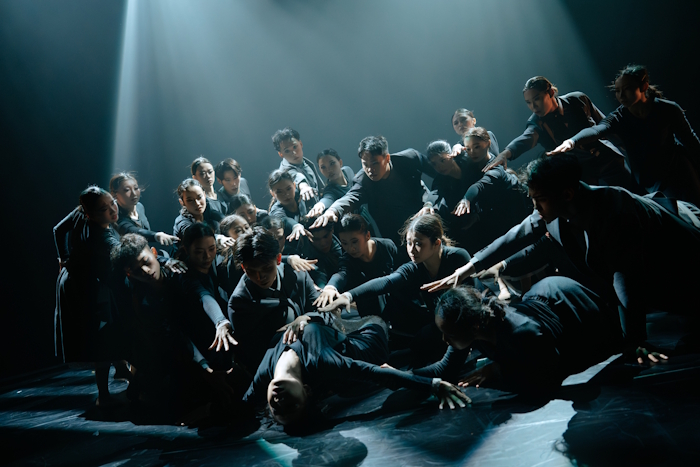
This year’s university graduation performances in Taipei got underway at the Metropolitan Hall with the visit of the Department of Dance at National Taiwan University of Sport (國立臺灣體育運動大學舞蹈學系, NTUS). Lien Sheng (瀲生) included nine very varied student choreographies, sandwiched between two quality professional works by members of faculty.
August by Ko Ju-ting (葛如婷) is a very appealing and very easy on the eye ballet, contemporary in nature but imbued deeply with classicism. Right from the expressive opening trio that’s backed by an upstage tableau that slowly melts, it’s richly layered and beautifully structured. The lighting and the soulful piano and vocals of Andy Monroe’s ‘Dusk’, the first of three tracks from his Joyful Noise album, lend the opening an air of sadness, although the programme note suggests that steadfastness in the face of a clamouring world is more the intent. The dynamic changes later, however, the choreography increasing in pace. It was quite superbly danced, as were all the works where the choreography allowed the performers to show their technical skills.
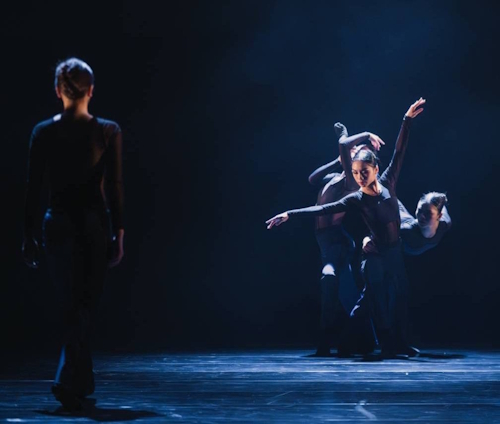
Photo Wang Yan-dun
Just as impressive was The angels have left by Ben Huynh, which closed the evening. There may be no words but the choreography speaks volumes, as did the performances. The choreography is all helped along enormously by the haunting piano-driven minimalism of Ramin Djawadi’s ‘Light of the Seven’ from the soundtrack for Game of Thrones. Indeed, the dance is so at one with the music, you would think the latter was specially composed.
It opens with a single woman who, one senses, is dealing with loss, or at least trying to. There follows a female couple, then a male-female couple, each narrating their own situation in their own way. One senses sadness and regret.
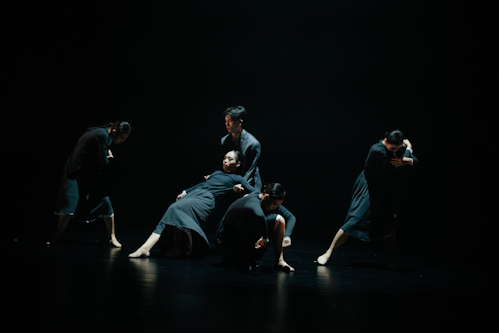
Photo Wang Yan-dun
The dancing was again terrific, the movement gorgeous. While the difficulties of life are pictured, there’s always a powerful sense of support from individuals and the group. Tenderness is never far away. Gorgeous picture follows gorgeous picture. A woman is lifted high. Another is laid gently to the floor. There are long, lean, reaching arabesques.
The pacing is beautifully judged, even when the ensemble appears as the music grows with a cello adding depth. Huynh never rushes. He takes time, allowing each scene, the mood, the feeling, the message to sink in. It’s all an object lesson for the students. I hope they noticed.
NTUS graduation performances always feature student creations alongside those of members faculty. Being able to show work on a big stage is a marvellous opportunity for the selected young choreographers and a terrific learning experience. While there were lots of good ideas, not everything matched the initial promise. Getting everything said that you want to say in just ten minutes or so is no easy task, however, especially when it comes to those works at the dance theatre end of the spectrum, which is where the contemporary pieces tended to sit. Inspirations sometimes got lost in a sea of movement or theatrical ideas.
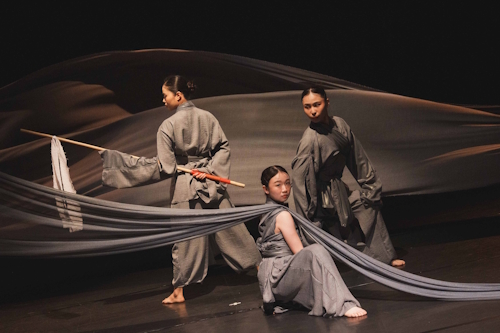
Photo Wang Yan-dun
The Chinese dance influenced pieces tended to have most clarity, probably due in large part to technique being more to the fore. Among the best was San-Zhang-San Xuan Paper (三丈三) by Hsu Yu-en (許予恩) and Wu Chia-hsin (吳佳芯), which took a trip back in time to the idea of 2nd-century Han Dynasty court official and inventor Cai Lun (蔡倫) that tree bark, hemp fibres, worn cloth and fish nets could be used to make paper; an idea that proved very successful. Without being overly literal, Hsu and Wu’s choreography and staging retained clear links to their theme. Even the colour palette embodied the essence the raw materials. Making good use of props, the dance was always fluid and had a pleasing rhythm.
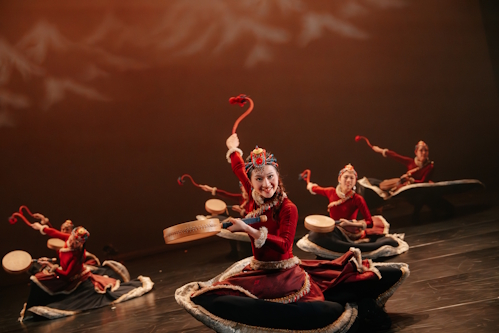
Photo Wang Yan-dun
Soaring Through the Skies, Riding the Wind (凌霄 御風行) by Jian Chen-an (簡辰安), came with lots of appealing patterns and more good use of props, this time the wooden frames of traditional umbrellas, minus their fabric. In Dawn (旭), danced against a backdrop suggestive of snowy peaks and blue skies, choreographer Chang Chen-hsin (張宸馨) employed effectively pellet drums carried by the dancers. Again, structurally excellent with good patterning, all to stirring music.
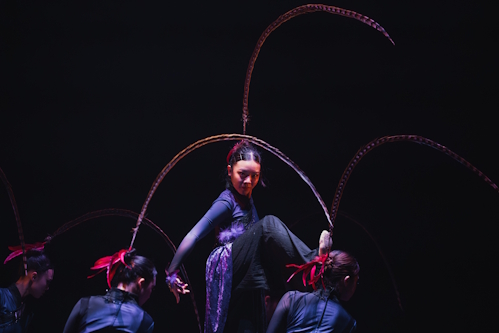
Photo Wang Yan-dun
Vast and Boundless (昊蒼兮) by Chen Xin-yu (陳欣好), saw the choreographer make use of the long pheasant feathers usually worn on heads, but here soon taken off and used as props in hand. It did indeed have a super sense of space.
For Decoy (蠱), Lin Chien-hsuan (林千暄) had the dancers in wide-rimmed red hats that very effectively covered hid faces. When removed in the second half, the work took on a somewhat spiritual feel.
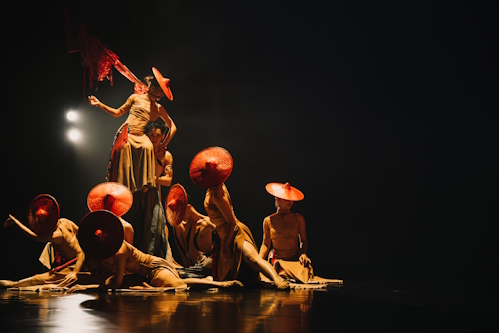
Photo Wang Yan-dun
Caffeine addiction is an unusual topic for dance, but that was the starting point for Caffeine buzz by Hu Ya-chu (胡雅筑). After an orderly start that involved coffee being brewed and served, matters drift between order and disarray. The coloured confetti that falls as chaos and energy take hold is presumably a reference to the addictive high that caffeine can have.
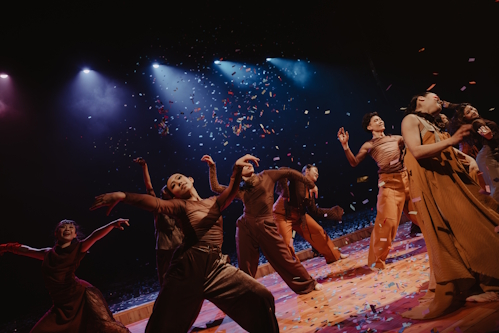
Photo Wang Yan-dun
In X, Chiu Yu-fan (邱郁帆) sets out to ask some very deep questions that I’m not convinced anyone can answer in ten minutes, including ‘What is it to be human?’ ‘What is humanity?’ and, indeed, ‘Who are ‘We’?’ With the cast in dark jackets, yellow tops and red ties, the first half has a lot of distorted, distended movement and music, the second a party feel.
Joyful Drums in Spring (囍鼓春聲) by Zhuo Fang-yuan (卓方緣) and Lin Siou-huei (林琇惠) brought a lot of colour and a touch of humour in a tale of a matchmaker, whose first impression of a couple was one of incompatibility, but where everything turned out fine in the end. Riotous at times, it was impossible not to smile.
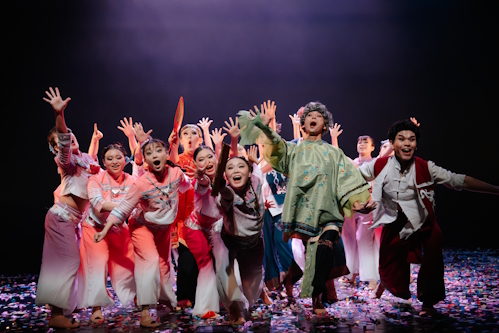
Photo Wang Yan-dun
Completing the line-up, BoOm bOoM by Chien Cheng-yu (簡證堉) set out to show how, amidst the crowding, jostling, and clanging of voices and breaths, individuals cease to be isolated entities, instead becoming part of the rhythm. Loud and brash, with shuddering, roving spotlights, it certainly had atmosphere and bags of energy.