
Deutsches Theater, Munich
March 11, 2026
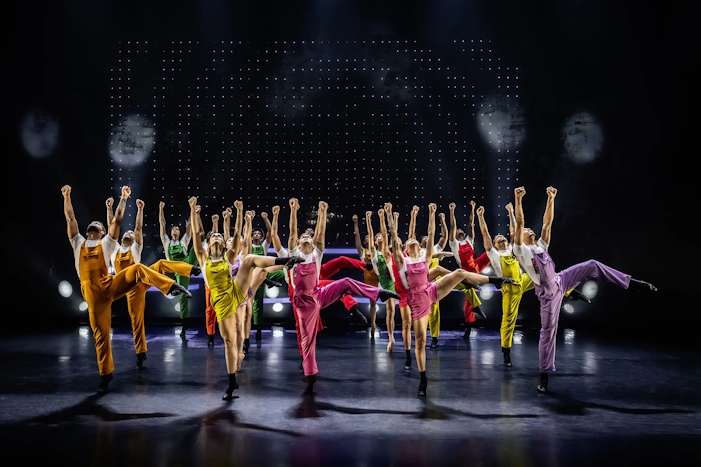
For six days in March the Cuban Ballet Revolución enchanted the audience in Munich, one of the last stops on their fourteen-city German spring tour. The show is like a musical without a plot, one dance routine follows the next without any discernible connection. But this is easily made up for by the exuberant dancing to the beats from a live orchestra with a female and a male singer, present on stage, but at times made invisible.
The first of the two acts was a little subdued but with very high energy levels. It started with what reminded of an evening in a nightclub. The eighteen-member ensemble danced amicably with jazzy movements and hip thrusts giving strong sexual connotations.
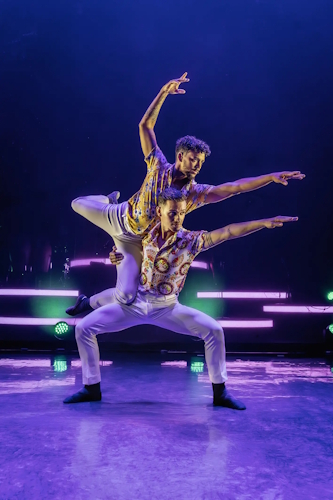
Photo Jochen Quast
The men wore hats. Some of the women wore pointe-shoes, some slippers, as they did throughout the show. Suddenly, one of the men did a high split jump in second position, which made the audience gasp and applaud, but it turned out that this feat was just part of the stock movements.
Solos, duets, trios and group pieces followed, each act with new costumes. In one, the women wore unitards with big holes. The movements were like ballet class exercises, suddenly changing into what looked like a break-dance performance, where individuals showed their stunts in the middle of the group.
This was followed by two couples dressed in white, performing duets that could have come straight out of a William Forsythe ballet. Another couple clad in black danced a balletic duet in which the woman broke up with the man, made clear by her pushing him away. Then the men flew across the stage doing back-flips landing on one hand, and break-dance solos, breaking the jazzy and balletic flow.
The second act really took off. It started with a tango; the women dressed in red short sequin dresses. Nine couples swirled around full of passion. Another remarkable piece followed, during which two couples, each sitting on a chair, performed a love duet with the most incredible lifts. The men were lying on the chairs, holding the women above them as if they were a long, stiff boards, moving them up and down with some easy looking push-ups, or holding them in this position on one flat hand. The amazing thing was that they made it look like dance.
What makes Ballet Revolución so special is that they mix so many styles. In doing so, they create a new movement vocabulary, making us see dance in new ways. One male dancer clad in black shorts, did what could have been a routine in an Olympic Games gymnastics competition. But it was not simply movement to music. He managed to turn it into dance.
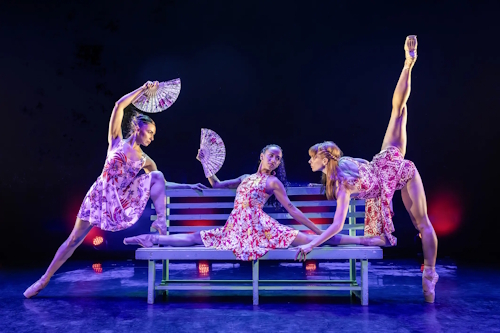
Photo Jochen Quast
At one point behind a group dancing, three men appeared. They were clad in black with sleeveless t-shirts, hoods up and covering their heads. They looked threatening. A group you definitely do not want to meet alone at night in a narrow street. The three scanned the other dancers, then took their hoods off. But instead of launching an attack, they did an arabesque, a turn in attitude, a kick and a grand jete ending with a port de bras in third position. In doing so, they made ballet cool, revoking the cliché that male ballet dancers are effeminate beings in white tights.
It took some time to get used to the lack of connection between the segueing acts to pop music by Lady Gaga, Billie Eilish and Prince, to mention a few, R&B songs and more traditional Cuban-like sounds. But the music also got its say. At one point the percussionist delivered a solo on congas drums, succeeding into a duet with the drum player, which brought the house down.
But the fabulous dancing by all eighteen dancers made up for it. They were all good at every style, be it ballet, jazz or breakdance, and all mixed with an incredible athleticism. All were from Cuba, most educated at either the Escuela Nacional de Ballet or the Escuela Vocacional de Arte, the two main vocational ballet schools in the country.
It is wonderful to see that this small part of the world still brings forth such a huge pool of talented dancers. It’s easily forgotten that codified dance came late to Cuba, even though dance is a part of the culture, much of it stemming from the long ago arrival of African slaves and Spanish colonizers. The first Cuban ballet school was established in 1931, but it was not until 1955 that Alicia Alonso founded the first ballet company, Ballet Nacional de Cuba.
Since then, Cuba has fostered not only the wonderful dancers of Ballet Revolución, but many others, not least the renowned dancer and now director of Birmingham Royal Ballet, Carlos Acosta, his nephew Yonah Acosta and Osiel Gouneo both principals with the Bayerisches Staatsballett.