
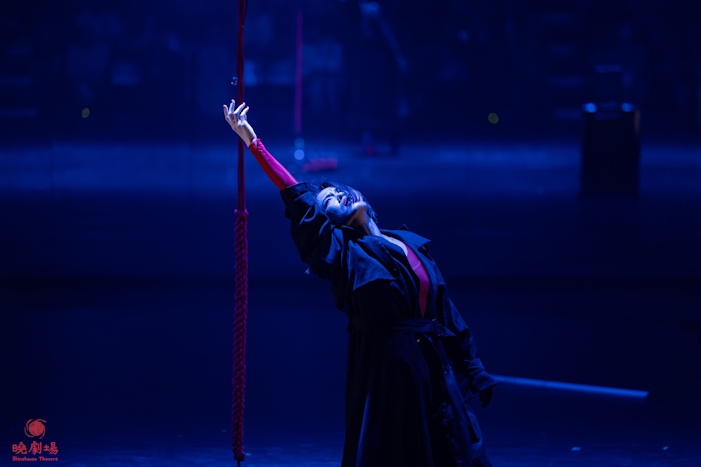
Wan Theater, Taipei
April 18, 2026
The Saturday of Taipei’s Want to Dance Festival (2026艋舺國際舞蹈節節目表), staged and curated by Shinehouse Theatre (曉劇場), and that had the overall title as Sublimation (昇華), was largely given over to four mixed programmes in the company’s Wan Theater. All were around 90 minutes in length, and all staged in under eight hours.
The first of two Exchange Programs (國際交流單元) got off to an often lightly amusing start with Puàh-pue – Divination of blocks (搏筊 Pua̍h-pue) by Kuo Chueh-kai (郭爵愷) and Nonlybody (身體不止), the ensemble he founded with performers Hsu Li-en (徐立恩) and Chen Yu-chi (陳郁錡).
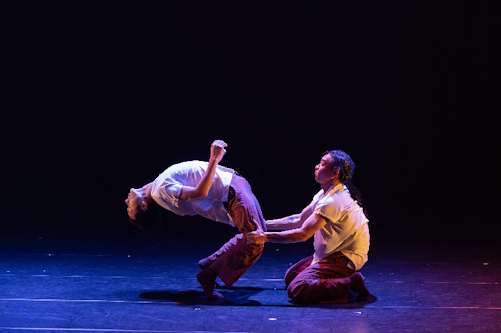
Photo Terry Lin
Divination blocks are a form of oracle used to communicate with gods and seek guidance about the future. The ritual typically involves casting two crescent-shaped wooden blocks (pue) and interpreting how they land. One flat side up and one rounded side up signifies divine approval; two flat sides up indicates disapproval; while two rounded sides up is usually understood as the deity laughing, suggesting the question be asked again.
In between some impressive partnering and tumbling, the choreography includes much throwing of blocks, how they land adding an element of uncertainty as to how the work will play out. That very neatly brought the audience into things, throws met with groans or amusement depending on how the blocks landed. But do the answers the blocks give really represent divine will? A question left hanging somewhat, albeit with a suggestion that they are rather more projections of human desires.
Choreographed and directed by Spanish theatre-maker Matilde J. Ciria, Borboleta do Céu e da Terra (Butterfly of Heaven and Earth) is a solo dance work with experimental music that draws on flamenco and, to a less obvious extent, butoh.
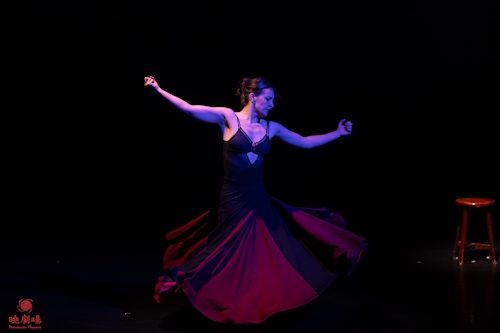
Photo Terry Lin
The programme notes talk of a journey through memory and identity, of transformation, of the tension between rootedness and liberation, of displacement and marginalisation. Performed by Virginia Torres, a Spanish independent artist, dancer and researcher, there are hints at connections with the past in the opening, which sees her sat upstage, the lighting primarily on her legs and feet, the latter tapping out rhythms, although they did not feel overtly flamenco. Later, sat on a stool in a long dress, the movement suggests being restricted, perhaps a nod to the restrictions imposed by society on women in the past.
The collaboration with onstage Taipei-based experimental musician and sound artist Xu Chia-chun (徐嘉駿) has promise but his accompaniment of his sounds alongside hints of flamenco here and there often seemed more to sit alongside the dance rather interact. The sound was also occasionally ear-splittingly loud, as when cante is heard with white noise. Xu’s presence on a rather darkly lit stage was also very distracting. That onstage sound decks elsewhere on the same day were not, probably speaks volumes.
The closing minutes have a more overt flamenco feel but, as elsewhere, the choreography lacks intensity and depth. While Borboleta do Céu e da Terra certainly challenges aesthetic boundaries, in bringing flamenco and butoh together, both get lost.
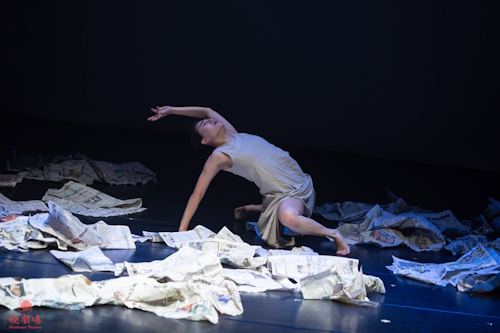
Photo Terry Lin
Numerous studies have found that people who live in dense urban environments are more likely to feel lonely. Among the hubbub, the crowds, the chatter and laughter, you remain a stranger, disconnected. Alone in a crowd, as the saying goes. That feeling is projected very effectively in Exile Land (流放地), created and performed by Tseng Ching-en (曾靖恩), which reflects how some people in today’s world struggle and feel cut off from society.
It opens with black and white film of a busy intersection. Then footage of people walking. Pictured through what could be thick bars on a window, there’s immediately a sense of being isolated, distanced from what we see. Tseng, in white and surrounded by scrunched up old newspapers, looks to be ill at ease. Later, she almost seems to be fighting her way through the city as she continues to make her point with clarity.
Top marks too for the sound accompaniment, which quotes The Lonely Game (寂寞的遊戲) by Taiwanese writer Yuan Zhe-sheng (袁哲生) in which he captures aspects of loneliness, “a dilemma everyone has to face,” through different interpersonal emotions.
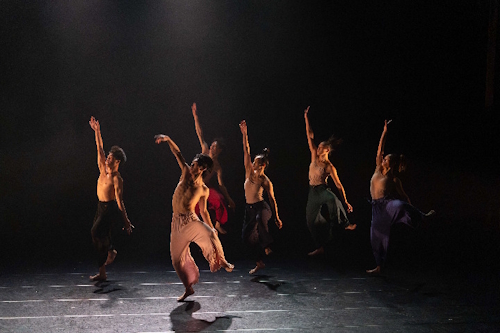
Photo Terry Lin
Program B got off to an excellent start with Guan (觀) by Hsu Wei-ting (徐尉庭), a contemporary dance piece rooted firmly in Taiwanese temple culture.
It opens beautifully, Yeh Chia-heng (葉家恆) highlighted in a downstage spotlight, five more gently undulating. The dance thereafter is well structured with some impressive creativity in the movement vocabulary. It was very reminiscent of the rocking and swaying motion found in temple parades, all accompanied by the gentle tinkling of small bells sewn into the waist of each dancer’s pants.
The whole cast were excellent, the best moments coming in duets that emerge from the ensemble, notably for Huang Wei-siang (黃暐翔) and Fei Hsin-tseng (費心岑), a fluid dance that featured much excellent partnering. There was also a great, almost drunken solo by Liu Yu-wu (劉育吳) and a powerful dance by Huang.
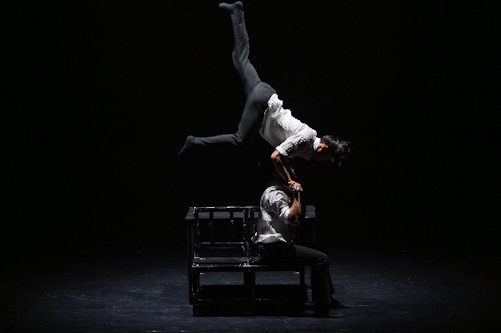
Photo Terry Lin
Imaginary Enemy (假想敵), co-created by Tsai Hung-yi (蔡宏義) and Yang Chun-yi (楊峻毅) of Uni Contemporary Circus (優尼客當代馬戲團), impressed last year when seen outdoors. In theatre, it works even more effectively; a real step up with intent and meaning all the more the clearer.
The work combines elements from dance, theatre and circus in an exploration of inner conflict and the tensions. As such, the two performers are not human opponents but reflections of the self. And while that reflection may be imaginary in one sense, it can be all too real in another; the enemy that we struggle with, fight, attempt to flee from, but ultimately that we have to learn to coexist with.
It opens with slow-motion mirroring, cleverly establishing that we are watching one person. Through balances, collapses, physical confrontation and some superbly fluid acrobatic dance, the performers then navigate the constantly shifting relationship. At times, the chairs and table almost become third characters, being brought into the action, which happens on, over and under them. There is no resolution. We cannot escape ourselves. But the work ends hopefully, suggesting that getting along with who we are is possible.
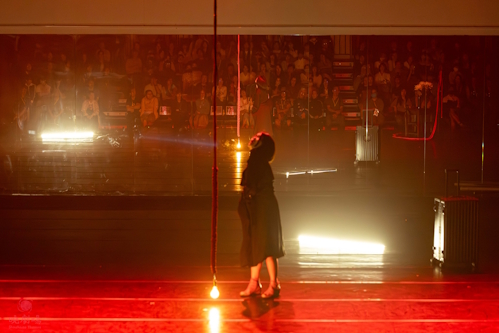
Photo Terry Lin
“I probably understood something at the moment. It may not be the mist or thick fog, not the missing part in between translations, not the poor pronunciation, nor the alien faces or skin tone. But each of us lives in our own dream, which might be comfortable and bright, yet without sunlight…” So wrote Huang Chih-chia (黃至嘉), founder of Nomadic ARTS Collective (蓺術遊牧) in her introduction to MARY 李/瑪麗 LI.
The work was born during a residency at The Place in 2024 when the director and choreographer started to explore how migrants’ bodies, languages and cultures interact within modern society and the environment they find themselves in. It has come a long way since a first sighting as a work-in-progress in 2025, having been presented in full in March 2026 at the Experimental Theatre of the National Theatre
Huang is emotional and sensitive as a dancer and actress. You can tell she has worked previously in film and performance art as well as dance. She knows how to paint pictures that live on afterwards in the memory.
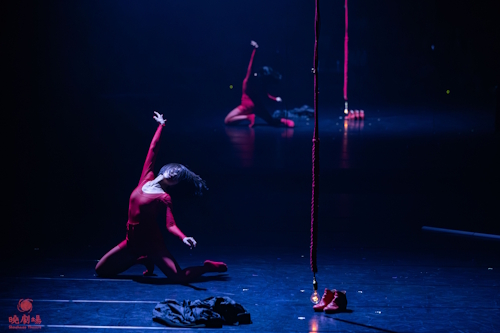
Photo Terry Lin
It opens with the stage bathed in red (lighting by Yin Sin-syong, 尹信雄). A train passes. Flashing striplights. Assorted voices from an unseen crowd. It oozes atmosphere and place. And, in the distant gloom, a woman with a suitcase in an overcoat. And red boots. The red feels important.
We hear text. But the movement overlays it rather than being literal. Always, always there is a beautiful feeling of depth and intent. Huang is unafraid to let everything take its time, thus giving everything a chance to sink in. And the movement quality is fabulous too.
She produces red rope from her case to add to that already on stage. Symbolic of a link to somewhere, perhaps. The affecting mood is added to by the he now soulful sounds produced by terrific live musician Lin Hsiao-feng (林小楓), who coaxes some very interesting sounds from his flutes throughout while sat at a downstage table. More great accompaniment comes in two tracks by Lopkerjo. It ends with an umbrella, and a smile. And a sense of peace.
Given the origins of MARY 李/瑪麗 LI, it seems remarkable that there are still no plans to bring it to London.