

Theaterhaus, Stuttgart
November 23, 2025
Gauthier Dance Juniors have become such a success story that it seems remarkable to recall that it’s only a year since the ensemble was introduced with the Renaissance, a programme of six works including pieces by Sharon Eyal and Marco Goecke. That was then followed by the hugely popular Barker by Barak Marshall that premiered at the Colours International Dance Festival last summer.
Now, they hit the heights again in a very enjoyable and strikingly well danced quadruple-bill of two new works and two existing pieces. All six dancers appeared in all four pieces, performing with class, commitment and bags of energy. They never let up for a second. Yes they’re young, but their stamina is astounding. Best of all though was the way all connected with the audience. A Dream Team indeed.
The original working title of the evening was ‘Something old, something new, something borrowed, something blue.’ And, yes, brides and wedding dresses do put in an appearance!
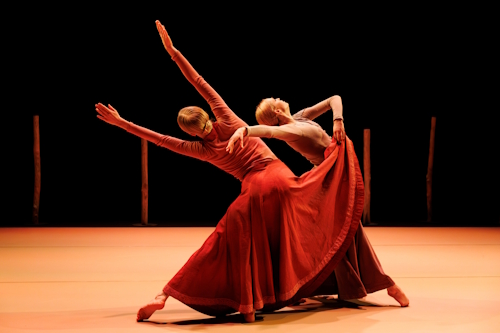
Photo Jeanette Bak
First, something old, and Nacho Duato’s Jardi Tancat. Created in 1983 for another junior company, NDT2, it has long been established as a modern classic. The dancers captured beautifully the integrity of the stirring and evocative work that pictures the hardships of those who work the barren Catalonian soil, their prayers for rain, and their dealing with love and loss, all of which are emphasised in the accompanying soulful songs of Spanish singer, Maria de Mar Bonet.
The dancers delivered all the technique and expression the work requires. It is incredibly fast-paced at times, the choreography full of turn-on-a-sixpence changes of direction. Elsewhere, there’s plenty of hard work and pain, the women often doubled over, the grounded dance full of deep Graham-like pliés.
Jardi Tancat culminates in a gorgeous section of three duets. As each couple dances, the others turn their backs as if looking into the far distance, just like the woman in Bonet’s song, who is lamenting the loss of her lover at sea. All three couples left rich images that linger although, and appropriately, it’s the women who look the most pained of all.
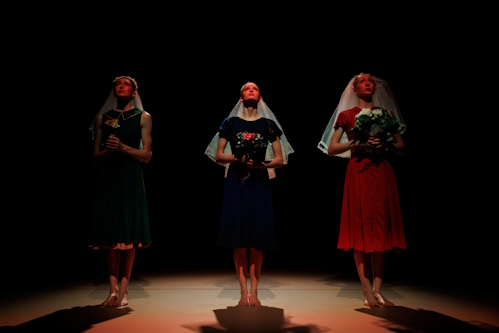
Photo Jeanette Bak
Next up, something blue and Barak Marshall’s new The Blue Brides, a deliciously tongue-in-cheek work that was the high point of what was a good evening all round.
It opens with three brides waiting in vain for their grooms. Performed to a selection of love songs from all over, what follows is smorgasbord of scenes whose threads are doomed love that it’s clearly no use being a good girl. Fast-paced and often extremely witty, it’s very entertaining. Tragicomedic dance theatre at its best, it was brilliantly carried off by the six performers. That they all kept straight faces just made it even better.
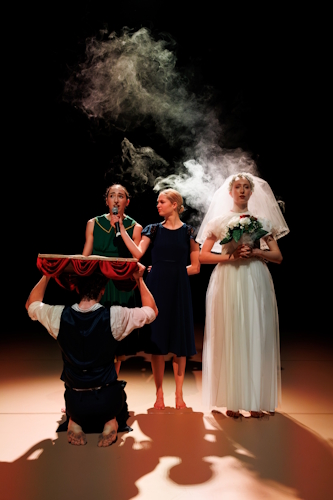
Among the many memorable moments are three monologues, each given at a human lectern. The first saw Mathilde Roberge’s red shoes nailed to a piece of wood before she was upturned to lay on her back, her legs stretched up forming the pedestal. Atticus Dobbie told of Julia, who did everything right but never had any friends. As he spoke, Julia, played by Ashton Benn, proceeded to finger shoot her grooms, Rong Chang and Guiseppe Iodice, to sight of Naia Dobrata popping balloons, only for the victims to bounce back up for a repeat dose.
in The Blue Brides by Barak Marshall
Photo Jeanette Bak
The second saw a fringed reading surface placed on Benn’s head, who sat on a three-legged stool strapped to her bottom. Dobbie this time told of Annabella, beautiful by forever harassed. For the third, the tables were turned with Dobbie now the lectern as Benn, assisted by Roberge, told of Stella, played wonderfully by Dobrota, for whom everything in life went wrong. But no matter because as she kept telling us, and despite smoke gently rising from her seemingly smouldering wedding dress, “That’s OK, the sun will rise.”
Everything sort of all comes together at the end, though, with a brighter ensemble dance to a number by Romanian gypsy brass band, Fanfara din Cozmesti.
Something borrowed came in the shape of Alejandro Cerrudo’s Lickety-Split, originally created in 2006 for Hubbard Street Dance Chicago, where Cerrudo subsequently became resident choreographer from 2008 to 2018. Always popular, the work entered the main Gauthier Dance company repertory in 2011.
Performed to folksy music by Davendra Banhart, it’s a skilfully constructed work. But don’t be fooled by the title, there are times when it is decidedly lyric but it is sometimes very fast. Indeed, one of the best moments comes in a solo by Rong Chang that’s packed with warp speed spins, super jumps, and no little humour. Although some scenes focus on individuals, at the work’s heart are three couples whose relationships run from sensual to upbeat and just a little eccentric. In all, the partnering was excellent, lifts seamless, connection there for all to see.
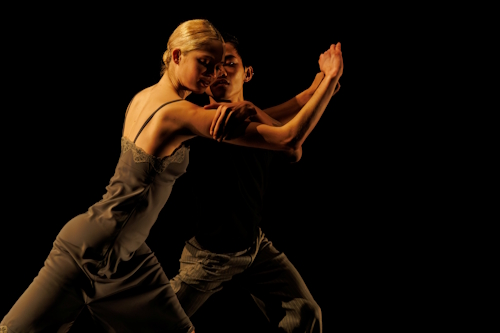
Photo Jeanette Bak
Ravel’s Bolero is one of those scores that many choreographers feel attracted to. It’s probably something to do with the music’s rhythmic power, the way it builds to a crescendo and the inherent tension within it. But time and again, whether the choreography works with or against the music, the dance tends to pale when put alongside it.
For something new, Canadian choreographer Virginie Brunelleat least turned to a Bolero techno-remix by Laurier Rajotte that comes with a sort of club feeling for her High Moon. But from the moment the familiar strains of Ravel’s melodic line are first heard, the die is cast.
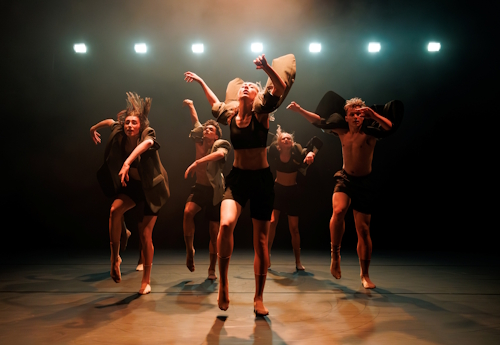
Photo Jeanette Bak
Matching the music, the dancers appear from the upstage gloom. The choreography is edgy, fidgety. The gestural movement flips between aggression, all punching fists, and looser poses where bodies almost sagged; perhaps with the effort. There are hints at sensuality but they never really go anywhere. There’s also no big Bolero finale, not that there has to be of course, the end instead seeing them gather stage-front, gazing upwards.
Choreographically it was a slightly unsatisfying conclusion, but look what it was up against. And that should not detract from what was a fine evening of dancing by six seriously top-quality performers. Great company. Great title. Great evening. I wonder if anyone from the Royal Ballet & Opera has caught up with them yet. Dream Team would make a wonderful addition to the Next Generation Festival.