
Nationale Opera & Ballet, Amsterdam
October 22, 2025
Shakespeare’s drama Romeo and Juliet was first turned into a ballet in 1785 by Italian choreographer Eusebio Luzzi. Numerous versions have followed. Dutch choreographer Rudi van Dantzig created his production for Dutch National Ballet in 1967, just a few years after those by John Cranko and Kenneth MacMillian, whose ballets premiered in 1958 and 1965 respectively. But whereas Cranko and MacMillan focus entirely on the love story, van Dantzig also shows how the blood feud between the Montague and Capulet families affects the whole community around them.

in Rudi van Dantzig’s Romeo and Juliet
Photo Altin Kaftira
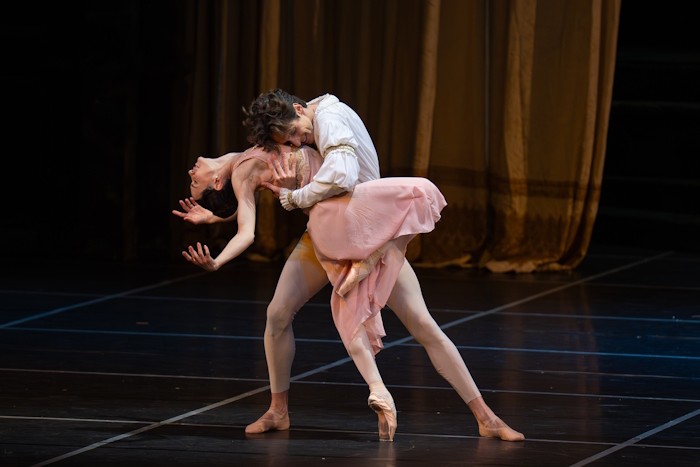
Juliet, wonderfully danced by Anna Ol, is not the isolated, innocent and naïve girl, like in Cranko’s version. She sees the servants kiss each other and, during the ball, dances with and talks to her girlfriends. She is embedded in a vibrant community.
Perhaps this is the reason she does not appear very innocent. Both the Balcony and Bedroom pas de deux look like love scenes between a mature couple. Ol seems weightless in the lifts, her balances are perfect, her footwork fast, she is pliable but you always have the feeling that she is a strong-willed woman; one who knows exactly what she wants.
Romeo, danced by Jan Spunda, moves nobly and with grandeur. But the couple never really convey the impression that this is the first budding love. It doesn’t matter, however, because it lends an unstoppable determination, especially for Juliet.
For her it is not a question of whether she drinks the sleeping potion, it is a matter of getting her parents and Paris out of her bedroom, so that she can drink it.
The scene in which she meets Romeo makes you hold your breath. It takes place in the ballroom with all the guests present, deeply engaged in conversation, but with their backs to the action and the audience. It would only take one of them to turn the head to discover the couple. Tybalt does just that but when he tries to bring it to his father’s attention, he waves him away.
Vsevolod Maevsky is perfectly cast as Tybalt. He is tall, takes up all the space around him, his every movement full of aggression and anger. He is a guy you would not want to meet alone in a dark street at night. He even teaches Juliet’s younger brother, a character invented by van Dantzig, to fight with his wooden sword.

Photo Altin Kaftira
Mercutio, Joseph Massarelli, is his counterpart. He is shorter, and meanders in and out of the different groups of people with ease. He is a reckless prankster, vivacious and lovable.
The families and social classes are indicated by colors. The Capulets wear red, the Montagues blue. The peasants appear in simple dresses for the women and girls, and shorts and shirts for the men and boys, all in different hues of beige and light brown. Costumes and sets, an Italian Renaissance palazzo and town square, are by Toer van Schayk.
By integrating the peasants in the action van Dantzig turns the love story into a bigger tale about violence and its effects. When the first fighting scene is interrupted by the Duke of Verona, Casey Herd, all the peasant women and a large group of children of various ages fearsomely gather in a group. With folded hands they beg for him to stop it. Later, the children imitate the grown-ups, fighting with their wooden swords.

in Dutch National Ballet’s Romeo and Juliet
Photo Altin Kaftira
Before the ball, van Dantzig also has a group of peasants assemble in front of the entrance to the Capulet’s palazzo to watch the guests arrive. This not only demonstrates class differences, but also allows him to show the different attitudes of the two families. Romeo and his friends are the only ones generous enough to throw them some money.
Conducted by Koen Kessels, the Dutch Ballet Orchestra played Prokofiev’s score with verve and empathy. On the stage, the company was excellent, and not only in their dancing. Their acting turned every little sideshow into a treat, like the nurse, Kira Hilli, watching Romeo and Juliet in the balcony scene, or a monk pretending not to see Juliet when she visits Father Lorenzio, Nicolas Rapaic.
But the most surprising is the ending. Romeo finds Juliet, kills himself, then she discovers him and kills herself without much ado. But then the two families appear in the vault. Upon discovering their dead children, their fathers make peace by shaking each other’s hands. It was a heart-breaking conclusion to the story of escalating conflict and deaths, which is just where the world seems to be today. It offers a glimpse of hope. I could not help wishing that all present war-makers could follow the ballet’s example.