
Opera House, Zurich
December 6, 2025
When Cathy Marston was appointed director of Ballett Zürich, one of the first things she did was to write to the Swedish choreographer Mats Ek and ask if he would allow for the company to dance his Carmen. Now two years later, the ballet sweeps across the stage. One of Marston’s programming aims is to combine old ‘classics’ with a new works. For Oiseaux Rebelles, she commissioned Australian choreographer and Oregon Ballet Theatre director, Dani Rowe, to create a piece to Modest Mussorgsky’s Pictures at an Exhibition, which opened the evening.
Ek created Carmen in 1992 for the World Exhibition in Seville using Rodion Shchedrin’s Carmen Suite from 1967 as his music, an adaptation for ballet of Georges Bizet’s original 1875 opera score. It unfortunately lacks some of Bizet’s grand emotion, but it was vividly played by the Orchester der Oper Zürich under Matthew Rowe’s baton.
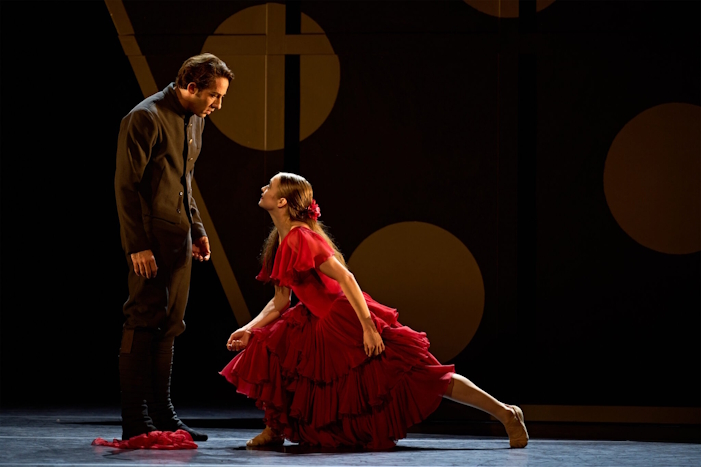
Ek follows Prosper Mérimées story about Carmen, written in 1845, and on which Bizet based his opera. But Ek changes the point of view from Carmen to Don José, well danced by Esteban Berlanga. His infatuation for Carmen changes him from a law-abiding corporal into a possessive lover, wanting her for himself; her rejection turning him into her murderer.

in Mats Ek’s Carmen
Photo Admill Kuyler
The ballet opens with Don José standing in front of a firing squad and in the long moment before the fatal volley, he looks back at the events that led to his demise. With his choreography, Ek plays with our associations. The soldiers, at times, stand in a straight, diagonal line pointing from floor to ceiling looking like light artillery guns.
Nancy Osbaldeston, who joined the company this season, was a zesty Carmen. She insists on her freedom, seeing herself as equal with the men. In one sequence she joins them in a cigar smoking dance; in another she sits alone smoking. Clad in red, she seduces the men she fancies and leaves them again at a whim.
Escamillo, the matador, was wonderfully danced by Brandon Lawrence, clad in gold (sets and costumes by Marie-Louise Ekman). He’s a tall dancer and towered over the others, when he swung his muleta. But Ek also makes the character very human. At one point he stands quivering, perhaps in fear of his next fight.
M (Shelby Williams) is a character invented by Ek. As explained in the playbill, the initial could stand for Micaëla, the girlfriend Don José leaves for Carmen, Mother or La Mort (Death). In a shiny, long mauve dress she enters to comfort, cajole or perhaps to rebuke Don José’s actions. Soldiers in uniforms and women in shiny flamenco-like dresses swirl around them heating up the atmosphere. The movement is Spanish influenced, but Ek mixes in grand pliés à la seconde, flexed feet and arabesques on bent standing legs, adding another dimension, making the story grounded and perhaps more contemporary.

Photo Admill Kuyler
For her piece, Vestige, meaning the smallest left-over piece of something, Rowe uses Mussorgsky’s ten-movement piano suite, composed as a gallery walk-through to mark the death of architect and painter, Victor Hartman, each movement of which describes a painting.
Rowe describes her ballet as “a collection of fragments of memories,” which appear to revolve around the recurring theme of one, perhaps more, weddings. Costume designer Louise Flanagan dresses the nineteen dancers in white, some, men and women, with wedding veils covering their faces and falling down to their elbows. They move in a set of various empty picture frames created by Jörg Zielinski. At times the frames float in the air, at times they separate the stage, so that the dancers move in an out of the divided up and downstage space. The choreography is classical ballet-based with the women in pointe shoes, the dancers constituting a homogeneous group, their movement flowing.
Amongst them are the characters Human, Max Richter, and Him, Karen Azatyan. Him sometimes blends in with the group, but Human never becomes part of it. She always seems to be an outsider, watching the action. At times, the pair take off in a duet. Alone or amongst the flurry of the long, tulle skirts of the other women, Human creates a strong contrast. She not only wears a plain skirt and a black top, but her movement also differs. Her port de bras are imprecise, without the flow of the others. It’s as if they stop briefly before they finish, lending them a sloppy look.
Vestige was like going through an exhibition seeing the same painting on all the walls, or down memory lane with only one event remembered.

Photo Admill Kuyler