
National Theater, Taichung, Taiwan
September 20, 2025
The title of the latest production from Taipei Capital Ballet (台北首督芭蕾舞團), Echoes from Afar (遠山的呼號), translates literally as ‘Call of the Distant Mountains.’ It could hardly be more perfect. We don’t just hear it in Su Yin-sheng’s (蘇胤勝) wonderfully evocative score, but see and feel it in Zhang Xiao-xiong’s (張曉雄) richly layered and deeply expressive choreography too.

Photo Chen Te-cheng
Effectively in four sections separated by brief blackouts, Echoes from Afar has no narrative as such but is deeply ingrained with mood and imagery, the whispers of nature and history. It is, in many ways, an ode to Taiwan that evokes pictures of the island, its nature, its mountains and coastline, and its people. It has the feel of a gaze on the past, albeit ending with an expression of hope for the future. Through its 65 minutes, it shows struggles and resilience but perhaps more than anything is a response to the footprint left by time, and how nature leaves its mark just as much as does humankind. Anyone with a deep attachment to Taiwan surely cannot fail to the touched.

Photo Chen Te-cheng
Echoes from Afar opens with seven men dressed only in black trunks and socks. To the right stands what looked initially like the top of the mountain peeking out above the clouds, although on reflection maybe it’s more one of the many rocks jutting out from the sea on Taiwan’s east coast. Whichever you choose, the effect is enhanced by Wu Wen-an’s (吳文安) lighting and a little stage mist. Trembling bodies suggest being jolted or buffeted by natural forces: earthquakes, typhoons, or sometimes just a more gentle wind. Very contemporary and full of Zhang’s trademark style, there are also lots of deliciously smooth lifts. Already there’s an almost mystical air. When female lead Huang Yu-mian (黃渝棉) glides through, she’s like a vision.

Photo Chen Te-cheng
The final pas de deux excepted, it is very much a dance in which the men are to the fore. Their dance is largely powerful and grounded, in contrast to that for the women, where Zhang uses classical ballet and pointework to emphasise their lightness. It does feel that the female ensemble is very secondary, however. They get disappointingly little to do and, while aesthetically pleasing, their choreography is far from challenging.
When the other four women do appear, with everyone now in black Romantic-style tutus, the women also in skin-toned leotards and pointe shoes, the mood changes. As they bourrée across the stage (and they bourrée a great deal), their arms give the impression of soaring birds, and that’s before we hear what sounds like seabirds and waves breaking on the shore in Su’s soundscape, which now emphasises piano and strings and is much airier. That upstage rock now glints as if caught by the first rays of the rising sun. The scene is stunningly beautiful.

Photo Chen Te-cheng
Another change in lighting has the outcrop is now bathed in silver light making it appear icy. With the music getting darker, a quartet in which Huang Yu-mian (黃渝棉) is lifted and carried by Wang Xiang-yu (王祥宇), Liao Chen (廖晨) and Wang Sheng-hao (王聖皓) is quite delicious.
The darkness continues to build in the third section. The rock or mountain may now hang above but continues to appear to wield some sort of power, casting its influence on everything that happens. The choreography again focuses on the men, now back in black trunks. The music here is more ominous, the dance suggestive of danger. Some of the choreography is quite animalistic although there are a couple of hints at indigenous dance. Chang Chieh-ju (張杰儒) and Tai Yu-yu (戴佑宇) stood out in two powerful duets.

Photo Chen Te-cheng
The female ensemble returns briefly for the final part, which opens to the familiar strains of Arvo Pärt’s Spiegel im Spiegel. The heart sank when I heard the first notes. It’s a piece of music much overused by choreographers but it does its job here. Even the transition sounds fine. First two women, then all five, drift among the prone men.
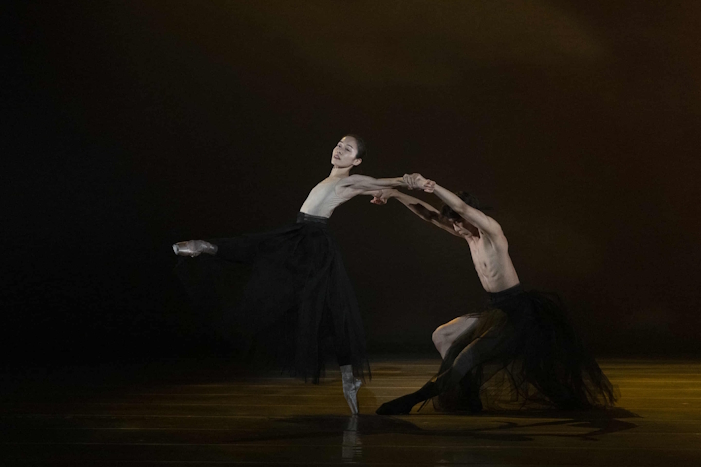
Later, the section features two pas de deux, the first to an almost tango-infused interjection. It was well-danced by Chien Hsiang-ting (簡湘庭) and Tseng Kuan-wei (曾冠偉) but is the one place the dance and music do not feel quite as one. The second and much longer duet, for Huang Yu-mian (黃渝棉) and Wang Xiang-yu (王祥宇) is much better, however.

Photo Chen Te-cheng
Danced to ‘Lai Su’ (來甦) an ancient traditional song of the Paiwan tribe whose lyrics talk of trees and vines intertwining, the dance is writ through the notions of love, leaving and longing, not so much for each other as for the island and all its people. Singer Lin Guang-cai’s (林廣財) voice is deep, rugged and full of feeling.
Yu is delicate, weightless and graceful, yet strong. In amongst that are a couple of more decisive moments. Danced in a golden light, it’s full of interesting and difficult lifts, you don’t want to take your eyes off the couple for a moment. They have a wonderful rapport, their dance having a sense of resolution about it. The song suggests that, if people can coexist harmoniously, like tree and vine, then the land will flourish with greater vitality.

Photo Chen Te-cheng
Again, Wu’s lighting is noteworthy. He produces yet another magical space, this time his design that reminds one of a sky ablaze at sunset and suggests hope for a bright tomorrow.
Founder Hsu Chin-feng (徐進豐) did wonders keeping Taipei Capital Ballet going, battling through financial problems and the contemporary dance focus of Taiwan’s dance scene. His productions ranged from the out-and-out classical to more of a fusion with contemporary dance, and were sometimes brave, poking at the establishment.
But now under the artistic directorship of Leona Yu (尤儷蓉), the company appears to be on an upward curve. Last year’s production, Reformation Series – Swan Lake (翻轉系列-天鵝湖), in which three choreographers were invited to deconstruct and rebuild the classic focusing on the love and hatred between black and white, was the best for a long time, especially the sections by Chen Shou-qín (陳壽琴) and Yan Shu-hao (燕樹豪). In some ways, Call from Afar is even more impressive. I just wish the contemporary and classical could have met on more even terms, the two intertwining like that tree and vine of the song. But it is another step forward. The future looks bright.
(Reviewed from film)