Kammerballetten at Takkelloftet, Royal Opera House, Copenhagen
August 16, 2025
Sol León and Paul Lightfoot presented six new pieces and one old one in Copenhagen in August in an evening under the overall title of Stay Tuned. They had been invited by Kammerballetten, founded in 2018 by Alexander McKenzie, and which once a year brings new, contemporary choreography to the stage in collaboration with music ensemble, Trio Vitruvi. The ensemble, which aims to rejuvenate chamber music and push the boundaries of classical music and ballet, and of which McKenzie was also co-founder, is also involved in the creation of the ballets and plays live on stage at performances.
Kammerballetten is not a company as such. Each performance brings a new roster of dancers. León and Lightfoot had brought together nine, which they know well, including four former dancers with Nederlands Dans Theater, where Lightfoot was director from 2011 to 2020 and León artistic director from 2012 to 2020.

Photo Erik Berg
The programme was largely performed in Takkelloftet, a small black box space in the Royal Opera House, although it started unexpectedly in the foyer with León and Lightfoot’s Particles, danced to ‘Island Songs VI’ from Icelandic composer Olafur Arnalds composition of the same title, sung by the dancer Roger Van der Poel. Unfortunately, I was not prepared for the dancers appearing among the audience waiting to enter the auditorium and found myself in a place where all I could see was a face, an extended arm or foot. Pitted against the spectacular view of Copenhagen Harbour and its dry docks, it was, nevertheless, spectacular to watch.
Proceeding into the main space, Particles segued neatly into Lightfoot’s Samenkomen, which opens with the dancers gathered in a line in front of the first row, facing the four musicians sitting upstage. At the beginning they swayed gently and slowly walked in unison as if particles in a bigger connected structure. Caught in spotlights they turned into individuals, who left the stage to hover at the wingless sides. The spotlights narrowed into what resembled a wood full of white tree trunks. Here a couple met, embraced and engaged in a loving duet. After he turned over having jumped softly, landing face-down, she stepped onto his body in a way that looked like a caress. Then they split.

Photo Erik Berg
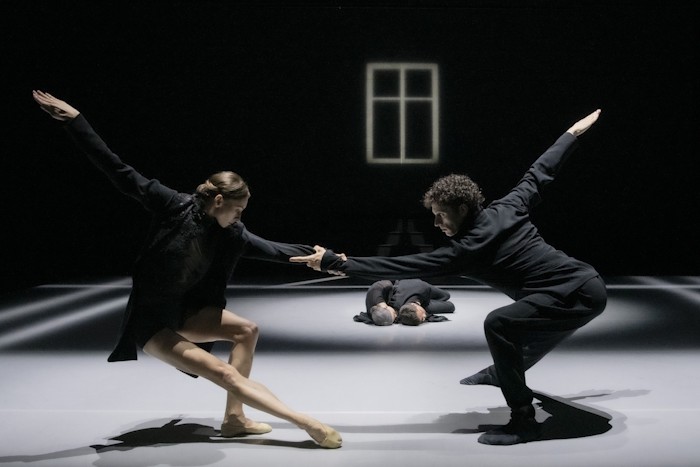
The move into Lightfoot’s Suffer Little Children, made in 2023 and inspired by a school-shooting in Texas, was almost imperceptible, indicated only by a shift of music from Bach to Händel and a slight change in movement quality, which became more dreamlike. A man and a woman met and separated, a woman touched a man, met another who made her fly away in a lift as if weightless. At times dancers held their hands in a spotlight, looking at them, as if wondering what to do with them. At the end, headshots of children appear at the backwall, and eight pairs of shoes in small circles of light were left on the floor, a memory of those who lost their lives.
The second part of the programme saw a change from sombre to cheerful. With the musicians now seated at the side, it opened with León’s Serendipia to a mix of music including two pieces by Andreas Bernitt and McKenzie. In León and Lightfoot’s set that indicates a house with a door and a short stairway, the dancers, clad in costumes reminiscent of evening clothes, meet in duets only to be separated by a stooped-over grey-haired granny. With incredibly flow, they slung each other around or floated on one another on the floor, while vividly mumbling. or talking and screaming silently. At one point the violinist, Andreas Bernitt, entered the stage playing, just to be interrupted by the granny who took his violin bow and laughed, before she gave it back to him.

Photo Erik Berg
The songs ‘Debilidad’ and ‘Toda una Vida’ by Spanish-Cuban singer and musician Antonio Machin lend their names to the next two pieces by Lightfoot and Leôn respectively. Both choreographers use the Latin-American dance language, but with a twist that turn it into funny parodies of the genre. The evening ended with the joint choreography Glass to music by Philip Glass.
In the introduction to Serendipia León commented how she was inspired by the meeting of the dancers, coming together from different cultures and companies, but united in their love for and commitment to their art form. Meeting like this is of paramount importance “in a world in which negativity, fear and injustice, all under the name of power and war, are persistently present in our reality.” With this evening León, Lightfoot and Kammerballetten proved, that if we work together with mutual respect, love and commitment, we can create a better world.